

When negative content appears in Google search results, the first question many people ask is simple: can it be removed?
Sometimes the answer is yes. But in many cases, negative search results cannot be deleted quickly, easily, or at all. A news article, forum discussion, complaint page, legal mention, outdated profile, or third-party blog post may remain online even if it is damaging, incomplete, unfair, or no longer relevant.
This is where the difference between removal and suppression becomes important.
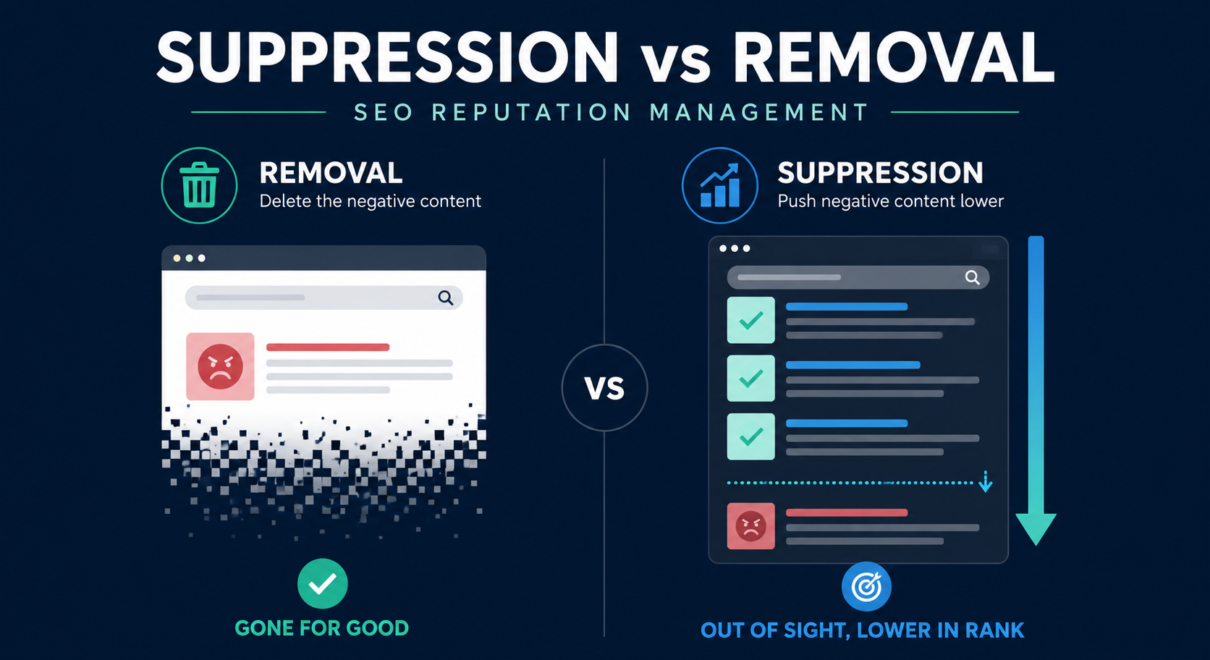
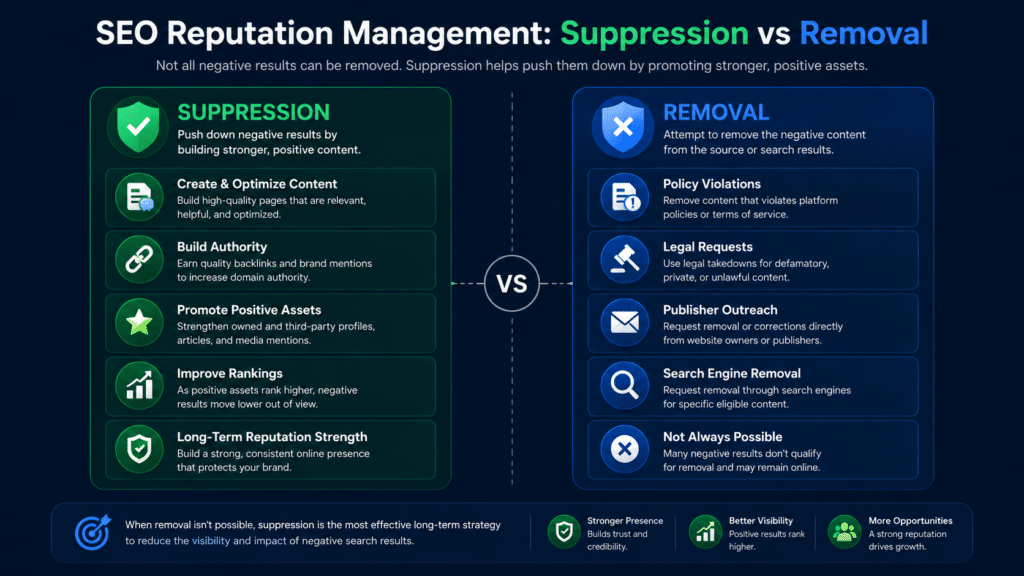
Removal means the negative content is deleted, deindexed, or taken out of search results.
Suppression means the negative content still exists, but it becomes less visible because stronger positive or neutral content ranks above it.
Most SEO reputation management campaigns focus on suppression rather than removal. The goal is to improve what people see first when they search for a name, company, founder, executive, or brand.
This article explains the difference between suppression and removal, what SEO reputation management can realistically do, and when a suppression strategy may be the better path.
What Is Negative Search Result Removal?
Negative search result removal means the unwanted content is taken down from the source website or removed from search engine results.
This can happen in a few ways.
The publisher may delete the page. The platform may remove it because it violates guidelines. Google may deindex the result under specific removal rules. A legal process may require removal. In some cases, outdated personal information may qualify for removal from search.
Removal is usually the cleanest outcome because the negative content no longer appears where people can easily find it.
But removal is not always realistic.
Many third-party websites are not required to delete content simply because it is negative or inconvenient. Search engines also do not remove most pages just because they damage someone’s reputation. If a page is public, indexed, and not violating clear policies, it may continue to rank.
This is why SEO reputation management often focuses on what can be influenced: search visibility.
What Is Negative Search Result Suppression?
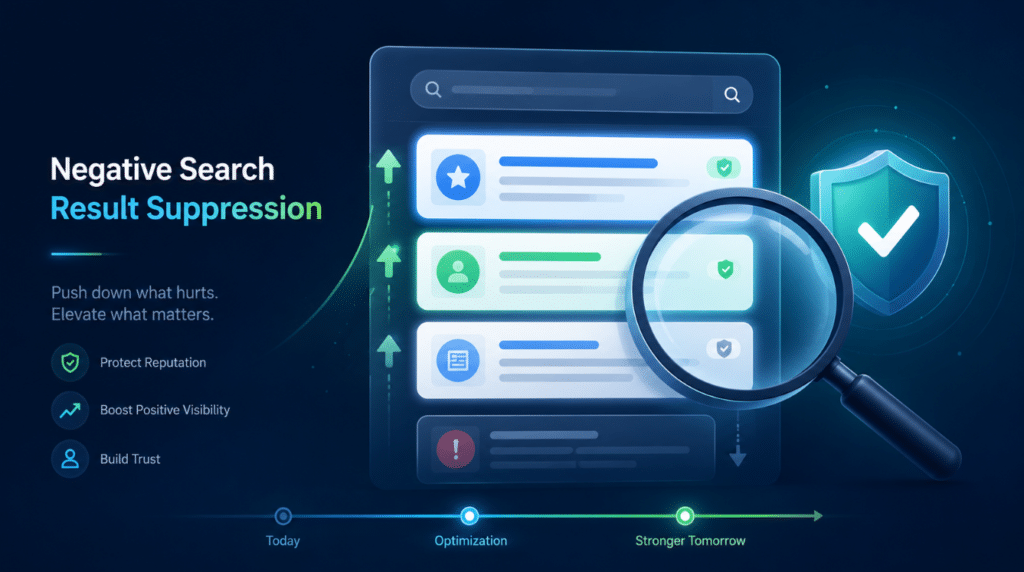
Negative search result suppression means pushing unwanted content lower in Google by promoting stronger positive or neutral results above it.
The negative page may still exist, but fewer people see it if it moves from position 3 to position 8, or from page one to page two.
Suppression usually involves creating, optimizing, and promoting assets such as:
- official website pages
- About pages
- personal bios
- company profiles
- LinkedIn profiles
- interviews
- guest posts
- PR-style articles
- press releases
- industry profiles
- business listings
- podcast pages
- case studies
- thought leadership articles
- social profiles
- third-party mentions
The goal is to give Google better search results to rank for a branded query.
For example, if someone searches a company name and sees a negative article on page one, an SEO suppression campaign may work to rank the company website, leadership pages, professional profiles, positive articles, interviews, and industry mentions above that negative result.
This does not erase the negative content. It reduces its visibility.
Why Suppression Is Often More Realistic Than Removal
Removal is attractive because it sounds final. But in practice, it is often difficult.
Suppression is often more realistic because it works with the way search engines already function.
Google ranks pages based on relevance, authority, quality, links, freshness, and other search signals. If a negative result ranks highly, it usually has enough relevance or authority for that branded search.
SEO reputation management works by building and strengthening competing assets.
Instead of asking Google to remove a result that may not violate any rule, suppression focuses on improving the rest of the search results.
This can be more practical when the negative result is:
- an old news article
- a complaint page
- a forum discussion
- a negative blog post
- a third-party profile
- a public record mention
- an outdated article
- a review platform page
- a social media result
- a page controlled by someone else
If the result cannot be removed, the next question becomes: what positive assets can realistically outrank it?
That is the core of reputation management SEO.
When Negative Content Can Sometimes Be Removed
There are situations where removal may be possible.
Negative content may be removable if:
- it violates a platform’s terms of service
- it contains private personal information
- it includes copyrighted material used without permission
- it is defamatory and legally actionable
- it is clearly impersonation
- it includes spam or malicious content
- it contains sensitive personal data
- it violates Google’s removal policies
- the publisher agrees to remove or update it
- the content is factually wrong and correction is accepted
In these cases, the first step may be a removal request, legal review, publisher outreach, or platform report.
However, removal is not guaranteed.
Even when a removal request is valid, the platform or publisher may take time to respond. If the request is rejected, suppression may still be needed.
This is why many reputation campaigns use both paths where appropriate: explore removal if possible, but build a suppression strategy as the practical long-term solution.
When Removal Is Usually Not Realistic
In many cases, negative content cannot be removed just because it is harmful to reputation.
Removal is usually difficult when:
- the content is published by a legitimate news site
- the page does not violate platform policies
- the information is public
- the publisher refuses to edit or delete it
- the content is opinion-based
- the page is an old but indexed article
- the result is hosted on a high-authority third-party domain
- the negative content is not legally removable
- the content is uncomfortable but not clearly false
- the page is part of a public record or archive
This can be frustrating, but it is important to set realistic expectations.
An ethical SEO reputation management service should not promise that it can delete third-party content in all cases. No agency controls Google’s index, third-party publishers, forums, news sites, or public databases.
What can often be influenced is the order of search results.
That is where suppression becomes valuable.
How SEO Reputation Management Supports Suppression
SEO reputation management supports suppression by improving the ranking potential of positive and neutral assets.
This usually starts with a branded SERP audit.
A SERP audit reviews what currently appears when someone searches for the person, company, executive, founder, or brand. Each result is classified as positive, neutral, or negative. Then the results are evaluated based on strength, ranking position, domain authority, relevance, and suppression difficulty.
After that, the strategy may include:
- optimizing owned website pages
- improving About pages and bios
- strengthening LinkedIn or company profiles
- publishing guest posts or interviews
- creating new third-party assets
- building links to positive pages
- improving entity consistency
- creating brand-controlled content
- monitoring result movement
- adjusting the campaign over time
The key is not just creating content. The key is creating and promoting content that has a realistic chance of ranking.
A weak profile page may not suppress a strong media article. A low-quality press release may not move a forum result. Random content rarely works.
Suppression requires relevance, authority, and patience.
The Role of Positive and Neutral Assets
Positive and neutral assets are the building blocks of suppression.
Positive assets clearly support the person or brand. These may include interviews, company profiles, case studies, founder bios, press mentions, industry articles, and thought leadership pieces.
Neutral assets are not promotional, but they are not negative. These may include directory pages, professional listings, social profiles, database profiles, factual company pages, or public profiles.
Both can be useful.
For example, a branded search result page may look stronger if it includes:
- official website
- About page
- LinkedIn company profile
- founder interview
- guest post by an executive
- industry directory listing
- positive press release
- podcast feature
- professional bio
- case study or company story
The more strong positive and neutral assets Google has available, the less space negative content has on page one.
Why Content Quality Matters
Suppression does not work well with thin or generic content.
Search engines are not likely to rank weak content just because it is positive. The content must be relevant to the search query and strong enough to compete with existing results.
Good suppression content should be:
- clearly connected to the person or brand
- useful to readers
- professionally written
- optimized for the branded query
- published on a credible platform
- complete enough to stand on its own
- supported by internal or external links
- consistent with the brand identity
- accurate and trustworthy
For an individual, this may mean a detailed professional biography, interview, author page, or thought leadership article.
For a business, this may mean a company profile, case study, industry article, positive announcement, or leadership feature.
Content should not look like artificial reputation filler. It should feel like legitimate brand-building content that also supports search visibility.
Why Link Building Matters for Suppression
Publishing positive content is not always enough.
A new article or profile may be indexed, but it may not rank high enough without authority. This is especially true when competing against negative results on strong domains.
Link building helps strengthen positive assets.
This may include:
- links from the official website to important profiles
- backlinks to positive guest posts
- links from related third-party articles
- partner or association mentions
- citations from business directories
- internal links between owned pages
- links to interviews or media pages
- links from relevant niche publications
The goal is not to create spammy links. The goal is to give legitimate positive assets the authority they need to compete.
In suppression campaigns, link building often focuses not only on the main website but also on third-party assets that need to move higher in branded search results.
Suppression Takes Time
Negative search result suppression is usually not immediate.
Search engines need time to crawl new content, process signals, evaluate links, and adjust rankings. Some results may move within weeks or months, while harder cases can take longer.
Timeline depends on:
- strength of negative result
- current ranking position
- authority of negative domain
- number of negative results
- strength of existing positive assets
- quality of new content
- publishing platforms used
- backlink strength
- brand-name competition
- SERP volatility
- indexing speed
A negative result in position 9 on a weak site may be easier to push down than a major news article in position 2.
This is why a suppression audit is important. It helps estimate difficulty before building unrealistic expectations.
What SEO Reputation Management Cannot Guarantee
SEO reputation management can improve search visibility, but it cannot guarantee everything.
It cannot guarantee that:
- every negative result will disappear
- Google will rank every positive asset
- third-party publishers will remove content
- negative content will never return
- suppression will happen instantly
- one article will solve the problem
- a strong news article will be easy to outrank
- all branded searches will show only positive results
Search results are controlled by search engines, not agencies.
A responsible reputation management SEO strategy should focus on realistic improvement, not impossible promises.
The right goal is to improve the branded search landscape over time by building stronger, more accurate, and more credible assets.
What SEO Reputation Management Can Do
SEO reputation management can still be very effective when expectations are realistic.
It can help:
- identify damaging search results
- measure suppression difficulty
- improve owned assets
- create positive content
- strengthen personal or company profiles
- publish third-party articles
- build authority to positive assets
- improve branded search visibility
- reduce dependence on removal
- monitor new negative mentions
- support long-term reputation protection
- push negative results lower over time
This can make a meaningful difference.
Even moving one negative result from position 3 to position 8 can reduce how many people notice it. Moving it from page one to page two can have an even greater impact.
Search visibility matters because most people form opinions from what they see first.
Suppression for Individuals
For individuals, suppression often focuses on personal-name search results. This is where SEO reputation management for individuals can be especially useful, because the goal is to improve what appears when someone searches a person’s name and to promote stronger professional, neutral, or credibility-building assets above outdated or negative results.
This may apply to:
- founders
- executives
- doctors
- attorneys
- consultants
- creators
- public figures
- investors
- professionals
- job candidates
- people affected by old online mentions
Positive assets may include:
- personal website
- LinkedIn profile
- professional bio
- company leadership page
- interviews
- podcast appearances
- guest articles
- author pages
- speaker profiles
- association profiles
- portfolio pages
For individuals, the goal is to create a search result page that reflects current work, credibility, expertise, and professional identity.
This is especially useful when old content, outdated information, or unrelated results are shaping the first impression.
Suppression for Businesses
For businesses, suppression often focuses on branded search results.
This may apply to companies affected by:
- negative articles
- complaint pages
- outdated media
- forum discussions
- old disputes
- negative branded searches
- third-party pages outranking owned assets
- poor page-one search perception
Positive and neutral assets may include:
- official website
- About page
- leadership pages
- case studies
- company profiles
- industry articles
- press releases
- guest posts
- partner mentions
- media features
- business directories
- social profiles
For businesses, suppression is not only about reputation. It can affect sales, hiring, partnerships, investor confidence, and customer trust.
If people search the company before making a decision, page-one results matter.
How to Decide Between Removal and Suppression

The best approach depends on the situation.
Removal may be the first option if:
- the content violates policies
- personal information is exposed
- the content is clearly false and legally actionable
- the publisher may be willing to update it
- Google removal rules may apply
- the page is spam or impersonation
Suppression may be the better option if:
- removal is unlikely
- the content is on a legitimate third-party site
- the page does not violate clear rules
- the publisher will not cooperate
- the result is old but still ranking
- the main goal is reducing visibility
- stronger positive assets can be created
- multiple search results need improvement
In many real cases, suppression is the more practical long-term strategy.
A good campaign may still explore removal opportunities, but it should not depend entirely on them.
Common Mistakes to Avoid
Reputation issues are sensitive, and rushed decisions can make them worse.
Avoid these mistakes:
- assuming every negative result can be removed
- paying for guaranteed deletion promises
- publishing low-quality positive content
- creating fake reviews or fake profiles
- building spammy links
- over-optimizing anchor text
- using duplicate articles across multiple sites
- attacking the negative publisher publicly
- ignoring existing positive assets
- failing to monitor search results
- expecting instant movement
- focusing only on one page
Suppression works best when it is strategic, gradual, and based on the actual search results.
When to Get a Suppression Audit
A suppression audit can help determine what is realistic before starting a full campaign.
It is useful when:
- negative content appears on page one
- negative results rank near the top
- the issue affects leads, hiring, partnerships, or credibility
- removal is unlikely
- existing positive assets are weak
- multiple negative or neutral results dominate the SERP
- the negative result is on a strong domain
- previous attempts did not work
- confidential planning is needed
- you need a realistic timeline and roadmap
A good audit should identify:
- what currently ranks
- which results are damaging
- which assets can be improved
- which new assets are needed
- how difficult suppression may be
- which pages need links
- what timeline is realistic
This helps move from uncertainty to a practical plan.
Suppression Is Often the Practical Path Forward
Negative search results can be difficult to remove, especially when they are hosted on third-party websites, news platforms, forums, complaint pages, or public databases.
That does not mean nothing can be done.
SEO reputation management focuses on what can often be improved: the search results around your name, company, or brand. By creating and promoting stronger positive and neutral assets, negative content can become less visible over time.
Removal may be possible in some cases, but suppression is often the more realistic long-term strategy.
If negative content is affecting trust, leads, hiring, partnerships, or professional credibility, a confidential SEO reputation management review can help determine whether removal is possible, whether suppression is more realistic, and which positive assets should be promoted first.