
SEO reputation management usually takes time because it depends on how search engines evaluate and rank competing pages. If negative content appears in Google for a person, company, founder, executive, or brand, it usually cannot be pushed down overnight.
A simple case may begin showing movement within a few months. A more difficult case can take longer, especially if the negative result is ranking on a high-authority website, has strong backlinks, or appears near the top of page one.
The exact timeline depends on what currently ranks, how strong the negative content is, how many positive assets already exist, what new content needs to be created, and how much authority can be built around positive or neutral pages.
This article explains how long SEO reputation management can take, what affects the timeline, and why negative search suppression should be planned as a gradual process rather than a quick fix.
Why SEO Reputation Management Is Not Instant
SEO reputation management is based on search visibility.
The goal is usually to help positive, neutral, or brand-controlled assets rank higher than negative search results. This process is often called suppression.
Suppression means the negative result may still exist, but it becomes less visible because stronger pages rank above it.
That takes time because Google has to:
- discover new content
- crawl updated pages
- index new assets
- evaluate relevance
- process links
- compare competing pages
- test ranking changes
- reassess branded search results
Even if new content is published quickly, that does not mean it will immediately rank above the negative result.
A new interview, guest post, profile, press release, or authority page may need optimization, backlinks, internal links, and time before it becomes competitive.
This is why SEO reputation management services should be judged by realistic progress, not instant promises.
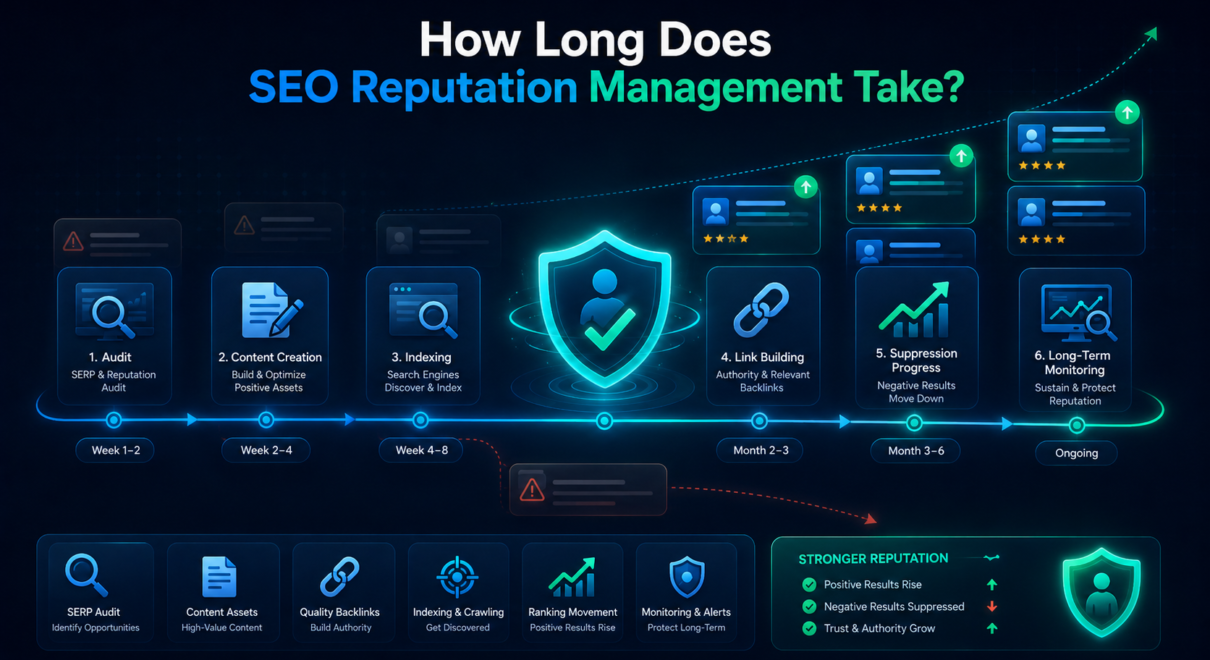
Typical SEO Reputation Management Timeline
There is no single timeline that applies to every case, but most campaigns follow a general pattern.
First 1-2 Weeks: Audit and Strategy
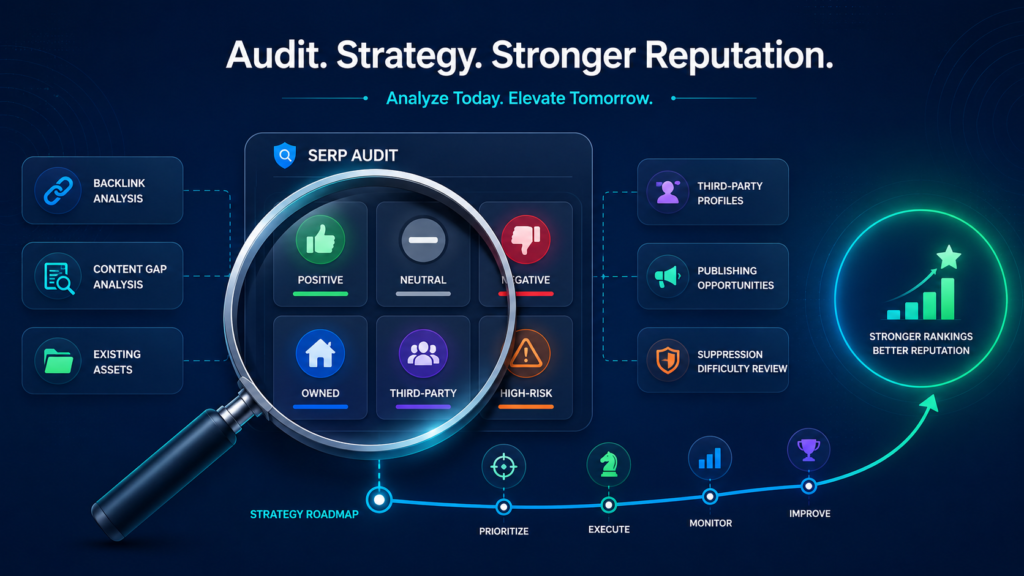
The first stage is usually research and planning.
This may include:
- branded SERP audit
- classification of positive, neutral, and negative results
- suppression difficulty review
- review of existing owned assets
- review of third-party profiles
- backlink analysis
- content gap analysis
- publishing opportunity research
- strategy development
At this stage, the main goal is to understand the search results.
Which negative results are most damaging? Which positive assets already rank? Which pages can be improved? Which new assets are needed? How strong are the negative results? What timeline is realistic?
Without this step, the campaign becomes guesswork.
Months 1–2: Content Creation and Asset Optimization
After the strategy is built, the next stage is improving existing assets and creating new ones.
This may include:
- optimizing the official website
- improving About pages
- updating personal or company bios
- strengthening LinkedIn profiles
- creating founder or executive profiles
- publishing guest posts
- preparing interviews
- creating PR-style content
- building company profiles
- improving business listings
- creating branded blog content
- preparing authority pages
This is where the foundation is built.
In easier cases, early movement may begin during this stage. For example, an existing LinkedIn profile, company page, or interview may improve if it was already close to page one.
However, in many cases, this stage is still mostly setup. The content is being created, published, indexed, and prepared for stronger promotion.
Months 2–3: Indexing, Link Building, and Early Movement
Once positive assets are published or optimized, they need to gain visibility.
This stage often includes:
- checking indexation
- building links to positive assets
- improving internal links
- strengthening third-party articles
- promoting profiles
- supporting interviews or guest posts
- monitoring branded rankings
- adjusting content if needed
This is when early ranking movement often becomes more visible.
Some positive assets may move from page two to page one. Some negative results may move down a few positions. Some content may fail to rank and need additional support.
At this stage, the campaign begins to show which assets are working and which need more authority.
Months 3-5: Stronger Suppression Progress
By months three to five, a well-planned campaign may show more measurable progress, especially in moderate cases.
This may include:
- positive assets occupying more page-one positions
- negative results moving lower
- owned pages ranking more strongly
- third-party profiles improving
- interviews or guest posts gaining visibility
- improved branded search balance
- better control of personal or company search results
This does not mean every case is solved by month five. But this is often when suppression campaigns become easier to evaluate.
If the negative result is weak or moderate, meaningful movement may already be visible. If the negative result is very strong, the campaign may still need more content and link building.
6+ Months: Difficult Cases and Long-Term Protection
Difficult cases can take longer than six months.
This is common when negative results are:
- major news articles
- high-authority media pages
- strong complaint pages
- legal or public record pages
- old pages with backlinks
- highly relevant to the branded query
- ranking in the top three positions
- supported by strong domain authority
- part of a larger public issue
In these cases, SEO reputation management may require a longer-term suppression strategy.
The campaign may need more third-party assets, stronger authority building, better content diversity, and continued monitoring.
Longer timelines are not always a sign of failure. They often reflect the strength of the negative result and the difficulty of the branded SERP.
Easy, Moderate, and Difficult Reputation Cases
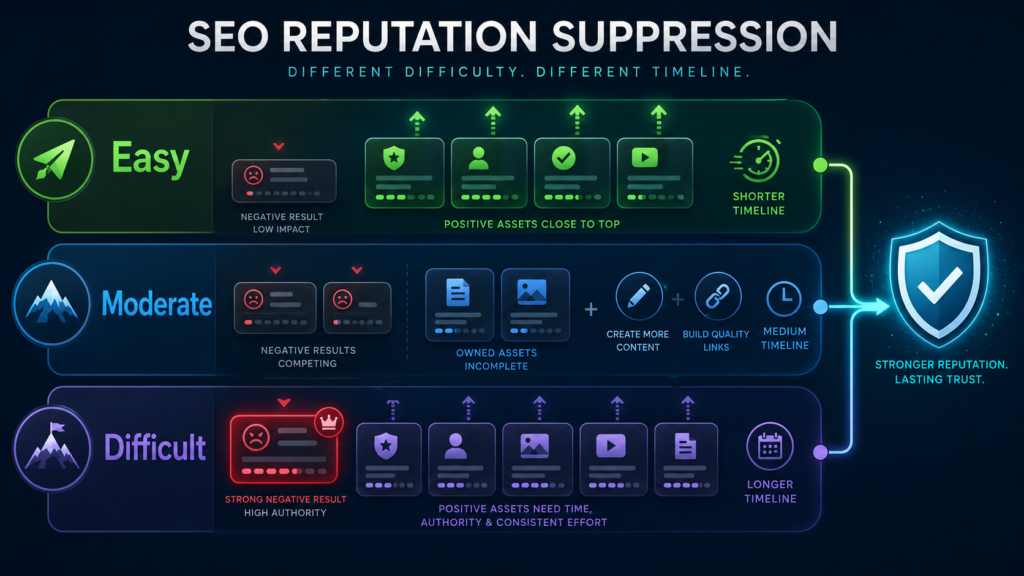
The timeline depends heavily on case difficulty.
Easy Cases
Easy cases may begin showing movement within one to three months.
These usually involve:
- weak negative results
- negative content ranking low on page one
- little authority behind the negative page
- existing positive assets close to ranking
- a unique personal or brand name
- strong owned website pages
- available third-party profiles
- limited competition in branded search
For example, if a weak forum result ranks near the bottom of page one and several positive profiles already rank on page two, suppression may be more realistic in a shorter period.
Easy cases still require strategy, but they usually have more immediate opportunities.
Moderate Cases
Moderate cases may take three to five months or longer.
These usually involve:
- one or two negative results on page one
- medium-authority third-party pages
- limited existing positive assets
- weak personal or company profiles
- incomplete owned pages
- need for new content creation
- need for backlinks
- moderate branded search competition
In moderate cases, a campaign often needs both content creation and authority building.
The first few months may focus on publishing and optimization. Later months may focus on pushing the strongest positive assets higher.
Difficult Cases
Difficult cases may take six months or more.
These may involve:
- negative content in the top three results
- major media websites
- strong legal or public record pages
- multiple negative results
- strong backlinks to negative pages
- limited owned assets
- generic or competitive names
- widespread public discussion
- negative content appearing across several branded queries
Difficult cases require realistic expectations.
A single press release or profile update will not usually suppress a strong news article. The campaign may need multiple high-quality assets, consistent link building, entity strengthening, and careful monitoring.
What Affects a Negative Search Suppression Timeline?
Several factors influence how long a negative search suppression timeline may be.
Strength of the Negative Result
The stronger the negative result, the harder it is to suppress.
A negative page may be strong because it is published on a high-authority domain, has many backlinks, is highly relevant to the branded query, or has been ranking for a long time.
A major publication, popular forum, public database, or established complaint site may be harder to outrank than a weak blog post.
Position of the Negative Result
A negative result in position 9 is usually easier to push down than one in position 2.
The higher the result ranks, the more competing assets are needed to move above it.
Moving a negative result down one or two positions can still help, but pushing it from the top three to page two usually requires more work.
Existing Positive Assets
If a person or business already has strong positive assets, the timeline may be shorter.
Helpful existing assets may include:
- official website
- About page
- LinkedIn profile
- company profile
- founder bio
- interviews
- guest posts
- press mentions
- business listings
- professional directories
- podcast pages
- authority pages
If these assets already rank on page one or page two, they may be easier to improve.
If there are very few existing assets, the campaign has to build more from scratch.
Quality of New Content
Content quality matters.
Thin, generic, or overly promotional content is unlikely to rank well. Stronger content has a better chance of becoming a useful reputation asset.
Good reputation management SEO content should be:
- clearly connected to the person or brand
- professionally written
- useful to readers
- optimized for branded search
- published on credible platforms
- indexable
- supported by links
- accurate and current
A strong interview, bio, guest article, or company profile is more useful than a short page created only to fill search results.
Publishing Platform Authority
Where content is published matters.
A profile or article on a strong, relevant platform may rank faster than the same type of content on a weak or unknown website.
Useful platforms may include:
- industry publications
- business profiles
- professional directories
- partner websites
- podcast websites
- interview platforms
- association pages
- credible guest post sites
- media outlets
- owned websites with authority
The best platform depends on the case.
For individuals, personal bios, LinkedIn, interviews, and professional profiles may work well. For businesses, company profiles, guest posts, case studies, business listings, and PR-style articles may be more useful.
Link Building and Authority Signals
Positive assets often need backlinks or authority signals to rank.
This is especially true when they compete against negative results on stronger domains.
Link building may support:
- official website pages
- About pages
- personal bios
- company profiles
- guest posts
- interviews
- PR-style articles
- business listings
- authority pages
- third-party mentions
Without links, some positive assets may stay on page two or three.
With relevant authority signals, they may have a better chance of moving higher and supporting suppression.
Indexing Speed
New content must be indexed before it can rank.
Some pages are indexed quickly. Others may take longer, especially if the publishing site is weak, the page has few internal links, or the content is not easily discoverable.
Indexing speed can affect early campaign movement.
A published article that is not indexed cannot help suppress negative results until Google discovers and includes it.
Name or Brand Competition
A unique name or brand may be easier to manage because search results are more focused.
A generic company name, common personal name, or name shared with other people or businesses can make reputation management harder.
For common names, the campaign may need more specific assets that connect the person to their company, industry, location, or professional title.
For businesses with generic names, Google may need stronger entity signals to understand the brand clearly.
Search Result Volatility
Some branded search results change frequently. Others remain stable for months or years.
Volatile SERPs may create opportunities because Google is already testing different results. Stable SERPs may require stronger signals to change.
Monitoring helps identify whether positive assets are gaining traction or whether the strategy needs adjustment.
Why One Article Is Usually Not Enough
Many people hope that one positive article will solve the problem.
Sometimes one strong asset can help. But in most cases, one article is not enough.
Suppression usually requires several positive or neutral results that can compete together.
A stronger campaign may include:
- official website improvements
- optimized About page
- personal or company profiles
- interviews
- guest posts
- press releases
- branded blog content
- business listings
- authority pages
- third-party mentions
- links to positive assets
The goal is to create a group of assets that can occupy more space in the search results.
One article may move up, but multiple assets create a stronger branded search presence.
How Progress Is Measured
SEO reputation management progress should be measured by search visibility, not just published content.
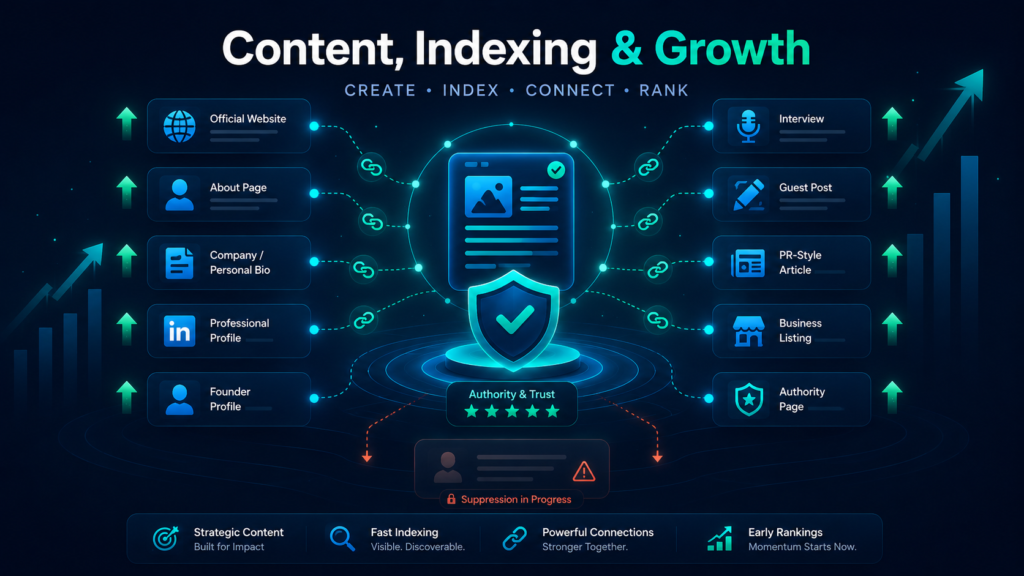
Useful metrics include:
- position of negative results
- position of positive assets
- number of positive results on page one
- number of negative results on page one
- movement of owned assets
- movement of third-party assets
- indexation of new content
- backlink growth to positive assets
- changes in branded search appearance
- page-one sentiment balance
A campaign may be working even before the negative result reaches page two.
For example, if a negative result moves from position 3 to position 6, that is progress. If two positive assets move onto page one, that is progress. If the official website and professional profiles strengthen, that is progress.
Reputation improvement is often gradual.
Why Monitoring Matters After Initial Progress
SEO reputation management does not end when one negative result moves down.
Search results can change again.
A negative result can move back up. A new article can appear. A third-party page can change titles. A profile can drop. A positive asset can lose visibility. Google can test different results.
Ongoing monitoring helps detect these changes early.
Monitoring may include:
- tracking top 10 results
- tracking top 20 results
- watching negative result movement
- checking positive asset rankings
- monitoring branded variations
- reviewing new mentions
- tracking indexation
- watching competitor or third-party pages
For high-risk personal or business reputations, monitoring is often part of long-term protection.
Can SEO Reputation Management Work Faster?
Some actions may speed up progress, but there are limits.
Faster movement may be possible when:
- strong positive assets already exist
- pages are close to page one
- the negative result is weak
- content can be published on strong platforms
- backlinks can be built to positive assets
- owned pages can be improved quickly
- technical issues are fixed
- profiles are completed and optimized
- Google indexes new assets quickly
However, shortcuts can be risky.
Spammy links, fake profiles, duplicate content, and low-quality articles may create more problems than benefits. Reputation campaigns should be built for stability, not quick artificial movement.
The goal is not just to move results temporarily. The goal is to build a stronger search presence that can last.
What to Expect From a Reputation Management SEO Service
A professional reputation management SEO service should not promise instant deletion of negative content.
Instead, it should provide a realistic process.
A proper service should include:
- SERP audit
- suppression difficulty review
- existing asset analysis
- content strategy
- profile optimization
- content creation
- third-party publishing
- link building
- monitoring
- reporting
- campaign adjustments
The campaign should explain what can be influenced, what may be difficult, and what timeline is realistic.
A good provider should be clear about the difference between removal and suppression.
Removal may be possible in specific cases. But when removal is not realistic, suppression is usually the practical SEO path.
When to Start SEO Reputation Management
The best time to start is before a negative result becomes the only thing people notice.
Businesses and individuals should consider SEO reputation management when:
- negative content appears on page one
- a damaging result ranks in the top three positions
- old content still shapes perception
- branded search results are weak
- there are not enough positive assets
- a founder or executive is being searched
- trust-sensitive opportunities are affected
- leads, partnerships, hiring, or sales are impacted
- new negative content appears
- confidential monitoring is needed
Waiting can make the work harder.
If a negative page gains more links, engagement, or visibility over time, suppression may become more difficult. Building positive assets early can provide more control before a problem grows.
Reputation Suppression Is a Gradual Process
SEO reputation management takes time because it works through search visibility, content quality, authority, and ranking movement.
The timeline depends on the strength of the negative result, the number of existing positive assets, the quality of new content, link building, indexing speed, and the competitiveness of the branded search results.
Some cases can show movement within a few months. Others require a longer-term campaign.
The most important step is to start with a clear audit. Once you know what is ranking, how strong the negative result is, and which positive assets can realistically compete, you can build a practical suppression roadmap.
If negative search results are affecting trust, leads, hiring, partnerships, or professional credibility, a confidential SEO reputation management services review can help estimate the difficulty, timeline, and best next steps for suppression.