

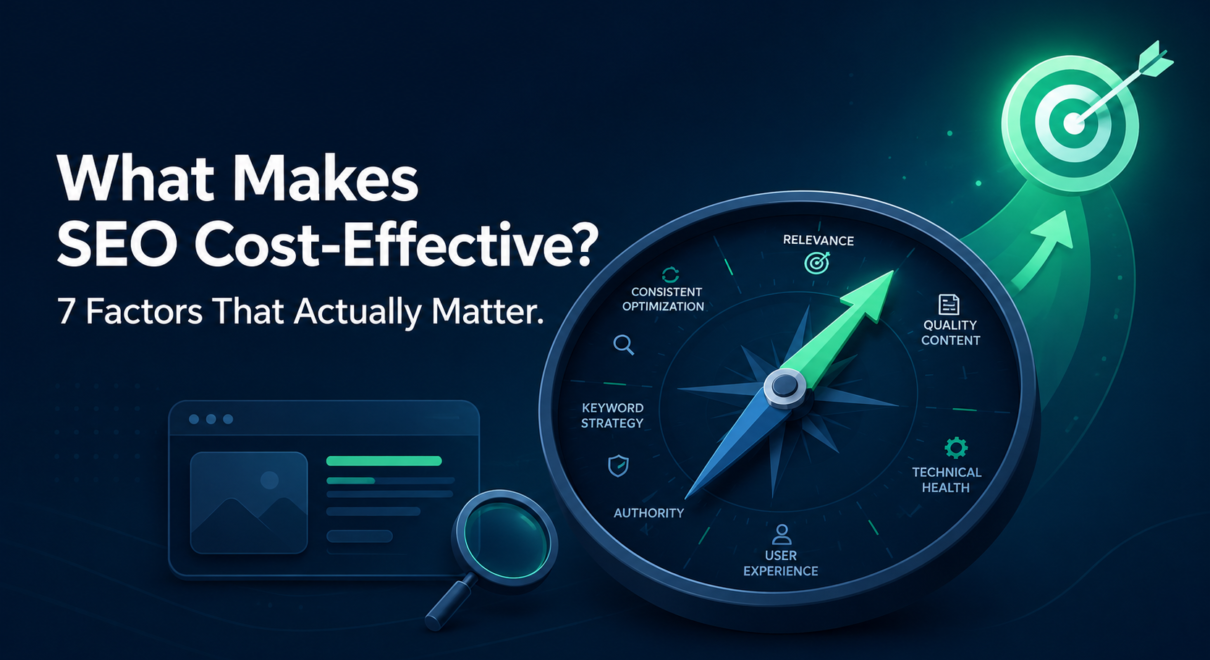
SEO can be affordable without being cost-effective.
That difference matters. Many businesses choose SEO based mostly on monthly price, the number of tasks included, or the promise of quick ranking improvements. But a low-cost campaign can still waste money if it focuses on the wrong work, ignores important problems, or produces activity without measurable progress.
Cost effective SEO is different. It is not about doing the cheapest possible SEO. It is about using the available budget in the smartest way possible.
A cost-effective campaign focuses on the actions most likely to improve rankings, traffic quality, leads, sales, local visibility, or long-term authority. It is built around priorities, not random monthly tasks.
Businesses often waste money on SEO because they:
- start without proper diagnosis
- target keywords that are too broad or unrealistic
- publish content with no connection to business goals
- ignore technical SEO issues
- build weak or irrelevant backlinks
- measure activity instead of meaningful results
- use the same generic plan for every website
The strongest SEO campaigns are not always the largest. They are the campaigns that solve the right problems in the right order.
Below are seven factors that make SEO truly cost-effective.
Why SEO Value Matters
SEO should be treated as a long-term business investment, not only a marketing expense.
Organic search remains one of the largest digital traffic sources. BrightEdge research found that organic search accounts for about 53% of trackable website traffic, while organic and paid search together account for around 68% of trackable traffic.
That does not mean every SEO campaign will automatically succeed. It means SEO budget should be used carefully. If organic search can become a major source of qualified traffic, the work should focus on the pages, keywords, technical fixes, content assets, and authority signals most likely to improve business results.
A cost-effective SEO strategy is built around that idea. The goal is not simply to spend less each month. The goal is to invest in work that can create measurable value over time.
SEO Budget Question | Better Value-Based Question |
|---|---|
How much does SEO cost? | What can this budget realistically improve? |
How many tasks are included? | Which tasks have the highest impact? |
How many blog posts do we get? | Will this content support important pages? |
How many links are included? | Are these links relevant and useful? |
When will rankings improve? | What early indicators should we track? |
Cost-Effective SEO Starts With the Right Diagnosis
Before a business spends money on content, backlinks, technical fixes, or monthly SEO, it needs to understand what is actually limiting performance.
Without diagnosis, SEO becomes guesswork.
A website may not need more blog content right away. It may need stronger service pages. Another site may not need backlinks first. It may have crawl or indexing problems. A local business may not need national content. It may need better Google Business Profile optimization and local landing pages.
A proper SEO diagnosis may review:
- crawl and indexing issues
- weak or thin service pages
- poor keyword targeting
- missing internal links
- duplicate content
- slow loading pages
- broken redirects
- poor mobile usability
- backlink gaps
- local SEO weaknesses
- competitor advantages
- ranking drops or traffic loss
- conversion path problems
This does not always require a massive audit. But every cost-effective SEO campaign should begin with some level of analysis.
A proper diagnosis helps answer the most important question:
What should be fixed, improved, or built first?
This is also where the difference between cost-effective SEO vs affordable SEO becomes clear. Affordable SEO usually focuses on whether the monthly price fits the budget. Cost-effective SEO focuses on whether the work is solving the right problems.
1. Realistic Keyword Prioritization
Not every keyword is worth targeting first.
Some keywords have high search volume but extremely strong competition. Others have lower volume but much stronger buying intent. Some keywords may bring traffic but not leads. Others may be easier to rank for and more closely connected to the services or products a business actually sells.
A cost-effective SEO strategy prioritizes keywords based on:
- relevance
- search intent
- ranking difficulty
- business value
- conversion potential
- current website authority
- connection to important pages
- local or national competition
- long-term growth potential
For example, a small local company may not benefit from chasing a broad national keyword immediately. It may get more value from targeting service-specific or city-specific searches that are easier to rank for and more likely to generate inquiries.
The same principle applies to ecommerce websites. Ranking for a broad product category may take time, but optimizing specific collection pages, product comparison content, and buyer guides can create earlier opportunities.
Cost effective SEO does not ignore larger keywords. It builds toward them through realistic opportunities first.
A strong keyword strategy should answer:
- Which keywords can realistically improve in the next few months?
- Which keywords support commercial pages?
- Which terms match buyer intent?
- Which topics help build authority?
- Which pages need stronger keyword focus?
- Which keywords are not worth targeting yet?
This type of prioritization prevents businesses from spending months on keywords that are too broad, too competitive, or too disconnected from revenue.
2. Technical SEO That Removes Ranking Barriers
Technical SEO is cost-effective when it removes problems that prevent pages from performing.
It is not about endless technical work for the sake of it. The purpose is to make sure search engines can crawl, understand, index, and evaluate the site properly.
Important technical SEO areas include:
- crawlability
- indexability
- XML sitemaps
- robots.txt settings
- canonical tags
- redirects
- mobile usability
- page speed
- Core Web Vitals
- structured data
- duplicate pages
- internal site structure
- broken links
- orphan pages
For example, if important service pages are not indexed, publishing new blog posts will not solve the core problem. If a website has redirect chains after a migration, authority may not pass properly. If product category pages are thin and poorly structured, ecommerce SEO may underperform.
Technical SEO is often one of the most cost-effective SEO solutions because it improves the foundation for everything else.
Content performs better when pages are crawlable and indexable. Backlinks are more useful when they point to strong, accessible pages. Internal links work better when the site structure is clear.
A cost-effective technical SEO approach focuses on issues that affect visibility, crawling, indexing, user experience, and conversion potential. It does not waste budget on low-impact technical details that are unlikely to improve results.
3. Content That Supports Priority Pages
Content is one of the most common SEO investments, but not all content is cost-effective.
Many businesses publish blog posts because they were told that blogging helps SEO. But random blog content rarely creates strong results. A blog article should have a purpose. It should support a service page, product category, location page, topical cluster, or high-intent search journey.
Cost-effective SEO content may support:
- service pages
- product pages
- category pages
- location pages
- comparison pages
- FAQ sections
- buying guides
- local landing pages
- pillar pages
- topic clusters
- high-intent informational searches
Bad content usually looks different. It may be generic, disconnected from business goals, duplicated across city pages, missing internal links, or written around keywords that have no commercial value.
For example, if a moving company wants to rank its main service pages, supporting articles might cover local moving tips, long-distance moving preparation, packing advice, storage questions, apartment moving, office relocation, and city-specific moving guides. These articles are not random. They help build topical relevance around the company’s most important services.
The same logic works for many industries.
A pest control company may create content around termite signs, rodent prevention, seasonal pest problems, mosquito control, and commercial pest management. A med spa may publish educational content about treatments, skin concerns, recovery expectations, and location-specific service pages. An ecommerce store may create buying guides, product comparison articles, category support content, and product care guides.
A cost-effective content strategy uses content to strengthen the pages that matter most, instead of publishing articles only to keep the blog active.
4. Strong Internal Linking
Internal linking is one of the most overlooked cost-effective SEO tactics.
Unlike backlinks, internal links do not require outreach, publisher fees, or external approvals. They are fully within the website owner’s control. When done correctly, they help search engines understand which pages are important and how topics are connected.
Internal links help:
- connect related topics
- support commercial pages
- distribute authority across the site
- improve crawl paths
- reduce orphan pages
- strengthen topic clusters
- guide users to useful next steps
- clarify page importance
For example, a pest control company may have separate service pages for termite control, rodent control, mosquito control, and commercial pest control. Supporting blog articles about pest prevention, seasonal infestations, or signs of termite damage can internally link back to the most relevant service pages.
An ecommerce store may use buying guides, product comparison articles, and FAQ content to support important category pages. A med spa may connect educational articles about treatments, recovery, and skin concerns to its main service pages. A law firm may use informational articles to support practice area pages.
Good internal linking is not just about adding random links. The links should make sense in context.
Useful anchor examples might include:
- termite control services
- acne treatment options
- commercial cleaning services
- product buying guide
- family law consultation
- emergency plumbing services
The anchor text should be descriptive, but not repetitive. Using the exact same anchor too many times across the site can look forced. A natural mix of exact, partial, branded, and semantic anchors is usually better.
For many websites, internal linking can produce meaningful improvements without requiring major new content or backlink investment.
5. Relevant Backlinks, Not Just More Backlinks
Backlinks still matter in SEO, especially in competitive markets. But more links are not always better.
A cost-effective backlink strategy focuses on quality, relevance, and placement.
Useful backlinks often come from:
- niche-relevant guest posts
- industry blogs
- business publications
- local websites
- partner mentions
- resource pages
- expert contributions
- editorial placements
- relevant directories where appropriate
The goal is not to build as many links as possible. The goal is to build links that help search engines trust the website and understand its topical relevance.
A few relevant backlinks to the right pages can be more valuable than many weak links from unrelated websites.
Poor backlink strategies often waste money because they focus on volume instead of value. Common problems include:
- unrelated guest posts
- low-quality domains
- unnatural anchor text
- links placed in thin content
- excessive exact-match anchors
- backlinks to pages that are not optimized
- links from sites with no topical connection
- mass placements with little editorial value
Backlinks are usually most effective after the website has a strong foundation. If a service page is weak, thin, or poorly targeted, building links to it may not deliver the expected result. If a blog article is already ranking on page two or three, a few relevant links may help it move further.
Cost-effective link building is not separate from the rest of SEO. It should support the overall strategy.
6. Local, Ecommerce, or Service-Specific Focus
SEO becomes more cost-effective when it is customized to the business model.
A local business, ecommerce store, SaaS company, professional service provider, and multi-location business should not all receive the same SEO plan. Each type of business has different ranking factors, conversion paths, and priorities.
Local businesses
Local businesses often need:
- Google Business Profile optimization
- local service pages
- city pages
- citations
- reviews
- Google Maps visibility
- local backlinks
- service-area clarity
- local schema where appropriate
For a local business, ranking in Google Maps and local organic results may be more valuable than broad national traffic.
Ecommerce businesses
Ecommerce websites often need:
- category page optimization
- product page SEO
- technical SEO
- faceted navigation cleanup
- structured data
- internal linking
- buying guides
- product comparison content
- content that supports commercial categories
For ecommerce SEO, blog content alone is rarely enough. Category and product pages usually need significant attention.
Service businesses
Service businesses often need:
- strong service pages
- trust signals
- FAQs
- case studies
- testimonials
- conversion-focused copy
- topical authority
- internal links from supporting content
- location or industry-specific pages
For service providers, the goal is not just traffic. The content should help convert visitors into leads or consultations.
Multi-location businesses
Multi-location businesses may need:
- location pages
- multiple Google Business Profiles
- citation management by location
- city-level tracking
- localized content
- review strategy by branch
- internal linking between services and locations
This is why one-size-fits-all SEO packages often underperform. Cost-effective SEO adapts to the business model instead of forcing every client into the same workflow.
7. Reporting That Measures Progress, Not Just Activity
SEO reporting should show more than a list of completed tasks.
A report that says “we wrote two articles, updated five titles, and built three links” may be useful, but it does not fully explain whether the campaign is working.
Cost-effective SEO reporting should connect work to progress.
Useful reporting may include:
- keyword movement
- Google Search Console clicks and impressions
- organic traffic changes
- priority page performance
- leads or conversions
- local ranking changes
- Google Business Profile actions
- technical fixes completed
- content improvements
- backlink acquisition
- pages gaining visibility
- pages that need more work
- next recommended priorities
The most useful SEO reports answer three questions:
- What was done?
- Why was it done?
- What changed or should happen next?
This is especially important for small businesses. If the budget is limited, the business needs to understand whether the SEO work is creating momentum.
Rankings may take time, but early indicators can still be useful. Increased impressions, better indexation, improved rankings for long-tail terms, stronger page engagement, and more Google Business Profile actions can all show whether the strategy is moving in the right direction.
If reporting only shows activity, it is difficult to know whether SEO is cost-effective.
How These 7 Factors Work Together
Cost-effective SEO is not one isolated tactic. It is a system.
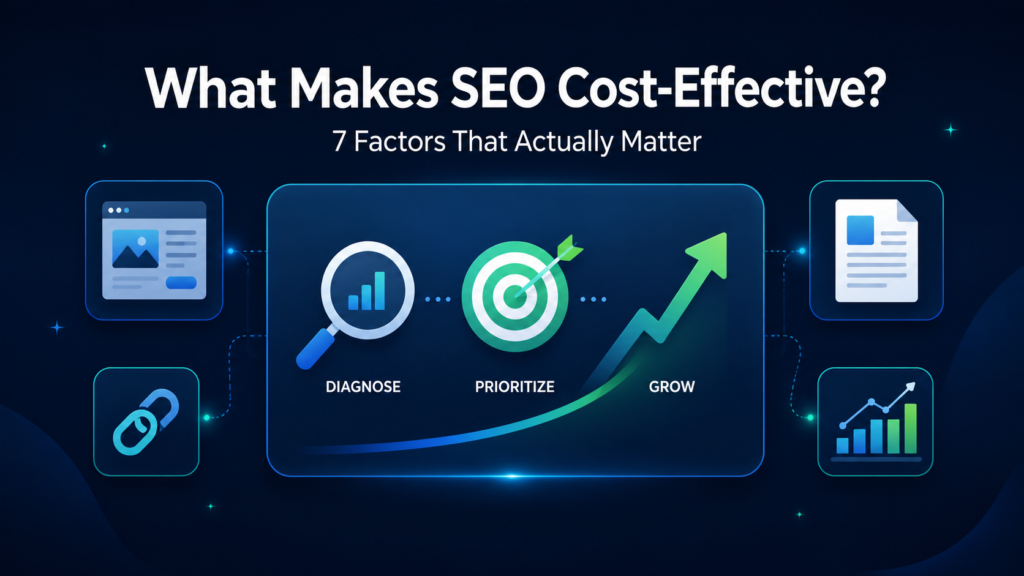
Diagnosis identifies the real problems. Keyword research sets direction. Technical SEO removes barriers. Content builds relevance. Internal links connect related pages. Backlinks build authority. Reporting helps refine the next step.
Factor | Main Role | Why It Matters |
|---|---|---|
Diagnosis | Finds the real problems | Prevents wasted work |
Keywords | Sets realistic targets | Focuses the campaign |
Technical SEO | Removes barriers | Helps pages perform |
Content | Builds relevance | Supports rankings and authority |
Internal links | Connects pages | Strengthens priority URLs |
Backlinks | Builds authority | Helps compete in SERPs |
Reporting | Measures progress | Improves future decisions |
When these parts work together, SEO becomes more efficient. The business is no longer paying for disconnected tasks. It is investing in a structured process where each action supports the next.
That is what makes SEO cost-effective.
What Cost-Effective SEO Is Not
Cost-effective SEO is often misunderstood.
It is not the same as buying the lowest-priced SEO package. It is not about doing the minimum possible work. It is not a fixed list of monthly tasks that never changes.
Cost-effective SEO is not:
- the cheapest possible SEO
- a generic monthly checklist
- publishing content without strategy
- targeting only high-volume keywords
- building backlinks randomly
- ignoring technical issues
- using the same plan for every business
- measuring only tasks completed
- waiting indefinitely without reviewing progress
- focusing on traffic that has no business value
A campaign may be affordable, but still not cost-effective. A campaign may also cost more, but create stronger value because it solves the right problems sooner.
The key is alignment.
The SEO work should match the website’s condition, competition, goals, and growth stage.
When Cost-Effective SEO Services Make the Biggest Difference
Cost effective SEO services are especially useful when a business needs clarity, not just more SEO activity.
This type of approach can help:
- small businesses with limited budgets
- companies that tried SEO before without results
- websites with traffic or ranking drops
- local businesses with weak Google Maps visibility
- ecommerce stores with underperforming category pages
- service businesses with thin or unclear pages
- multi-location businesses
- companies expanding into new markets
- businesses with technical SEO problems
- websites with content that gets impressions but few clicks
- companies that need better ROI from SEO spend
In these situations, doing more of everything is not always the answer. The better approach is identifying what matters most and investing there first.
For example, a business with weak service pages should not start with a large blog campaign. A local business with poor Google Business Profile visibility may need local SEO before national content. An ecommerce store with thin category pages may need category optimization before more informational articles.
Cost-effective SEO services help connect the work to the real opportunity.
How to Choose a Cost-Effective SEO Company
A cost effective SEO company should be able to explain the strategy clearly.
Before starting, the provider should help answer:
- What should be done first?
- Why does that work matter?
- Which pages are the highest priority?
- Which keywords are realistic?
- What technical issues need attention?
- What content should be created or improved?
- How should internal links support priority pages?
- What backlink strategy makes sense?
- What results will be measured?
- How can the plan scale over time?
A cost-effective SEO company should not only sell package volume. It should explain the reasoning behind the plan.
If a proposal focuses only on the number of tasks, articles, or links, it may be missing the bigger picture. The more important question is how those actions support rankings, traffic quality, leads, conversions, and long-term visibility.
Good SEO does not need to be confusing. A strong provider should make the priorities easier to understand.
Cost-Effective SEO Is About Better Priorities
SEO does not become cost-effective because it is cheap. It becomes cost-effective when every action has a clear reason and connects to a business goal.
The right strategy should identify the biggest opportunities, fix the most important problems, support priority pages, build useful content, strengthen authority, and measure progress clearly.
A business does not need endless SEO activity. It needs the right activity.
At CostEffectiveSEO, we build SEO strategies around priorities, realistic opportunities, and long-term ROI – helping businesses invest in the work that matters most.