

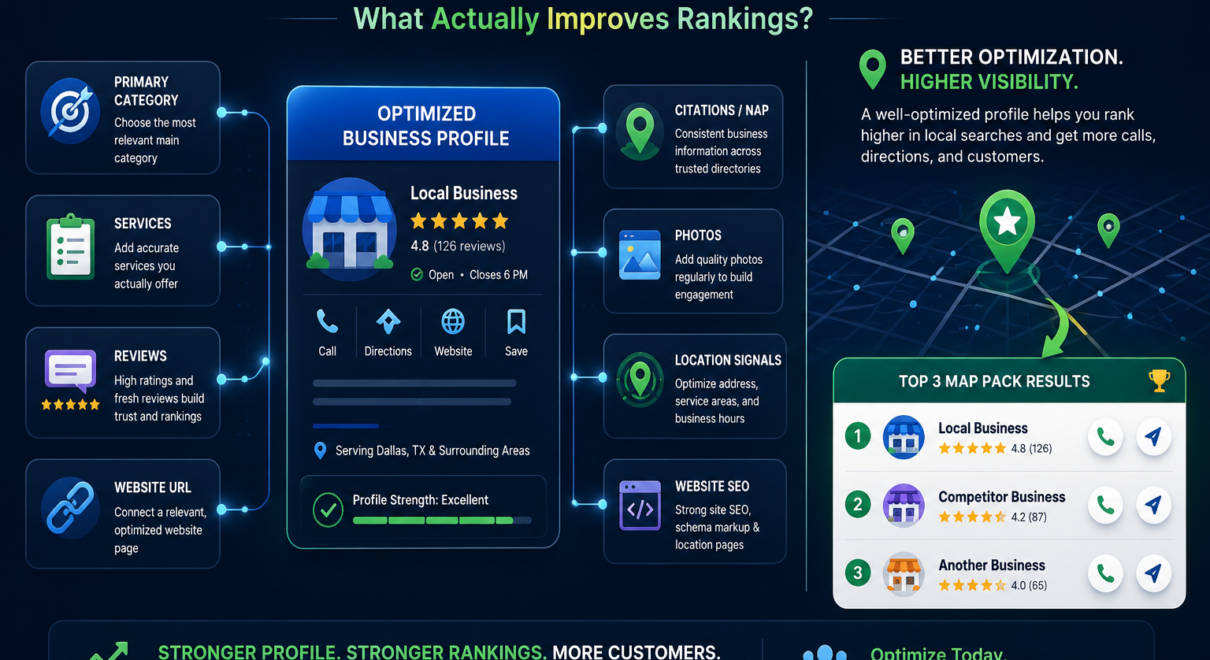
Many local businesses already have a Google Business Profile, but still struggle to appear in Google Maps, the Local Pack, or “near me” searches.
The profile exists. The business name is listed. The phone number is there. Maybe there are even a few photos and reviews. But competitors still appear above them, get more calls, and dominate the top map results.
That usually means one thing:
Creating a Google Business Profile is not the same as optimizing it.
Google Business Profile optimization is about helping Google clearly understand what your business does, where it operates, which services it offers, and why it should be trusted for relevant local searches. It is one of the most important parts of Google Maps SEO, but it is not just a simple profile setup task.
A properly optimized profile can improve relevance, trust, user engagement, and local search visibility. But in competitive markets, GBP optimization also needs support from reviews, citations, website SEO, location pages, backlinks, and ongoing local ranking analysis.
What Is Google Business Profile Optimization?
Google Business Profile optimization is the process of improving your business listing so it performs better in Google Maps and local search results.
A Google Business Profile helps Google understand:
- what your business is
- where it is located
- which areas it serves
- which services or products it offers
- when it is open
- how customers can contact you
- how trustworthy the business appears
- how users interact with the listing
For local businesses, the profile often becomes the first impression a potential customer sees. Users can call, request directions, read reviews, view photos, check hours, ask questions, or visit your website directly from the listing.
That makes GBP important for both rankings and conversions.
However, optimization does not mean filling in every field randomly. It means choosing the right categories, writing accurate service details, connecting the correct website page, managing reviews, keeping information consistent, and aligning the profile with the rest of your local SEO strategy.
In simple terms:
Google Business Profile optimization helps Google match your business with the right local searches and helps users choose your business once they find it.
Why Google Business Profile Optimization Matters for Google Maps SEO
Your Google Business Profile is the main business entity Google displays in Maps and the Local Pack.
When someone searches for a local service, Google needs to decide which businesses are most relevant, nearby, and prominent. Your profile is one of the main sources of information Google uses to make that decision.
For example, if someone searches:
- “dentist near me”
- “pest control in Dallas”
- “moving company near me”
- “private tutor Henderson”
- “med spa in Miami”
- “emergency plumber near me”
Google looks at many signals, including the business category, location, reviews, services, website, citations, and authority.
A weak or incomplete profile gives Google fewer reasons to show your business. A stronger profile gives Google clearer relevance signals and gives users more reasons to engage.
Good GBP optimization can help improve:
- Google Maps rankings
- Map Pack visibility
- profile views
- phone calls
- direction requests
- website clicks
- review engagement
- trust and conversion rate
This is why GBP optimization is a foundation of Google Maps SEO optimization.
But it is important to understand the limits. Your profile is not the only ranking factor. In competitive niches, businesses usually need a broader Local Maps SEO strategy that combines profile optimization with website improvements, citations, reviews, and competitor analysis.
The Google Business Profile Elements That Matter Most for Rankings
Not every Google Business Profile field has the same SEO impact. Some elements strongly affect relevance and rankings. Others mostly help users trust and choose the business.
The strongest optimization strategy focuses on both.
1. Primary Business Category
The primary business category is one of the most important Google Business Profile ranking factors.
It tells Google what your business mainly does.
If your primary category is too broad, inaccurate, or poorly matched to search intent, your profile may struggle to rank for important searches.
For example:
- A pest control company should use a pest-control-related category, not a broad home services category.
- A dental clinic should choose a category that reflects its main practice type.
- A tutoring center should select the most relevant education-related category.
- A moving company should avoid categories that do not clearly match moving services.
Category selection should be based on your actual services and the categories used by top-ranking competitors in your market.
The wrong primary category can make the rest of your optimization much less effective.
2. Secondary Categories
Secondary categories help Google understand additional services your business offers.
For example, a medical practice, law firm, home service company, or beauty business may have several relevant service areas. Secondary categories can help support those services when they are accurate.
However, adding too many unrelated categories can weaken clarity.
The goal is not to select every possible category. The goal is to choose the categories that accurately describe your business and match real search behavior.
3. Business Name
Your business name should match your real-world business name.
Some businesses try to add keywords or city names into the profile name to rank higher. This can sometimes create short-term visibility, but it is risky if the name does not match the real business branding.
For example, if the actual business name is “Green Valley Dental,” the profile should not be changed to “Green Valley Dental Best Dentist Miami Emergency Dental Implants” just for SEO.
Keyword stuffing the business name can lead to edits, reporting by competitors, ranking instability, or profile issues.
A safer long-term strategy is to build relevance through categories, services, reviews, content, citations, and website signals.
4. Services and Products
The services section helps clarify what your business offers.
This is especially important for local service businesses, such as:
- plumbers
- electricians
- pest control companies
- movers
- tutors
- dentists
- med spas
- cleaning companies
- HVAC companies
- law firms
Each service should be accurate, clear, and relevant.
For example, a moving company may list:
- local moving
- long-distance moving
- apartment moving
- office moving
- packing services
- storage services
A tutoring business may list:
- math tutoring
- reading tutoring
- test prep
- SAT tutoring
- private tutoring
- small group tutoring
Services help users understand what you offer and may help reinforce relevance for local searches.
5. Business Description
The business description gives you space to explain what your company does, who it serves, and what makes it relevant.
It is not usually as powerful as the primary category, reviews, or proximity, but it still matters for clarity and conversions.
A good description should:
- clearly explain your main services
- mention your service area naturally
- avoid keyword stuffing
- sound trustworthy and professional
- match what users expect from your business
- support the rest of your profile
A weak description often says very little:
“We are a professional company offering quality services.”
A stronger description is more specific:
“We provide residential and commercial pest control services for homeowners, property managers, and businesses across the Dallas area, including inspections, treatment plans, and ongoing prevention.”
The second version gives Google and users more useful information.
6. Website URL
The website URL connected to your Google Business Profile matters.
For a single-location business, the homepage may be the best choice if it clearly represents the business and location.
For a multi-location business, the profile should often link to the specific location page, not always the homepage.
For example:
/locations/miami/
may be better for the Miami profile than:
/
if the Miami page has the address, phone number, services, reviews, and local details for that branch.
For service-based businesses, the website should support the profile with strong service pages, local content, clear NAP information, and conversion-focused structure.
A profile linked to a weak, slow, thin, or irrelevant website may have less support in competitive markets.
7. Reviews
Reviews are one of the most visible and influential parts of Google Business Profile optimization.
They affect both rankings and conversions.
Important review factors include:
- number of reviews
- average rating
- review freshness
- review quality
- service-related wording
- location-related wording
- owner responses
- review consistency over time
A business with many recent, detailed reviews usually looks more trustworthy than a competitor with only a few old reviews.
Review content can also reinforce relevance. If customers naturally mention services, locations, or experiences, that can help Google and users better understand the business.
For example:
“They helped us with a same-day apartment move in Miami and were very professional.”
This is more useful than:
“Great company.”
Both reviews help, but detailed reviews provide more context.
The business owner should also respond to reviews. Responses show activity, professionalism, and customer care.
8. Location and Service Area
Location is a major part of Google Maps rankings.
For businesses with physical locations, proximity to the searcher can strongly influence visibility. A business may rank well near its address but poorly several miles away.
For service-area businesses, the setup is more complex. These businesses usually hide their address and define the areas they serve. However, simply adding many service areas does not guarantee rankings in each city.
A service-area business still needs supporting signals, such as:
- relevant service pages
- city landing pages where appropriate
- local reviews
- consistent citations
- clear website information
- strong local authority
A broad service area without local proof is usually not enough.
9. Photos and Profile Activity
Photos may not be the strongest direct ranking factor, but they can strongly affect engagement and trust.
Good photos help users understand the business before contacting it.
Useful photo types include:
- storefront
- office interior
- team
- vehicles
- service examples
- completed work
- product displays
- signage
- local environment
Regular profile activity can also make the listing look more active and reliable.
This may include:
- adding new photos
- posting updates
- answering questions
- responding to reviews
- updating hours
- keeping services current
A neglected profile may look less trustworthy to users, even if it technically ranks.
10. NAP Consistency and Citations
NAP means name, address, and phone number.
Your Google Business Profile information should match the business information found across the web.
Important citation sources may include:
- major directories
- industry directories
- local business listings
- social profiles
- map platforms
- data aggregators
- chamber of commerce pages
- local publications
Inconsistent information can reduce trust.
Common problems include:
- old addresses
- wrong phone numbers
- duplicate listings
- different business names
- incorrect categories
- outdated hours
- closed locations still appearing online
Citation cleanup is especially important for businesses that moved, rebranded, changed phone numbers, or have multiple locations.
Ranking Factors vs Conversion Factors
Not every Google Business Profile element works the same way.
Some elements mainly help rankings. Others mostly help users decide whether to contact you.
The best GBP optimization strategy considers both.
GBP Element | Main SEO Role | Main Conversion Role |
|---|---|---|
Primary category | Strong relevance signal | Helps users understand business type |
Secondary categories | Supports service relevance | Clarifies additional offerings |
Reviews | Rankings, trust, prominence | Major decision-making factor |
Business name | Entity clarity | Brand recognition |
Services | Relevance support | Helps users understand offerings |
Website URL | Connects GBP to website authority | Sends users to the right page |
Photos | Engagement and trust support | Helps users evaluate the business |
Business description | Relevance support | Explains services and positioning |
Posts/updates | Freshness and engagement support | Promotes offers or news |
Q&A | Trust and clarity | Reduces user hesitation |
Hours | Accuracy and user experience | Helps users decide when to call |
Citations/NAP | Trust and consistency | Prevents confusion |
A profile can rank but fail to convert if it looks weak, outdated, or untrustworthy. A profile can also look polished but fail to rank if the core SEO signals are weak.
That is why both sides matter.
Common Google Business Profile Optimization Mistakes
Many businesses make the same GBP mistakes without realizing they are limiting local visibility.

1. Choosing the Wrong Primary Category
This is one of the biggest issues.
If the primary category does not match the business’s main service, Google may not show the profile for the right searches.
2. Adding Too Many Unrelated Categories
Secondary categories should support your actual services. Adding unrelated categories can confuse relevance.
3. Keyword Stuffing the Business Name
Adding keywords to the business name may seem tempting, but it creates risk if the name does not match real-world branding.
4. Using a Weak Website URL
A profile should link to the most relevant page. For multi-location businesses, that may be a location page rather than the homepage.
5. Ignoring Reviews
A profile with few reviews, old reviews, or no owner responses may struggle to compete.
6. Adding Broad Service Areas Without Supporting Content
Listing many cities does not automatically make the business relevant in those cities. Service-area signals need website and reputation support.
7. Leaving Duplicate Listings Active
Duplicate listings can confuse Google and users. They should be reviewed and cleaned up carefully.
8. Using Inconsistent Phone or Address Data
If your GBP does not match other online listings, trust signals can weaken.
9. Not Updating Business Hours
Incorrect hours can create bad user experiences and missed leads.
10. Treating GBP Optimization as a One-Time Setup
Google Business Profile optimization should be monitored regularly. Competitors change. Reviews change. Google updates local results. Your profile should not be abandoned after setup.
How Website SEO Supports Your Google Business Profile
Your Google Business Profile does not work in isolation.
In competitive markets, website SEO can strongly support Google Maps performance.
A strong website helps Google understand:
- what services you offer
- which locations you serve
- how authoritative your business is
- how your pages connect to your GBP
- whether users can find useful information
- whether your business has topical depth
Website elements that support GBP performance include:
- optimized service pages
- useful location pages
- clear NAP information
- strong internal linking
- local schema markup
- mobile-friendly design
- fast loading speed
- backlinks
- locally relevant content
- clear calls to action
For example, if your Google Business Profile lists “emergency plumbing,” but your website has no emergency plumbing page, Google has less supporting evidence.
If your profile targets several cities, but your website has no useful location content, it may be harder to rank across those areas.
This is why Google Maps SEO and Local SEO work together.
GBP Optimization for Multi-Location Businesses
Google Business Profile optimization becomes more complex for businesses with multiple branches, offices, or service areas.
Each real location should have accurate and location-specific information.
Important requirements include:
- one profile per eligible real location
- correct address for each branch
- correct phone number
- correct business hours
- location-specific photos
- location-specific reviews
- accurate categories
- relevant services
- connection to the correct location page
- consistent NAP across citations
For example, if a dental group has offices in three cities, each profile should connect to the correct location page and collect reviews for that specific office.
For service-area businesses, the strategy should avoid fake locations. Instead, they should use strong service-area signals, city-specific content where appropriate, and consistent business information.
A proper multi-location local SEO strategy helps prevent confusion and strengthens visibility by market.
How Often Should You Update Your Google Business Profile?
Google Business Profile optimization should be maintained over time.
At minimum, businesses should review their profiles monthly.
Important ongoing tasks include:
- checking business hours
- reviewing categories
- updating services
- adding fresh photos
- responding to reviews
- answering questions
- monitoring suggested edits
- reviewing competitor changes
- checking GBP performance data
- updating holiday hours
- removing outdated information
Some industries should update more often, especially if services, offers, hours, or seasonal demand change frequently.
For example:
- restaurants may update menus, photos, and hours regularly
- med spas may update treatments and seasonal offers
- home service companies may update service availability
- education centers may update programs and schedules
- local retailers may update products and promotions
A regularly maintained profile looks more reliable and helps reduce missed opportunities.
When GBP Optimization Alone Is Not Enough
GBP optimization is important, but it is not always enough to rank.
In low-competition markets, a well-optimized profile may produce visible improvements quickly. But in competitive areas, your competitors may already have strong profiles, many reviews, better websites, and stronger authority.
In those cases, ranking improvement may require:
- citation cleanup
- review growth strategy
- local landing page optimization
- technical SEO fixes
- backlink building
- content improvements
- competitor analysis
- map grid tracking
- internal linking improvements
- ongoing profile updates
This is where local maps SEO services become more valuable. The goal is not only to complete the profile. The goal is to identify which signals competitors have that you are missing.
A complete Local Maps SEO approach looks at the full ecosystem:
- Google Business Profile
- website
- reviews
- citations
- competitors
- location pages
- backlinks
- local search behavior
- conversion signals
- ranking performance
That is usually what separates basic GBP setup from a serious Google Maps SEO strategy
Need Better Google Maps Visibility?
A properly optimized Google Business Profile can improve how Google understands your business, services, location, and trust signals. It can also help users feel more confident when choosing your company from Google Maps or the Local Pack.
But GBP optimization works best when it is part of a broader Local Maps SEO strategy.
Your profile should be accurate. Your reviews should build trust. Your citations should be consistent. Your website should support your services and locations. Your competitors should be analyzed. Your rankings should be tracked by location, not guessed.
If your business is not ranking well in Google Maps, the issue may not be one single field inside your profile. It may be a combination of profile gaps, weak reviews, poor local website signals, inconsistent citations, or stronger competitors.