

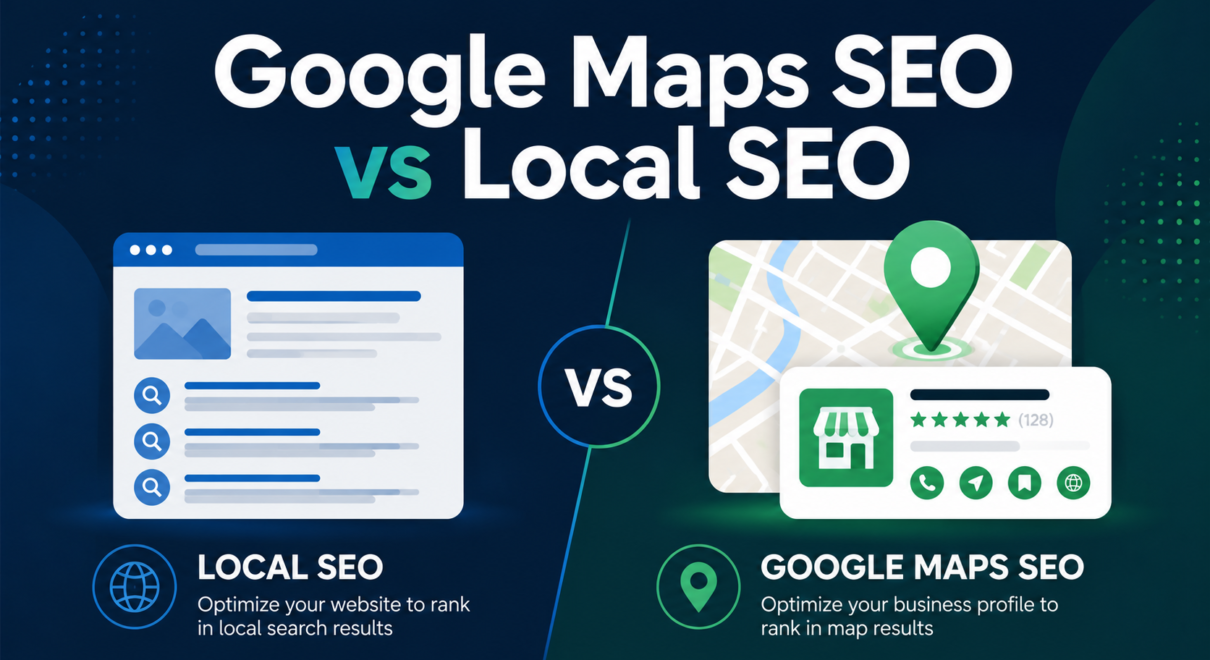
Many business owners use Google Maps SEO and Local SEO as if they mean the same thing. They are closely connected, but they are not exactly the same.
Local SEO is the broader strategy for improving visibility in local search results. It includes website optimization, local landing pages, citations, reviews, technical SEO, backlinks, and Google Business Profile optimization.
Google Maps SEO is more focused. It is the part of Local SEO that helps a business appear in the Google Map Pack and Google Maps results when nearby customers search for products or services.
Understanding the difference matters because the strategy you need depends on your goals. A business that wants more organic traffic from local service pages may need a broader Local SEO campaign. A business that mainly wants more phone calls, direction requests, and “near me” visibility may need a more focused Google Maps SEO optimization strategy.
For many local businesses, the best results come from using both together.
What Is Local SEO?
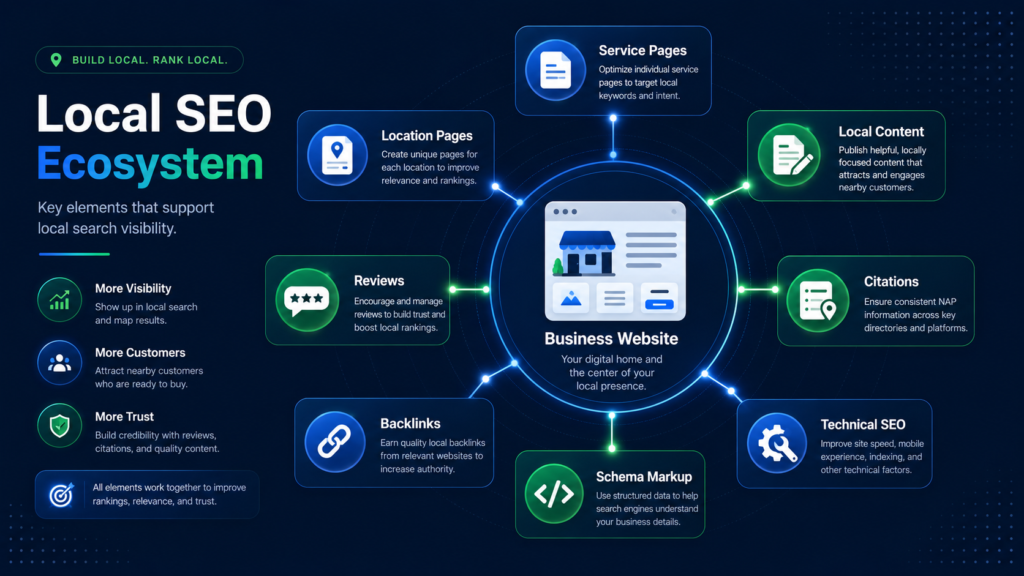
Local SEO is the process of improving a business’s visibility in search results for location-based searches.
These searches may include:
- “plumber in Austin”
- “dentist near me”
- “best pest control company in Dallas”
- “private tutor in Henderson”
- “moving company in Miami”
- “med spa near me”
Local SEO helps Google understand what your business offers, where you operate, and why your website or business profile should appear for relevant local searches.
A complete Local SEO strategy can include:
- service page optimization
- location page optimization
- Google Business Profile setup and improvement
- local keyword research
- review strategy
- local citations and NAP consistency
- local backlinks
- website authority building
- technical SEO
- schema markup
- mobile performance improvements
- local content development
The main goal of Local SEO is to improve visibility across the full local search ecosystem. That includes both regular organic search results and local map results.
For example, if a roofing company ranks on page one for “roof repair in Tampa” with a strong service page, that result is coming from Local SEO. If the same company also appears in the top three Google Maps listings, that is where Google Maps SEO becomes especially important.
What Is Google Maps SEO?
Google Maps SEO is the process of improving a business’s visibility inside Google Maps and the local Map Pack.
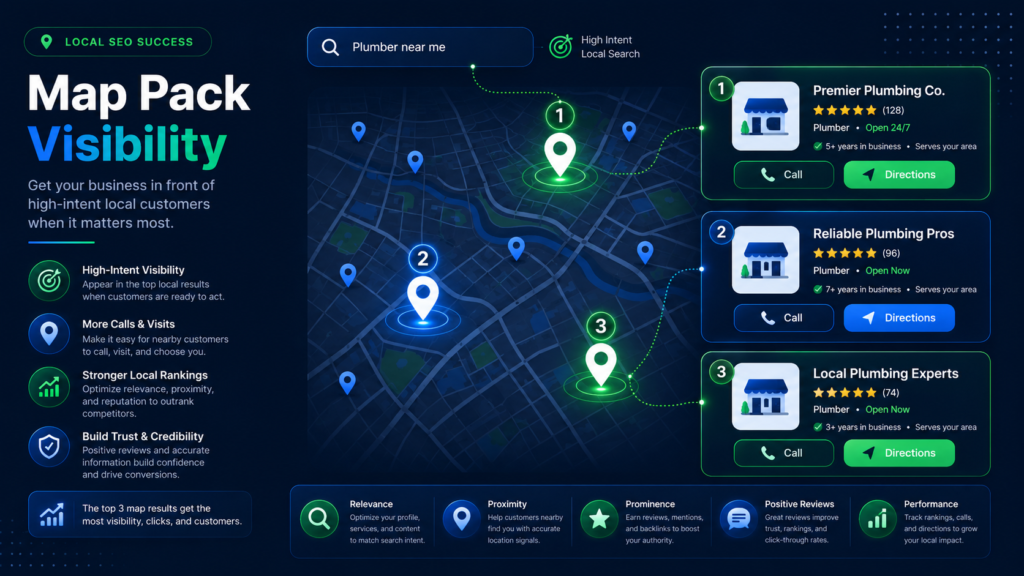
The Map Pack is the group of local business listings that often appears near the top of Google search results for local queries. It usually includes a map, business names, ratings, reviews, hours, locations, and quick action buttons.
Google Maps SEO focuses heavily on the signals that influence Map Pack visibility.
These include:
- Google Business Profile optimization
- primary and secondary business categories
- review quality, quantity, and freshness
- location relevance
- proximity to the searcher
- citation consistency
- business prominence
- website authority
- local landing page quality
- service relevance
- profile activity
- user engagement signals
For example, if someone searches “dentist near me” and a dental practice appears in the top three map results, that visibility is driven by Google Maps SEO.
This type of visibility is especially valuable because users in the Map Pack often have strong buying intent. They can call, request directions, visit the website, compare reviews, or check business hours without scrolling through traditional search results.
That is why many local businesses invest in Google Maps SEO services when they want more calls and local leads.
Google Maps SEO vs Local SEO: Main Differences
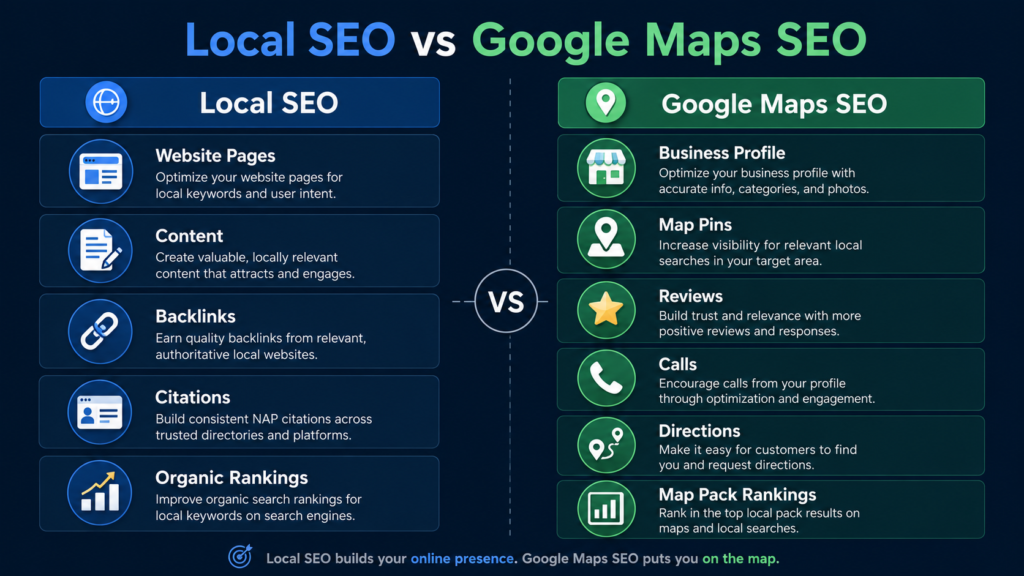
Local SEO and Google Maps SEO overlap, but they do not focus on the exact same things.
Factor | Local SEO | Google Maps SEO |
Main goal | Improve local search visibility overall | Improve Map Pack and Google Maps rankings |
Main asset | Website, service pages, local content, citations, GBP | Google Business Profile and map visibility |
Key ranking signals | Content, links, technical SEO, local relevance, citations | GBP optimization, reviews, proximity, categories, prominence |
Best for | Organic local rankings and broader visibility | Calls, directions, nearby searches, Map Pack leads |
Search area affected | Organic search results and local pages | Google Maps and local Map Pack |
Tracking method | Google Search Console, organic rankings, traffic | Map grid rankings, GBP actions, calls, directions |
Common use case | Ranking local service pages | Ranking in top three map listings |
The simple explanation is this:
Local SEO helps your business rank locally across Google. Google Maps SEO helps your business rank better in Google Maps and the Map Pack.
A strong local business often needs both.
Why Google Maps SEO Is Often More Important for Local Leads
Local SEO is important, but Google Maps SEO can be especially powerful for lead generation because of how people use local search.
When users need a nearby service, they often make quick decisions based on the Map Pack. They look at:
- business ratings
- number of reviews
- distance
- opening hours
- photos
- business category
- service relevance
- call button
- directions button
In many cases, users do not need to visit several websites before deciding. They may call directly from the Google Maps listing.
This is especially true for urgent or service-based searches, such as:
- emergency plumber near me
- pest control near me
- locksmith near me
- dentist near me
- movers near me
- HVAC repair near me
- med spa near me
- cleaning service near me
- car service near me
- private tutor near me
For these searches, Map Pack visibility can produce high-intent leads. A business ranking in regular organic results may still lose customers if competitors dominate the top map listings.
That is why Google Maps local SEO is often one of the most valuable parts of a local marketing campaign.
Where Local SEO and Google Maps SEO Overlap
Google Maps SEO is not separate from your website. Your Google Business Profile is important, but your website still supports local visibility.
The two strategies overlap in several important areas.
Google Business Profile Optimization
Google Business Profile optimization is central to Google Maps SEO, but it is also part of broader Local SEO.
A strong profile should include:
- accurate business name
- correct primary category
- relevant secondary categories
- complete services
- business description
- accurate hours
- service areas or address
- photos
- review responses
- business updates
- website link
An incomplete or poorly optimized profile can limit both Google Maps visibility and broader local trust.
Local Landing Pages
Local landing pages help Google understand which services you offer in which locations.
For example, a moving company serving multiple cities may need separate, useful pages for each major service area. These pages can support both organic rankings and Google Maps relevance.
Strong local landing pages usually include:
- clear service information
- city or area relevance
- helpful FAQs
- local proof or examples
- internal links
- calls to action
- structured data where appropriate
Thin location pages with only city names changed are much weaker.
Reviews
Reviews affect both trust and local visibility. They help customers choose your business and help Google understand prominence and relevance.
Review signals include:
- number of reviews
- average rating
- review freshness
- review content
- owner responses
- service-related keywords in reviews
A business with steady, natural review growth often has a stronger local presence than a competitor with old or limited reviews.
Citations and NAP Consistency
Citations are mentions of your business information across directories and platforms. NAP means name, address, and phone number.
If your business information is inconsistent across the web, it can weaken trust.
Common problems include:
- old phone numbers
- wrong addresses
- duplicate listings
- inconsistent business names
- different suite numbers
- outdated categories
Citation cleanup supports both Local SEO and Google Maps SEO optimization.
Website Authority
Backlinks and website authority still matter for local rankings, especially in competitive markets.
If two businesses have similar profiles and reviews, the one with a stronger website may have an advantage. Google can use website authority, content depth, and local relevance as supporting signals.
This is why a weak website can limit Google Maps performance, even if the business profile looks complete.
When You Need Local SEO
You need broader Local SEO if your business wants to improve visibility beyond the Map Pack.
Local SEO is especially useful when you want to rank for:
- service + city keywords
- location pages
- blog content
- local informational searches
- multiple service categories
- comparison searches
- long-tail local keywords
Examples:
- “roof repair in Phoenix”
- “best math tutor in Henderson”
- “how much does pest control cost in Dallas”
- “wedding limo service Atlanta”
- “emergency HVAC repair Tampa”
These searches may produce organic website results, local pages, blog posts, or service pages. A Google Business Profile alone is not enough to capture all of this traffic.
Businesses that usually need Local SEO include:
- law firms
- medical clinics
- home service companies
- tutors and education centers
- local real estate businesses
- moving companies
- cleaning companies
- med spas
- franchise businesses
- local professional service providers
Local SEO is also important when a business wants to build long-term authority across multiple services or locations.
When You Need Google Maps SEO
You need focused Google Maps SEO when your main problem is poor Map Pack visibility.
This is usually the case when:
- your Google Business Profile is not ranking
- competitors appear above you in the Map Pack
- you are not showing for “near me” searches
- you have few calls from Google Maps
- your profile has weak engagement
- your reviews are behind competitors
- your citations are inconsistent
- your business serves multiple areas
- rankings vary heavily by location
- your GBP category or services may be wrong
Google Maps SEO is especially important for businesses that rely on direct calls and nearby customers.
A focused Google Maps SEO strategy may include:
- profile audit
- category optimization
- service optimization
- review strategy
- citation cleanup
- competitor analysis
- local landing page improvements
- website authority review
- map grid tracking
- monthly profile updates
This is where many businesses need more than a one-time profile update. They need a structured system that improves local relevance, prominence, and trust over time.
Why Many Businesses Need Both
For most competitive local businesses, the strongest strategy combines Local SEO and Google Maps SEO.
Google Maps SEO can help you capture high-intent users who are ready to call or visit. Local SEO can help you build broader search visibility through your website, service pages, and content.
A combined strategy may include:
- Optimizing the Google Business Profile.
- Fixing business categories and services.
- Improving reviews and review responses.
- Cleaning up citations and NAP issues.
- Strengthening local service pages.
- Creating useful location pages.
- Adding schema markup.
- Improving website speed and mobile usability.
- Building relevant backlinks.
- Tracking rankings across different map locations.
This creates a stronger local ecosystem.
Your Google Business Profile supports map visibility. Your website supports relevance and authority. Your reviews support trust. Your citations support consistency. Your content supports topical depth.
When these elements work together, your business has a much better chance of improving both local organic rankings and Google Maps visibility.
Common Mistakes Businesses Make
Thinking Google Business Profile Setup Is Enough
Creating a profile is only the beginning. In competitive markets, a basic listing rarely ranks well by itself.
Your profile needs accurate categories, strong services, reviews, photos, updates, and support from your website.
Ignoring the Website
Some businesses focus only on Google Maps and forget the website. This is a mistake.
Your website helps Google understand your services, locations, authority, and trustworthiness. Weak website signals can hold back local rankings.
Choosing the Wrong GBP Category
The primary category is one of the most important Google Business Profile elements.
If your category is too broad or inaccurate, Google may not show your business for the right searches.
Building Thin Location Pages
Location pages should not be copied templates with only the city name changed.
They should provide real value, explain services clearly, answer local questions, and support the user’s decision.
Not Collecting Reviews Consistently
Reviews should grow steadily over time. A business with no recent reviews may look less active than competitors.
Consistent review generation is important for both trust and visibility.
Using Inconsistent Business Information
If your business name, address, or phone number is different across listings, Google may have less confidence in your business data.
Citation consistency is still important, especially for businesses with older listings or multiple locations.
Tracking Rankings from Only One Location
Google Maps rankings can change based on where the searcher is located.
A business may rank well near its address but poorly across town. Map grid tracking gives a better view of real visibility.
Treating Google Maps SEO as a One-Time Task
Local competitors keep improving. Reviews change. Google updates its systems. New competitors enter the market.
Google Maps SEO works best as an ongoing process, not a one-time setup.
Local SEO or Google Maps SEO: Which Should You Prioritize?
The answer depends on your current situation.
If your website has weak service pages, poor local content, and limited organic rankings, start with broader Local SEO.
If your website is already decent but your Google Business Profile is invisible, start with Google Maps SEO.
If you are in a competitive niche, you probably need both.
Here is a simple way to think about it:
Situation | Best Priority |
You are not ranking in the Map Pack | Google Maps SEO |
You have weak service pages | Local SEO |
You serve multiple cities | Both |
You need more calls quickly | Google Maps SEO |
You want long-term local traffic growth | Local SEO |
Your GBP is incomplete | Google Maps SEO |
Your website has technical or content problems | Local SEO |
Competitors dominate both maps and organic results | Both |
The most effective strategy usually starts with an audit. You need to know whether the biggest gaps are in your profile, reviews, citations, website, content, authority, or competitor strength.
Need Better Visibility in Google Maps and Local Search?
Local SEO and Google Maps SEO work best when they support each other. Your website builds authority and relevance. Your Google Business Profile helps you appear in map results. Reviews, citations, content, and local landing pages strengthen the full local search ecosystem.
If your business depends on local leads, you may need more than basic profile updates. A focused Google Maps SEO strategy can help identify why competitors outrank you, what signals are missing, and which improvements should come first.