

Many businesses want SEO that fits their budget. That is completely reasonable. SEO should not feel like an oversized expense with unclear value, vague reporting, or endless monthly tasks that do not clearly support growth.
But when comparing SEO providers, pricing alone is not the best way to judge value.
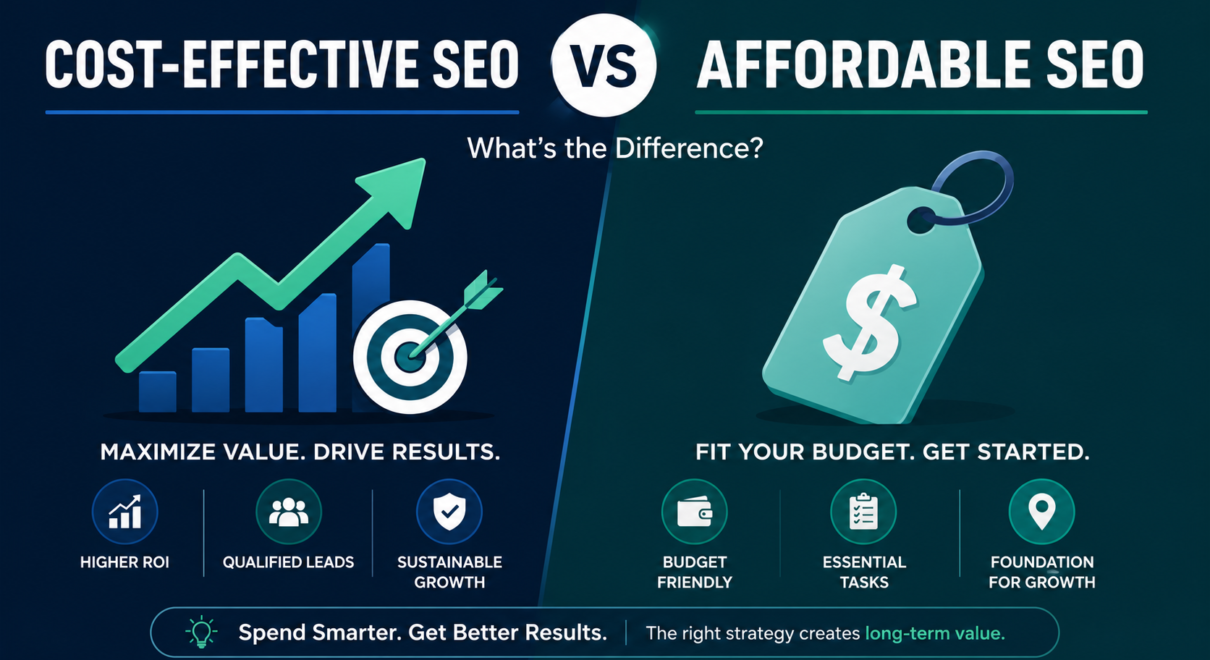
There is an important difference between affordable SEO and cost-effective SEO.
Affordable SEO usually refers to the price of the service. It answers the question:
“Can this fit within my current budget?”
Cost-effective SEO goes deeper. It answers a more important question:
“Will this investment produce meaningful results compared to what I spend?”
That difference matters. A service can be affordable but not very effective. Another service may require a slightly higher investment but produce better rankings, stronger traffic, more qualified leads, and a better long-term return.
The goal is not simply to spend less. The goal is to spend smarter.
What Does Affordable SEO Usually Mean?
Affordable SEO usually refers to SEO services priced in a way that is accessible for small businesses, startups, local companies, or businesses with limited marketing budgets.
This type of SEO can be useful when the scope is realistic and expectations are clear.
Affordable SEO may include:
- basic keyword research
- on-page optimization
- local SEO setup
- Google Business Profile improvements
- basic technical review
- content updates
- citation cleanup
- simple reporting
- monthly optimization tasks
For a small business that has never invested in SEO before, affordable SEO can be a practical starting point. It can help fix obvious issues, improve basic search visibility, and create a foundation for future growth.
Affordable SEO is not automatically weak. The problem starts when the service is priced attractively but lacks strategy, prioritization, or proper execution.
For example, a business may pay for monthly SEO but receive only generic blog posts, automated reports, or small technical edits that do not address the real ranking barriers. The monthly cost may look reasonable, but the work may not move the business forward.
That is where cost-effectiveness becomes more important than affordability alone.
What Does Cost-Effective SEO Mean?
Cost-effective SEO is SEO designed to produce the strongest possible impact from the available budget.
It is not only about keeping the price manageable. It is about using the budget efficiently.
A cost-effective SEO strategy focuses on:
- identifying the highest-impact opportunities first
- fixing issues that block rankings
- improving pages that can realistically perform
- targeting keywords with business value
- building topical authority around priority services
- strengthening technical SEO foundations
- improving conversion-focused pages
- measuring results based on rankings, traffic quality, leads, and ROI
This is the main difference:
Affordable SEO focuses on what the service costs. Cost-effective SEO focuses on what the service returns.
For example, if a website has serious indexing problems, publishing more blog articles may not be the best first step. If a local business is missing from Google Maps, building national blog content may not solve the immediate problem. If an ecommerce site has weak category pages, creating generic informational content may not be the best use of budget.
Cost-effective SEO starts with diagnosis, then prioritizes work based on impact.
Affordable SEO vs Cost-Effective SEO
Affordable SEO and cost-effective SEO can overlap, but they are not the same.

A service can be both affordable and cost-effective if the work is well planned, focused, and aligned with business goals. But a service can also be affordable and still waste money if it focuses on the wrong tasks.
Factor | Affordable SEO | Cost-Effective SEO |
Main focus | Keeping the price accessible | Maximizing value and ROI |
Main question | “Can we afford this?” | “Will this improve results?” |
Strategy | Often limited by budget | Prioritized by impact |
Best use | Basic setup or starter campaigns | Sustainable ranking and growth |
Scope | Usually narrower | Flexible, modular, and custom |
Measurement | Tasks completed | Rankings, traffic quality, leads, ROI |
Risk | Important work may be skipped | Budget is directed to priority issues |
Best for | Businesses needing entry-level help | Businesses wanting efficient growth |
The strongest SEO approach is not always the largest campaign. It is the campaign that solves the right problems in the right order.
Why Cost-Effective SEO Starts With Diagnosis
One of the biggest reasons businesses waste money on SEO is that they start executing before they understand the problem.
They publish content before checking whether important pages are indexed.
They build backlinks before fixing weak service pages.
They redesign pages before reviewing rankings and search intent.
They chase broad keywords before identifying realistic opportunities.
They pay for monthly SEO without knowing what the highest-priority issues are.
Without diagnosis, SEO becomes guesswork.
With diagnosis, SEO becomes prioritization.
A proper SEO diagnosis may review:
- technical SEO problems
- crawl and indexing issues
- page speed and Core Web Vitals
- keyword targeting
- content gaps
- on-page optimization
- internal linking
- backlink strength
- local SEO signals
- Google Business Profile performance
- competitor rankings
- conversion paths
- traffic drops or ranking losses
This does not mean every business needs a massive audit before doing anything. But some level of analysis should happen before budget is spent.
A cost effective SEO company should be able to explain what needs attention first and why.
What Makes SEO Truly Cost-Effective?
Cost-effective SEO is built around prioritization. It does not try to do everything at once. It identifies what matters most for the current situation.
Clear Business Goals
SEO should not chase traffic for the sake of traffic.
A strong SEO strategy should connect to business goals such as:
- more qualified leads
- better local visibility
- higher ecommerce sales
- stronger service page rankings
- better organic traffic quality
- recovery after a rankings drop
- improved brand visibility
- better performance in AI-driven search
- stronger authority in a niche
For example, a local service business may care more about Google Maps visibility and phone calls than national blog traffic. An ecommerce store may care more about category and product page rankings than general informational traffic.
Cost-effective SEO starts by defining what success actually means.
Correct Keyword Prioritization
Not every keyword is worth targeting immediately.
Some keywords have high volume but unrealistic competition. Others may have lower volume but much stronger buying intent.
A cost-effective SEO strategy looks for keywords that combine:
- relevance
- realistic ranking potential
- business value
- conversion intent
- topical fit
- long-term growth potential
This is especially important for small businesses. The best first targets are often not the biggest keywords in the industry. They are the keywords that can realistically bring qualified traffic and support revenue.
Strong Technical Foundation
Technical SEO is not always visible to business owners, but it can strongly affect results.
If a website has crawl problems, indexation issues, broken redirects, duplicate content, slow loading speed, or weak site structure, other SEO efforts may underperform.
Important technical SEO areas include:
- crawlability
- indexability
- site speed
- mobile usability
- Core Web Vitals
- structured data
- canonical tags
- redirects
- sitemap quality
- internal linking
- page architecture
Cost-effective SEO does not ignore the technical foundation. It fixes issues that prevent other work from performing.
Content That Supports Revenue Pages
Blogging can be useful, but not every blog article supports business growth.
A cost-effective content strategy should help important pages rank.
That means creating content that supports:
- service pages
- product pages
- local landing pages
- industry-specific pages
- comparison pages
- audit or recovery pages
- high-intent informational topics
For example, if the goal is to rank a Local SEO service page, supporting articles should explain Google Maps SEO, local ranking factors, Google Business Profile optimization, citations, reviews, and local landing pages.
This creates topical authority instead of random blog activity.
Smart Internal Linking
Internal linking is one of the most overlooked cost-effective SEO tactics.
A strong internal linking structure helps search engines understand:
- which pages are most important
- how topics are connected
- which pages support each service
- where authority should flow
- how users can move through the site
For example, a cluster of articles about SEO pricing, SEO ROI, small business SEO, and modular SEO services can all support a homepage or main SEO services page.
This helps build relevance without requiring every page to earn external backlinks immediately.
Relevant Backlinks
Backlinks still matter, but relevance and quality are more important than volume.
A cost-effective backlink strategy focuses on links that make sense for the page and topic.
Good backlink opportunities may come from:
- niche-relevant guest posts
- business publications
- industry blogs
- local websites
- partner mentions
- expert contributions
- resource pages
- editorial placements
The goal is not to build as many links as possible. The goal is to build links that strengthen trust, authority, and topical relevance.
Transparent Reporting
SEO reporting should not only show activity. It should show progress.
Useful reporting may include:
- keyword movement
- organic traffic changes
- Search Console clicks and impressions
- conversions or leads
- technical fixes completed
- content improvements
- backlink acquisition
- local ranking changes
- Google Business Profile actions
- next priorities
Cost-effective SEO should make it clear what was done, why it was done, and what changed as a result.
When Affordable SEO Is Enough
Not every business needs a large SEO campaign from the beginning.
Affordable SEO may be enough when:
- the website is small
- the market is not very competitive
- the business needs basic setup
- the site has obvious on-page issues
- local SEO foundations are missing
- there are simple technical fixes to complete
- the business is testing SEO for the first time
- expectations are realistic
For example, a small local business may first need Google Business Profile optimization, basic service page improvements, citation cleanup, and a simple content plan. That may not require a large campaign immediately.
The key is matching the scope to the business stage.
Affordable SEO can be valuable when it is honest about what it includes and what it can realistically achieve.
When You Need a More Cost-Effective SEO Strategy
A more strategic approach becomes important when SEO needs to solve deeper problems.
You may need a stronger cost-effective SEO strategy when:
- competitors are actively investing in SEO
- important pages are not ranking
- organic traffic has dropped
- the website has technical problems
- the business serves multiple locations
- ecommerce SEO is involved
- content is being published but not performing
- backlinks are weak or irrelevant
- previous SEO work failed
- local search visibility is poor
- AI search visibility matters
- the business needs measurable ROI
In these cases, the most cost-effective solution may not be the smallest package. It may be the strategy that identifies the real blockers and fixes them in the right order.
For example, if rankings dropped after a website migration, the best investment may be a recovery audit. If an ecommerce store has thousands of products but weak category pages, category optimization may matter more than blog content. If a local business is invisible in Google Maps, Local SEO and Google Business Profile work may come first.
A cost-effective SEO strategy is not one-size-fits-all. It adapts to the problem.
How Small Businesses Should Evaluate SEO Value
Small businesses should not evaluate SEO only by monthly price.
A better approach is to ask what the SEO work is designed to improve.
Question | Why It Matters |
What problem is SEO solving first? | Prevents wasted work |
Is there an audit before execution? | Identifies priorities |
Are services customized? | Avoids one-size-fits-all SEO |
Are rankings tied to business goals? | Keeps focus on ROI |
Is technical SEO included? | Protects the foundation |
Is content connected to service pages? | Builds topical relevance |
Is reporting transparent? | Shows whether progress is real |
Can the scope scale over time? | Helps manage budget efficiently |
A provider should be able to explain the strategy in clear language.
If the answer is only “we will improve your rankings,” that is not enough. The business should understand which rankings, which pages, which issues, and which actions matter first.
The Better Question: What Will This SEO Investment Improve?
Instead of only asking, “How much does SEO cost?” businesses should ask:
- Will this improve rankings for important pages?
- Will this fix technical barriers?
- Will this support lead generation?
- Will this create long-term SEO assets?
- Will this improve local visibility?
- Will this help service or product pages rank?
- Will this strengthen topical authority?
- Will this make future SEO work more effective?
- Will this improve the quality of organic traffic?
- Will this help us understand competitors better?
These questions shift the conversation from price to value.
A cost-effective SEO service should make the investment easier to understand because every action has a purpose.
Cost-Effective SEO for Small Businesses
Small businesses often have to be careful with marketing budgets. That makes prioritization even more important.
Good small business SEO services should focus on work that can realistically create momentum.
Depending on the business, that might include:
- improving service pages
- optimizing Google Business Profile
- fixing technical SEO issues
- creating a small content cluster
- cleaning up citations
- improving internal links
- targeting local keywords
- optimizing high-intent pages
- building a small number of relevant backlinks
- improving conversion paths
The goal is not to imitate the SEO strategy of a large national brand. The goal is to identify the best path for the business’s current size, market, and goals.
This is where custom SEO services can be more valuable than rigid packages.
Can SEO Be Cost-Effective Without a Large Retainer?
Yes. SEO can be cost-effective without a large fixed retainer if the work is planned correctly.
Some businesses benefit from monthly SEO. Others may need a project-based audit, a focused technical cleanup, a local SEO setup, or a content improvement phase before moving into ongoing work.
A flexible SEO model can include:
- one-time audits
- technical fixes
- local SEO campaigns
- content clusters
- backlink campaigns
- migration recovery
- ecommerce SEO improvements
- ongoing monthly optimization
- consulting and strategy
This modular approach helps businesses invest where the need is strongest instead of committing to a broad service package before priorities are clear.
Build an SEO Strategy Around Value, Not Just Price
Businesses do not need oversized campaigns or generic retainers to grow. They need a clear understanding of what matters most, which SEO work has the highest impact, and how each action supports rankings, traffic, leads, or ROI.
Affordable SEO can be useful when the scope is clear and realistic. But cost-effective SEO goes further. It focuses on strategy, prioritization, efficiency, and measurable growth.
The best SEO investment is not always the lowest-priced option or the largest campaign. It is the one that solves the right problems, supports the right pages, and creates long-term value for the business.