

Many businesses assume that SEO has to begin with a large monthly retainer. In some cases, a retainer makes sense. Competitive campaigns often need ongoing content, technical monitoring, link building, reporting, and strategic adjustments.
But a large fixed retainer is not always the best starting point.
Some businesses first need an SEO audit. Others need technical fixes, service page improvements, a content refresh, Google Business Profile optimization, backlink support, or help recovering from a traffic drop. When the real priorities are not clear yet, committing to a broad monthly package can lead to wasted effort.
That is where modular SEO services can be valuable.
Modular SEO allows a business to invest in the SEO work it needs most right now. Instead of paying for a large package before priorities are fully understood, the strategy can begin with the highest-impact work first and scale from there.
This is one of the most practical cost effective SEO solutions for businesses that want flexibility, clearer priorities, and better control over their SEO investment.
What Are Modular SEO Services?
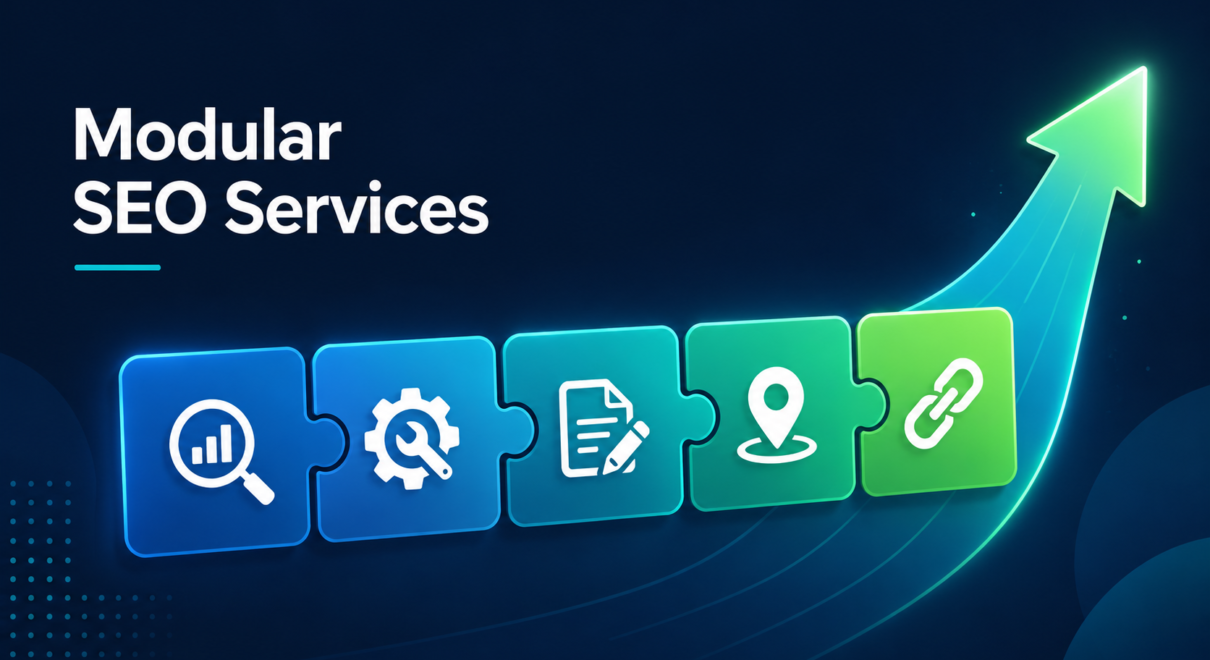
Modular SEO services are individual SEO services or phased SEO projects selected based on a website’s current needs.
Instead of buying one large package that includes every possible SEO activity, a business can choose the services that match its situation. These may include an audit, technical SEO cleanup, content optimization, local SEO setup, backlink support, or monthly campaign management.
Common modular SEO services include:
- SEO audit
- technical SEO fixes
- on-page optimization
- content refreshes
- service page optimization
- local SEO setup
- Google Business Profile optimization
- link building campaign
- website migration audit
- rankings loss recovery
- monthly SEO support
- ecommerce category optimization
- multi-location local SEO
This does not mean SEO should be random or disconnected. Modular SEO still needs strategy. The difference is that the work is selected based on priority instead of being forced into a fixed package.
A modular approach works best when each service has a clear purpose. For example, a technical SEO audit may identify why pages are not being indexed. A content refresh may improve pages that already have impressions but low rankings. A backlink campaign may support priority pages after they are properly optimized.
The value comes from choosing the right module at the right time.
Why Traditional SEO Retainers Can Be Useful
Monthly SEO retainers are not automatically a bad option. For many businesses, they are the right long-term structure.
A retainer can be useful when a business needs ongoing SEO management, regular content production, link building, reporting, technical monitoring, and competitor response. SEO is not static. Search results change, competitors improve their websites, new keyword opportunities appear, and technical issues can develop over time.
Monthly retainers can work well when:
- the business is in a competitive market
- SEO needs ongoing content and links
- the website has many pages
- competitors are active
- local rankings need regular management
- ecommerce SEO is ongoing
- reporting and monitoring are important
- the business has long-term growth goals
For example, an ecommerce store with hundreds of products may need ongoing category optimization, technical monitoring, internal linking, and content support. A multi-location business may need regular Google Business Profile work, location page updates, citation management, and city-level tracking. A law firm in a competitive market may need steady content, backlinks, and service page improvements.
In these cases, a monthly retainer can provide consistency.
The key is that the retainer should match the actual work needed. A retainer becomes valuable when the scope is clear, the priorities are justified, and the monthly work is tied to measurable progress.
When Big SEO Retainers Become Inefficient
A large SEO retainer can become inefficient when the work does not match the website’s real priorities.
This often happens when a business starts paying for ongoing SEO before the provider has properly diagnosed what is holding the website back. The monthly package may include content, reports, and general optimization, but the most important problems may remain unresolved.
For example, a business may be paying for blog posts when technical indexing issues are preventing important pages from performing. Another company may be paying for backlinks before its main service pages are strong enough to benefit from that authority. A local business may be paying for broad website content when Google Business Profile optimization and local landing pages would have a bigger impact.
Fixed retainers can become less efficient when they include:
- blog posts before technical issues are fixed
- backlinks before priority pages are optimized
- reports before basic tracking is set up
- broad SEO work when a focused audit is needed
- national-style SEO when local SEO is the real priority
- repeated monthly tasks without clear reasoning
- deliverables that do not connect to leads, rankings, or visibility
The problem is not the retainer itself. The problem is paying for a broad scope before the right priorities are clear.
SEO should not feel like a subscription to a task list. It should feel like a strategy where every action has a reason.
How Modular SEO Makes SEO More Cost-Effective
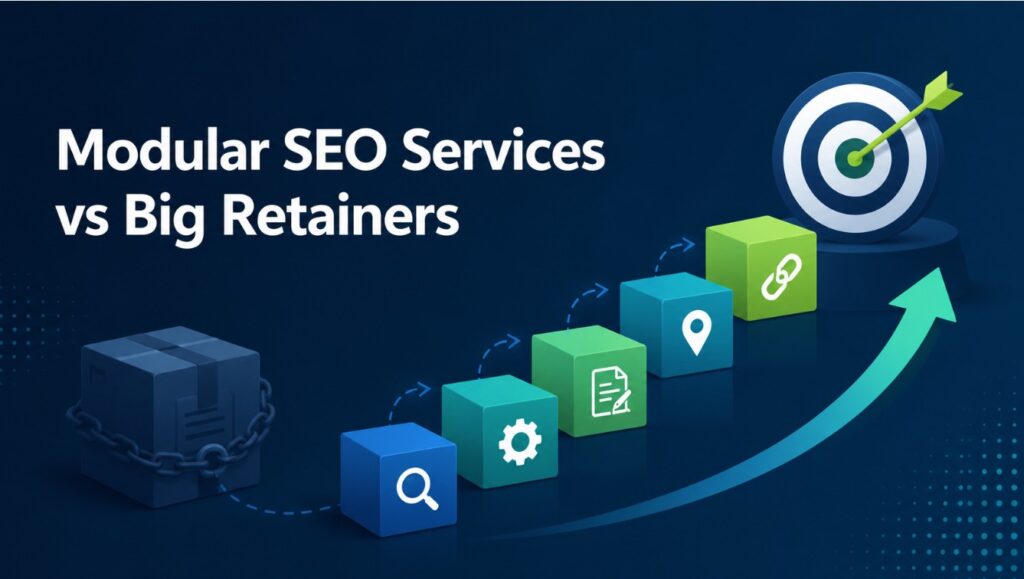
Modular approach can make SEO more cost-effective because it gives the business more control over scope and priority.
Instead of committing immediately to every part of SEO, the business can start with the work most likely to create value. That may be an audit, a technical cleanup, a service page improvement project, a local SEO setup, or a focused backlink campaign.
This approach can help businesses reduce wasted work and avoid paying for services they do not need yet.
Modular SEO can improve value through:
- better prioritization
- more flexible budgets
- project-based fixes
- easier scaling
- clearer accountability
- reduced wasted work
- better fit for small businesses
- faster focus on urgent problems
- stronger alignment with business goals
For example, if a website has recently lost rankings, the most cost-effective first step may be a rankings loss audit. If a local business is invisible in Google Maps, the best first step may be local SEO and Google Business Profile optimization. If an ecommerce site has weak category pages, category optimization may matter more than publishing blog articles.
Modular SEO allows the campaign to follow the problem.
That is why it can be one of the most practical cost effective SEO solutions. It lets businesses start with the highest-impact work instead of committing to a broad package before diagnosis.
Common Modular SEO Service Options
Different websites need different types of SEO support. A modular approach makes it easier to select the right service for the current stage of the business.
Modular SEO Service | Best Used When | Business Value |
|---|---|---|
SEO audit | You need to understand what is holding rankings back | Identifies priorities |
Technical SEO fixes | Crawl, indexing, speed, redirects, or structure issues exist | Improves foundation |
On-page optimization | Service or product pages are weak | Strengthens important pages |
Content refresh | Existing pages have impressions but poor performance | Improves current assets |
Content cluster | A service page needs topical support | Builds relevance |
Local SEO setup | Business depends on local calls or visits | Improves local visibility |
Google Business Profile optimization | Maps visibility is weak | Supports local leads |
Backlink campaign | Competitors have stronger authority | Helps close authority gaps |
Migration audit | Website was redesigned or moved | Protects rankings |
Rankings loss recovery | Traffic or positions dropped | Finds and fixes causes |
Monthly SEO support | Ongoing growth is needed | Keeps progress consistent |
The strongest modular SEO plans usually combine several services over time. The point is not to avoid ongoing SEO. The point is to build the sequence correctly.
A business may start with an audit, move into technical fixes, improve priority pages, then add content and backlinks after the foundation is stronger. Another business may begin with local SEO setup and later move into monthly support once visibility starts improving.
This staged approach can be much more efficient than starting with a broad retainer that tries to do everything at once.
Modular SEO for Small Businesses
Modular SEO is especially useful for small businesses because budgets are usually more limited and priorities need to be clear.
A small business may not need a large SEO campaign from the beginning. It may first need to understand what is missing, fix the most important issues, and build a foundation that can support future growth.
This is why cost effective SEO for small businesses often works best when the strategy is phased.
A local business may start with Google Business Profile optimization and service page improvements. An ecommerce store may start with category page optimization. A service business may begin with an audit and updates to its most important lead-generation pages. A business that lost traffic may need a recovery audit before spending money on new content.
Examples of modular SEO for small businesses:
- a local company starts with GBP optimization and service page updates
- an ecommerce store starts with category optimization and technical checks
- a service provider starts with an audit and priority page improvements
- a business with traffic loss starts with a recovery audit
- a multi-location business starts with its top priority cities first
This approach helps small businesses avoid overcommitting too early. It also makes SEO easier to understand because each phase has a clear purpose.
The goal is not to delay growth. The goal is to invest in the right first steps so future SEO work becomes more effective.
Modular SEO for Local, Ecommerce, and Multi-Location Businesses
A modular SEO strategy should adapt to the type of business. Local companies, ecommerce stores, and multi-location businesses usually need different priorities.

Local Businesses
Local businesses often need SEO that supports calls, bookings, direction requests, and local search visibility.
Useful modules may include:
- Google Business Profile optimization
- citation cleanup
- local service pages
- review strategy
- Google Maps tracking
- local backlinks
- city page optimization
- local schema suggestions
For a local plumber, dentist, med spa, moving company, tutor, pest control company, or contractor, local visibility can be one of the most valuable SEO outcomes. A modular local SEO campaign can start with the foundations first, then expand into content, links, reviews, and tracking.
Ecommerce Businesses
Ecommerce businesses often have different SEO problems. They may have thin category pages, duplicate content, product indexing issues, weak internal links, or technical problems caused by filters and product variations.
Useful modules may include:
- category page optimization
- product page SEO
- technical SEO
- structured data
- buying guides
- internal linking
- product description improvements
- indexation review
For ecommerce, blog content can help, but commercial pages usually need direct attention. A modular SEO plan can prioritize category and product pages before expanding into content clusters or authority building.
Multi-Location Businesses
Multi-location SEO is more complex because each branch, office, or service area may need its own local signals.
Useful modules may include:
- location page structure
- Google Business Profile review
- citation cleanup by location
- review strategy by branch
- city-level rank tracking
- internal linking between services and locations
- multi-city content planning
A business with several locations should not automatically build dozens of pages at once. It may be more effective to start with the highest-value cities, build strong location pages, clean up citations, and track each market separately.
For multi-location companies, modular SEO helps prevent thin city pages, inconsistent data, and wasted effort across too many markets at the same time.
Project-Based SEO vs Monthly SEO
Modular SEO often includes project-based work, but it can also lead into monthly SEO.
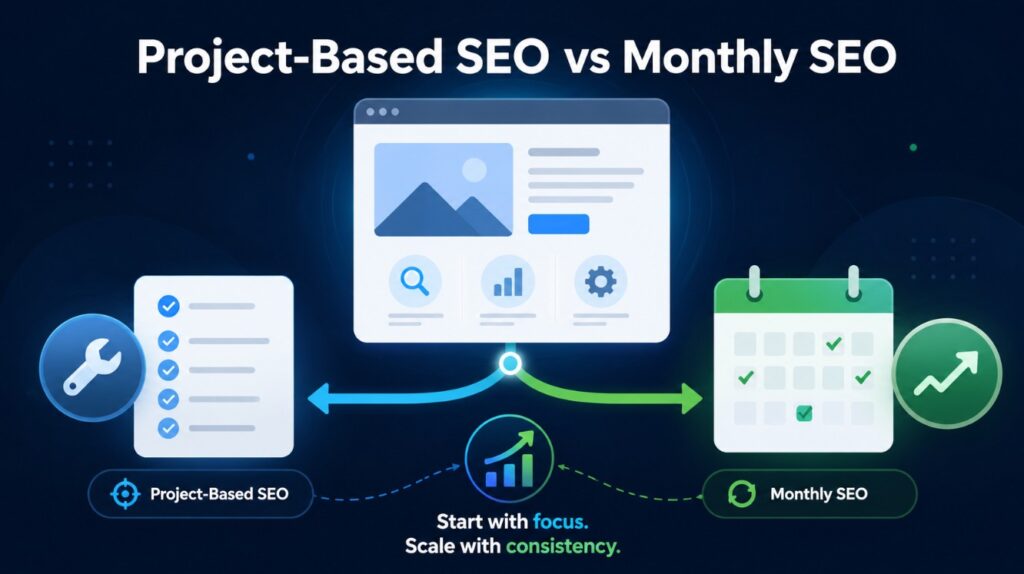
The two models serve different purposes.
Project-Based SEO
Project-based SEO is useful when the business has a specific problem or defined need.
It works well for:
- audits
- technical fixes
- content refreshes
- migration checks
- one-time local SEO setup
- priority page optimization
- rankings loss recovery
- Google Business Profile cleanup
For example, a company that recently redesigned its website may need a migration audit to check redirects, indexing, canonical tags, and traffic changes. A business with outdated blog articles may need a content refresh project. A local business may need a one-time Google Business Profile and citation cleanup before ongoing work begins.
Monthly SEO
Monthly SEO is better when the business needs ongoing growth and regular management.
It works well for:
- ongoing content
- competitor response
- backlink building
- local SEO management
- technical monitoring
- reporting
- long-term growth
- continuous optimization
In many cases, the best strategy combines both. A business may start with a project, such as an audit or technical cleanup, then move into monthly SEO services after the foundation is stronger and the priorities are clearer.
This structure can make ongoing SEO more efficient because the monthly work starts from a better position.
How to Build a Modular SEO Plan
A modular SEO plan should still follow a clear process. The services may be flexible, but the strategy should not be improvised.
A good modular plan usually starts with diagnosis. Before selecting services, the business needs to understand what is limiting performance and where the best opportunities are.
A practical process may look like this:
- Start with diagnosis
- Identify priority pages
- Review technical health
- Choose realistic keywords
- Decide what can produce the fastest useful improvement
- Select the right module
- Measure results
- Scale into the next module or monthly support
For example, the diagnosis may show that the homepage and service pages need stronger keyword targeting. In that case, on-page optimization may come first. If Google Search Console shows many impressions but poor ranking positions, content refreshes may be useful. If competitors have stronger authority, backlinks may become the next priority.
The important point is that each step should lead to the next.
This is how cost effective SEO services can create better value. The campaign does not start with a fixed assumption. It starts with the actual condition of the website.
What Modular SEO Should Not Mean
Modular SEO should not mean disconnected tasks.
A business should not buy an audit, a blog article, a few backlinks, or a technical fix without understanding how that work fits into a broader SEO direction. A modular approach is only useful when the modules are selected strategically.
Modular SEO should not mean:
- disconnected random tasks
- no strategy
- no reporting
- only one-off fixes with no follow-up
- skipping technical review
- ignoring long-term goals
- choosing services only because they are easy
- treating SEO as isolated tasks with no connection
For example, a backlink campaign may not be the best first module if the target page is weak. A content project may not help if the site has serious indexing problems. A local SEO setup may underperform if the website has no useful local pages.
The value of modular SEO comes from sequence.
Each module should support the next phase of growth. Otherwise, modular SEO becomes just another task list.
How to Choose a Cost Effective SEO Company for Modular Services
A cost effective SEO company should not automatically push the largest package.
Instead, it should help identify which SEO work matters most right now.
A good provider should explain:
- what module should come first
- why it matters
- what the expected outcome is
- what the budget can cover
- what should wait
- whether monthly support is needed later
- how results will be measured
- how modules connect to long-term growth
This matters because SEO can be confusing when every provider offers a different package. One company may recommend content. Another may recommend links. Another may recommend technical work. Without a clear diagnosis, it is hard for a business to know which recommendation is most important.
A cost-effective provider should make the decision easier, not more complicated.
The best question is not:
“What package should we buy?”
The better question is:
“What SEO work will create the most value at this stage?”
Modular SEO Works Best When Priorities Come First
A large retainer is not always the wrong choice, but it should not be the automatic starting point for every business.
SEO becomes more cost-effective when the work matches the website’s actual needs. Sometimes that means an audit. Sometimes it means technical fixes, content refreshes, local SEO, backlinks, or monthly support.
The best approach is the one that solves the right problem at the right time.
Modular SEO helps businesses invest in the work that matters most first, then scale when the foundation is stronger and the next priorities are clear.
At CostEffectiveSEO, we build flexible SEO strategies around priorities, realistic opportunities, and long-term value – helping businesses invest in the SEO work that matters most first.