

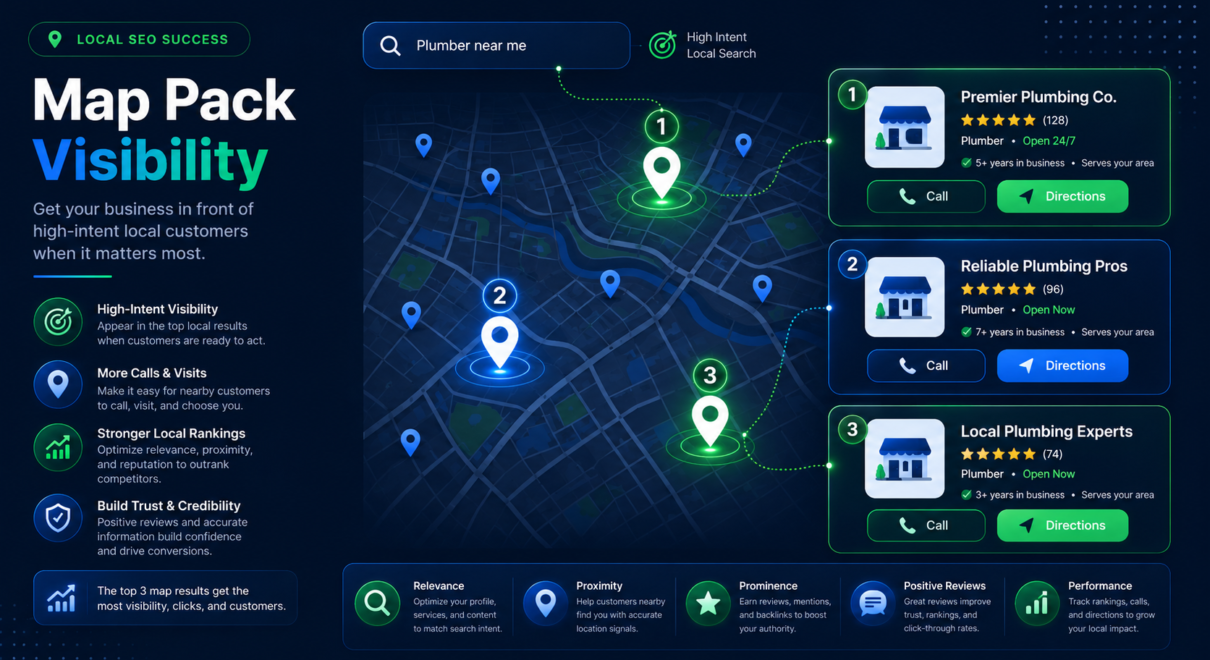
Google Maps rankings can feel stable one month and unpredictable the next. A business may appear in the top three Map Pack results for important local searches, receive steady calls from its Google Business Profile, and then suddenly lose visibility across key areas.
For local businesses, this can directly affect leads. When potential customers search for nearby services, they often compare ratings, business hours, distance, photos, and call buttons directly inside the Map Pack. If your listing drops out of the top results, many users may never reach your website at all.
This is why a Google Maps ranking drop should not be ignored. Your service page already highlights how important local intent and Map Pack visibility are for local lead generation, including the role of Google Maps rankings, reviews, local citations, and Google Business Profile optimization.
The challenge is that a ranking drop is rarely caused by one obvious issue. It may come from a Google Business Profile change, a website update, competitor improvements, weaker reviews, inconsistent citations, spam listings, or changes in how Google evaluates local results.
This guide explains the most common reasons businesses lose Google Maps rankings, how to identify the likely cause, and what to review first.
Why Google Maps Rankings Change
Google Maps rankings are dynamic. They are not fixed positions.
A business may rank differently depending on:
- where the searcher is located
- which keyword is used
- whether the search includes “near me”
- the device being used
- competitor activity
- review growth
- Google Business Profile changes
- website authority
- proximity
- category relevance
- local search behavior
This is why your business may rank well near your office but not across the entire city. You may rank for one service but not another. You may appear in the Map Pack one week and lose visibility the next.
Google Maps SEO is influenced by three broad ranking concepts:
Ranking Concept | What It Means | Example |
|---|---|---|
Relevance | How closely your business matches the search | A pest control company ranking for “termite treatment near me” |
Distance | How close your business is to the searcher or target area | A dentist ranking better near their office than across town |
Prominence | How trusted, reviewed, established, and authoritative your business appears | A business with stronger reviews, citations, and website authority outranking weaker competitors |
When one or more of these signals changes, rankings can shift.
Common Causes of Google Maps Ranking Drops
Before making random edits, it helps to separate the most likely causes.
Cause | What Usually Happens | What to Check First |
|---|---|---|
Google Business Profile changes | Rankings drop after edits to category, address, name, phone, or service area | GBP edit history, categories, business info |
Competitor growth | Rankings decline gradually as competitors improve | Reviews, GBP activity, location pages, backlinks |
Review slowdown | Competitors become more prominent and trusted | Review volume, freshness, rating, responses |
Website changes | GBP loses supporting local signals | URLs, redirects, service pages, location pages |
Citation inconsistency | Google sees conflicting business data | NAP across directories and local listings |
Google local update | Rankings shift across the market | SERP changes, competitor movement, timing |
Spam competitors | Fake or keyword-stuffed listings enter the Map Pack | Business names, addresses, duplicate listings |
Tracking issue | Rankings look different depending on location | Map grid tracking and geo-specific checks |
A good recovery process starts by identifying which category the issue belongs to.
GBP-Related Reasons Businesses Lose Google Maps Rankings
Google Business Profile changes are one of the first areas to check after a ranking drop. Even small edits can affect how Google understands your business.
Your Primary Category Changed
Your primary category is one of the strongest Google Business Profile relevance signals.
If it changes, your visibility can shift quickly.
This can happen when:
- you manually changed the category
- another user suggested an edit
- Google applied an edit
- an agency or team member changed it
- you added unrelated secondary categories
- a category was removed or adjusted
For example, a pest control company using a broad home services category may lose visibility for pest-specific searches. A tutoring center using a generic education category may struggle to appear for specific tutoring searches.
If rankings dropped after a profile edit, categories should be reviewed immediately.
Your Business Information Was Edited
Changes to your business name, address, phone number, website URL, hours, or service area can affect visibility.
This is especially true if:
- the address changed
- the business name was modified
- the phone number changed
- the website URL was changed
- business hours were removed or edited
- the service area became too broad or confusing
- the profile required reverification
Some changes are necessary, but they should be made carefully. After any major edit, rankings should be monitored across your main keywords and service areas.
Your Profile Was Suspended, Reverified, or Reinstated
Google Business Profile suspensions and verification issues can cause major visibility disruption.
Even after a profile is reinstated, rankings may not immediately return to the previous level.
After a suspension or reverification, check:
- business name
- primary category
- address or service area
- phone number
- website URL
- profile status
- duplicate listings
- suspended or merged profiles
If a profile was suspended because of guideline issues, the underlying problem must be fixed before rankings can stabilize.
Competitor-Related Reasons Rankings Drop
Sometimes your business did not do anything wrong. Competitors simply improved.
Local rankings are relative. You are competing against nearby businesses for the same Map Pack space.
Competitors Improved Their Google Maps SEO
A competitor can overtake you by improving several local signals at once.
They may have:
- gained more recent reviews
- optimized their GBP categories
- added better services
- uploaded fresh photos
- improved their website pages
- built stronger local citations
- earned better backlinks
- improved internal linking
- published local content
- become more active on their profile
If your business stays still while competitors keep improving, your rankings can decline even if nothing appears “wrong” on your end.
Competitors Passed You in Reviews
Reviews influence both rankings and conversions.
A business does not always lose rankings because it has bad reviews. Sometimes competitors simply build stronger review signals.
Important review factors include:
- total number of reviews
- average rating
- review freshness
- review consistency
- review content
- owner responses
- service-related mentions
- location-related mentions
For example, two businesses may both have a 4.8 rating. But if one has 35 older reviews and another has 180 reviews with steady monthly growth, the second business may look more prominent and trustworthy.
Review growth should be consistent and natural. Occasional bursts followed by months of silence are usually weaker than steady review acquisition.
Spam Listings Entered the Map Pack
Some industries have aggressive local spam.
Examples include:
- keyword-stuffed business names
- fake locations
- virtual office listings
- duplicate profiles
- lead-generation listings
- incorrect categories
- suspicious review patterns
Spam competitors can push legitimate businesses down, especially in high-value niches such as locksmiths, lawyers, pest control, moving, HVAC, and emergency services.
If you see clear violations, they can be documented and reported. However, spam reporting should not replace real optimization. Your own profile still needs strong categories, reviews, citations, website relevance, and authority.
Website and Local Signal Problems That Affect Google Maps Rankings
A Google Business Profile does not work alone. The website connected to the profile helps Google understand your services, locations, authority, and relevance.
This is especially important in competitive markets.
Your Website Changed or Lost Local Relevance
Google Maps rankings can drop after website changes such as:
- redesigning the website
- changing URLs
- removing service pages
- deleting location pages
- weakening internal links
- changing title tags or headings
- removing local content
- breaking redirects
- changing the GBP website URL
- creating duplicate pages
- adding technical SEO issues
For example, if a moving company had a strong “local moving in Dallas” page and that page was removed during a redesign, the Google Business Profile may lose an important supporting signal.
Website signals that support Google Maps SEO include:
- service pages
- location pages
- clear NAP information
- local schema markup
- strong internal links
- mobile usability
- page speed
- backlinks
- local content depth
If rankings dropped after a website update, the website should be audited before changing the GBP again.
Local Landing Pages Are Weak or Missing
Local landing pages help support visibility for specific cities, suburbs, and service areas.
Weak location pages usually have:
- duplicate content
- only city names changed
- no local details
- no unique service information
- no testimonials
- no internal links
- no useful FAQs
- no clear conversion path
Strong local landing pages include:
- specific service information
- unique local introduction
- nearby areas served
- relevant FAQs
- local proof where possible
- internal links to services
- clear contact options
- schema markup where appropriate
For service-area businesses and multi-location companies, local landing pages can be especially important.
Citations and NAP Data Became Inconsistent
NAP stands for name, address, and phone number.
Consistent business information across the web helps Google trust that your business data is accurate.
Citation problems may include:
- old addresses
- wrong phone numbers
- duplicate listings
- inconsistent business names
- incorrect categories
- closed locations still appearing
- outdated suite numbers
- mismatched location data
- old tracking numbers used incorrectly
This is common when a business moves, rebrands, changes phone numbers, opens new locations, or works with several marketing vendors.
For multi-location businesses, citation cleanup becomes even more important because each branch needs clean and consistent data.
Market and Tracking Issues That Can Look Like Ranking Drops
Not every apparent ranking drop means your business has lost authority. Sometimes the issue is how rankings are being checked or how Google is adjusting the local results.
You Are Tracking Rankings from the Wrong Location
Google Maps rankings depend heavily on searcher location.
A business may rank:
- top 3 near its office
- position 8 a few miles away
- outside the top 20 across town
- differently on mobile than desktop
- differently for “near me” vs city-based searches
Manual checks can be misleading. If you search from your own office or home, you are only seeing one version of the local results.
For accurate Google Maps SEO tracking, businesses should monitor:
- map grid rankings
- rankings by city or neighborhood
- Google Business Profile calls
- direction requests
- website clicks
- local organic rankings
- conversions by location
This is especially important for service-area businesses and companies trying to rank across multiple cities.
Google Updated Local Search Results
Google regularly updates how local results are ranked and displayed.
After an update, some businesses gain visibility while others lose it. This does not always mean a business was penalized. It may mean Google changed how it weighs certain signals.
Updates may affect:
- proximity weighting
- review signals
- spam filtering
- category relevance
- business name filtering
- local intent interpretation
- map result layouts
- organic and map overlap
If several businesses in your market shifted around the same time, a Google local update may be involved.
The best response is not panic. The best response is to compare competitors, review ranking patterns, check profile data, and identify whether the drop is isolated or market-wide.
The Local Market Became More Competitive
Sometimes rankings drop because the market itself changed.
New competitors may enter the area. Existing competitors may start investing in SEO. Larger companies may expand into your market. Franchises may open nearby. Review expectations may increase.
A business that ranked with 20 reviews three years ago may now compete against businesses with 200 reviews, stronger websites, and active Local SEO campaigns.
When a market becomes more competitive, small profile edits are usually not enough. The business may need a broader Local Maps SEO strategy.
Temporary Fluctuation vs Real Ranking Problem
Not every ranking movement requires immediate action. Some fluctuations are normal. Others should be investigated quickly.
Situation | Usually Temporary? | Needs SEO Action? |
|---|---|---|
One-day ranking movement | Often | Monitor first |
Drop from one search location only | Maybe | Check grid rankings |
Drop across all main keywords | Usually not | Investigate immediately |
Drop after GBP category edit | Usually not | Review category changes |
Drop after website redesign | Usually not | Audit URLs, redirects, and local pages |
Drop after suspension/reverification | Usually not | Review GBP status and profile data |
Competitors gradually pass you | No | Compare reviews, pages, links, and GBP activity |
Calls and direction requests decline with rankings | No | Treat as business-impacting issue |
The more widespread and persistent the drop is, the more seriously it should be treated.
What to Check First After a Google Maps Ranking Drop
A structured diagnosis is better than random changes.
Area to Review | Why It Matters |
|---|---|
GBP categories | Categories strongly affect service relevance |
Business information | Name, address, phone, URL, and hours must be accurate |
Profile status | Suspensions, reverification, and edits can disrupt visibility |
Reviews | Review freshness and competitor review growth affect prominence |
Website pages | Service and location pages support GBP relevance |
Citations/NAP | Consistent business data helps Google trust the listing |
Competitors | Rankings are relative, not isolated |
Map grid rankings | Shows whether visibility dropped everywhere or only in certain areas |
Local landing pages | Supports multiple cities and service areas |
Technical SEO | Website problems can weaken local signals |
Step-by-Step Recovery Checklist
If your Google Maps rankings dropped, start here:
- Check whether the drop affects all keywords or only specific services.
- Compare rankings from multiple locations, not just one device.
- Review recent Google Business Profile edits.
- Confirm the primary and secondary categories.
- Check the profile status and verification status.
- Compare review growth with top competitors.
- Review citation and NAP consistency.
- Check whether the website recently changed.
- Audit important service and location pages.
- Confirm redirects are working after any redesign or URL changes.
- Look for duplicate or spam competitors.
- Review Google Business Profile calls, directions, and website clicks.
- Compare competitor GBP activity, content, and backlinks.
- Prioritize fixes based on the most likely cause.
The goal is to identify whether the issue is caused by profile changes, website problems, competitor activity, review weakness, citation inconsistency, spam, or broader local market shifts.
When You Need Professional Local Maps SEO Help
Some ranking drops are simple to diagnose. Others require deeper analysis.
Professional help may be useful when:
- rankings dropped suddenly
- competitors dominate several keywords
- GBP edits caused instability
- citations are messy
- you manage multiple locations
- the website changed recently
- reviews are weaker than competitors
- Map Pack visibility varies heavily by area
- you are not sure which factor caused the drop
- you need a recovery plan, not random fixes
A proper Local Maps SEO audit should review the full ecosystem:
- Google Business Profile
- categories
- reviews
- citations
- website pages
- technical SEO
- local competitors
- backlinks
- map grid rankings
- ranking patterns
Need Help Recovering Google Maps Rankings?
Losing Google Maps visibility can directly affect calls, leads, and revenue. But the solution is not always obvious.
Your profile may need optimization. Your reviews may be falling behind. Your citations may be inconsistent. Your website may have lost local relevance. Competitors may have improved. Or Google may be interpreting your local signals differently than before.
A structured Local Maps SEO review can help identify the real cause and prioritize the fixes that matter most.