


Negative search results can create a serious trust problem before someone ever contacts you. A damaging article, outdated mention, complaint page, forum thread, legal reference, or negative third-party profile can shape how people see a person, company, founder, executive, or brand.
In many cases, the negative result cannot simply be deleted.
That is where SEO reputation management becomes useful.
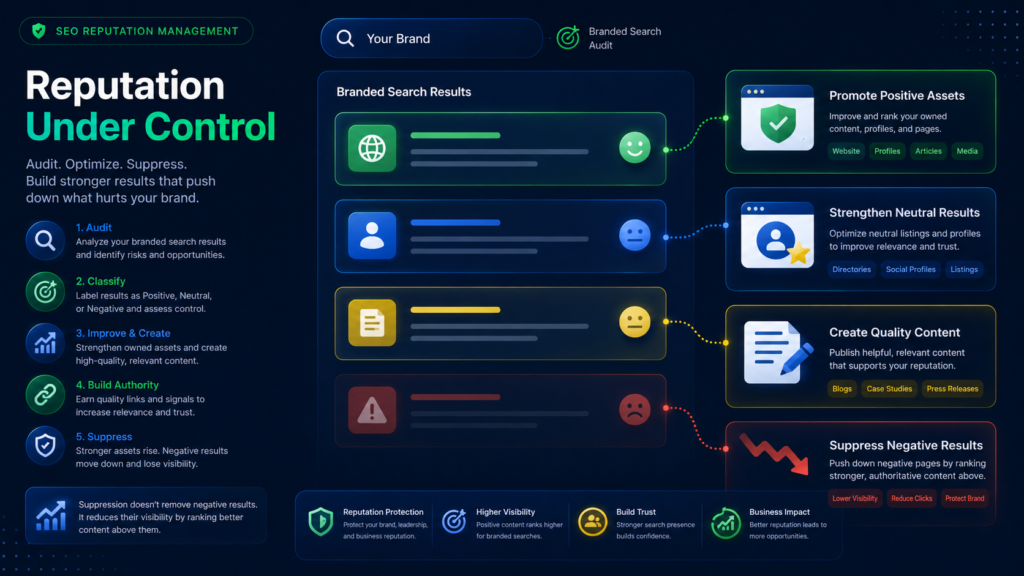
SEO reputation management works by improving what appears in search results for a name, company, or brand. Instead of focusing only on removal, it uses SEO, content creation, publishing, optimization, and authority building to help positive or neutral assets rank higher. As stronger results move up, negative search results can gradually move lower.
This process is called suppression.
Suppression does not erase the negative result from the internet. It reduces its visibility by promoting better, more relevant, and more authoritative content above it.
This guide explains how SEO reputation management works, what steps are involved, and why a structured process is needed to push down negative search results.
What Does It Mean to Suppress Negative Search Results?
Suppressing negative search results means pushing unwanted pages lower in Google by improving the rankings of positive, neutral, or brand-controlled assets.
For example, if a negative article ranks in position 3 for a company name, the goal may be to promote stronger assets into positions 1, 2, 3, and 4 so the negative result moves down.
Those positive or neutral assets may include:
- the official website
- About pages
- professional profiles
- company profiles
- interviews
- guest posts
- press releases
- third-party articles
- social profiles
- directory listings
- industry profiles
- case studies
- media mentions
- branded content hubs
The goal is not to hide legitimate information with spam. The goal is to build a stronger, more accurate, and more complete branded search presence.
Search engines rank pages based on relevance, authority, trust, content quality, links, and user signals. If a negative page ranks highly, it usually has enough relevance or authority to appear near the top. Suppression works by giving search engines better options.
Why Removal Is Not Always Possible
Many people first ask whether negative search results can be removed.
Sometimes they can. But in most cases, removal is difficult.
A negative result may only be removed if:
- it violates a platform policy
- it contains private personal information
- it is legally removable
- the publisher agrees to remove it
- the page is factually incorrect and can be corrected
- it qualifies for search engine removal under specific rules
- it is spam, impersonation, or abusive content
Many negative results do not meet these conditions.
A news article, forum thread, complaint page, review page, or old public mention may remain online even if it is outdated, unfair, or damaging. Search engines may continue to show it if they consider it relevant to the search query.
That is why SEO reputation management usually focuses on suppression instead of deletion.
If removal is not realistic, the next best option is to reduce visibility.
Step 1: Start With a Branded SERP Audit
A proper SEO reputation management process begins with a branded SERP audit.
SERP means search engine results page. This audit looks at what appears when someone searches for a name, company, brand, executive, founder, or related branded phrases.
The audit should identify:
- which results appear on page one
- which results are positive
- which results are neutral
- which results are negative
- which results are owned or controlled
- which results are third-party assets
- which negative results are most visible
- which positive assets can be improved
- which new assets may be needed
- how strong the negative results are
- how difficult suppression may be
This step is important because every reputation case is different.
A negative result on a weak website may be easier to push down. A negative article on a strong media domain may be much harder. A personal-name search may behave differently from a company-name search. A unique brand name may be easier to manage than a generic name.
Without a SERP audit, the campaign becomes guesswork.
Step 2: Classify Search Results by Sentiment and Control
After collecting the search results, each page should be classified.
A simple classification may include:
- positive result
- neutral result
- negative result
- owned result
- semi-controlled result
- third-party result
- high-risk result
- low-risk result
Positive results support the person or brand. These may include official websites, professional profiles, interviews, favorable articles, case studies, or positive company pages.
Neutral results are not necessarily positive, but they are not damaging. These may include directory profiles, social profiles, company listings, database pages, or factual mentions.
Negative results are pages that may damage trust. These could include old news, complaint pages, forum discussions, negative articles, legal mentions, or other unwanted content.
Owned results are assets you fully control, such as your website or blog. Semi-controlled results may include LinkedIn, Crunchbase, business directories, or professional profiles. Third-party results are assets controlled by external publishers.
This classification helps decide what should be promoted, what should be created, and what needs to be pushed down.
Step 3: Measure Suppression Difficulty
Not every negative result is equally difficult to suppress.
Suppression difficulty depends on several factors:
- domain authority of the negative page
- number of backlinks to the negative result
- relevance of the negative result to the branded query
- age of the page
- freshness of the search results
- strength of competing positive assets
- uniqueness of the name or brand
- whether the negative result is from a major media site
- whether the query has many available ranking opportunities
- whether positive assets already exist
A negative result from a weak forum may be easier to suppress than a major news article. A page with many backlinks may be harder to move than a page with no authority. A negative result in position 8 may be easier to push down than one in position 2.
This difficulty analysis is important for setting expectations.
SEO reputation management is not instant. Search engines need time to crawl, evaluate, and rank competing assets. More difficult cases require more content, stronger authority, and longer timelines.
Step 4: Identify Existing Positive Assets
Before creating new content, review what positive or neutral assets already exist.
Existing assets may include:
- official website pages
- About page
- team bios
- author pages
- LinkedIn profiles
- company profiles
- social profiles
- business directories
- podcast appearances
- media mentions
- guest articles
- professional association pages
- portfolio pages
- case studies
- press pages
Some of these assets may already rank on page one or page two. Others may be close enough to improve.
This is often one of the fastest opportunities.
For example, a LinkedIn profile ranking in position 12 may be easier to move to page one than a completely new article. A company About page that ranks below a negative result may improve with better optimization and internal links. An existing interview may become stronger with link building.
The goal is to find positive assets that already have search potential.
Step 5: Optimize Owned and Controlled Assets
Owned and controlled assets are the foundation of a reputation management SEO strategy.
These pages should clearly explain who the person, company, or brand is, what they do, why they are credible, and what information should be associated with their name.
Optimization may include:
- improving title tags
- rewriting meta descriptions
- improving H1s and headings
- adding name or brand references naturally
- improving About page content
- strengthening bios
- adding trust signals
- adding internal links
- improving page structure
- adding schema markup where appropriate
- improving indexability
- making profiles complete
- using consistent entity information
For a company, this may involve strengthening the homepage, About page, leadership pages, case studies, press page, and branded content.
For an individual, this may involve optimizing a personal website, LinkedIn profile, professional bio, author profile, interviews, and industry listings.
Owned assets matter because they give search engines clear, reliable information directly connected to the person or brand.
Step 6: Create New Positive or Neutral Content Assets
If existing assets are not enough, new content is needed.
This content should not be random. It should be created based on the specific branded search results and suppression goal.
Useful content assets may include:
- professional bios
- founder profiles
- executive profiles
- company overview pages
- interviews
- guest posts
- contributed articles
- press releases
- thought leadership articles
- industry commentary
- case studies
- project pages
- podcast appearances
- directory profiles
- partner profiles
- media features
For individuals, content may focus on professional background, expertise, achievements, projects, interviews, and current work.
For businesses, content may focus on company history, services, leadership, case studies, community involvement, media mentions, partnerships, and educational content.
The best assets are credible, useful, and relevant to the name or brand being searched.
Thin or low-quality content is unlikely to suppress strong negative results. Content needs enough relevance and authority to compete.
Step 7: Publish Content on the Right Platforms
Where content is published matters.
Publishing everything on a low-authority site may not create enough ranking power. Publishing only on the main website may not fully control the search results because branded SERPs usually include multiple domains.
A stronger strategy usually combines owned, controlled, and third-party publishing.
Possible platforms include:
- official website
- company blog
- personal website
- Medium or similar platforms
- industry blogs
- guest post websites
- business directories
- professional associations
- PR distribution platforms
- podcast websites
- interview websites
- partner pages
- media outlets
- niche publications
Third-party assets are useful because they diversify the search results. They also appear more independent than self-published content.
However, quality matters. A poorly written guest post on a weak website may do little. A well-optimized profile or article on a relevant, trusted site has a better chance of ranking.
Step 8: Build Authority to Positive Assets
Publishing content is only part of the process.
Positive assets often need authority to rank.
This is where link building becomes important. In SEO reputation management, links are used to strengthen the pages that should appear above negative results.
Authority-building may include:
- backlinks to positive articles
- links to profiles
- internal links from owned websites
- links from related guest posts
- citations from business directories
- links from partner websites
- links from media mentions
- social profile links
- links between positive assets where natural
For example, if a positive interview is ranking on page two, link building may help it move to page one. If a company profile has enough relevance but weak authority, backlinks may help it compete. If an official About page is underperforming, internal links and external mentions may help strengthen it.
The goal is not to build spammy links. The goal is to use relevant, ethical authority signals to support positive content.
Step 9: Track Rankings Over Time
SEO reputation management requires ongoing monitoring.
Search results can change as Google crawls new pages, reevaluates existing pages, and tests different results.
Tracking should include:
- branded search rankings
- position of negative results
- position of positive assets
- new negative mentions
- new neutral results
- new opportunities
- page-one changes
- page-two opportunities
- traffic to promoted assets
- backlink growth
- indexing status
Monitoring helps determine whether the strategy is working.
If a positive asset moves up, it may need additional support. If a negative result moves higher, the campaign may need to adjust. If a new negative result appears, it should be evaluated quickly.
Reputation management is not only about the first campaign. It is also about staying aware of what appears in search results over time.
Step 10: Adjust the Suppression Strategy
SEO reputation management is rarely a straight line.
Some assets may rank faster than expected. Others may not perform. Google may change the SERP. A new article may appear. A third-party page may gain or lose authority. A negative result may move unexpectedly.
The strategy should be adjusted based on actual search movement.
Adjustments may include:
- creating additional content
- strengthening existing assets
- changing link-building priorities
- improving owned pages
- optimizing underperforming profiles
- publishing on stronger platforms
- targeting related branded queries
- improving entity consistency
- expanding media or guest post coverage
A good campaign should not rely on one asset.
The best suppression strategies create a group of positive and neutral results that support each other.
How Long Does Negative Search Result Suppression Take?

Timelines vary depending on the difficulty of the case.
Some easier cases may show movement within a few months. More difficult cases can take longer, especially when negative results are hosted on strong domains or have many backlinks.
Timeline factors include:
- strength of negative result
- number of negative results
- current position of negative content
- authority of existing positive assets
- publishing speed
- backlink strength
- indexing speed
- brand-name competition
- number of available ranking opportunities
- search result volatility
A low-authority negative result in position 8 may be pushed down faster than a major media article in position 2.
It is important to set realistic expectations. SEO reputation management is not usually instant. It works through gradual ranking movement.
What Makes a Suppression Campaign More Effective?
A suppression campaign is more effective when it is specific, realistic, and based on data.
The strongest campaigns usually include:
- clear SERP audit
- realistic suppression targets
- strong owned assets
- credible third-party content
- consistent brand or name signals
- high-quality content
- relevant backlinks
- diversified publishing
- regular monitoring
- ongoing adjustments
The weakest campaigns usually rely on random content, low-quality profiles, weak press releases, or spammy links.
Search result suppression works best when positive assets deserve to rank.
That means they should be relevant, useful, optimized, credible, and supported by authority signals.
Common Mistakes in SEO Reputation Management
Many reputation campaigns fail because they are too generic.
Common mistakes include:
- trying to remove everything instead of building suppression assets
- publishing low-quality content
- creating duplicate profiles with little value
- using spammy links
- ignoring existing positive assets
- failing to monitor rankings
- targeting the wrong search queries
- using unnatural keyword stuffing
- expecting instant results
- relying on one article or profile
- not building authority to positive assets
- ignoring page-one search intent
Another mistake is treating all negative results the same.
A complaint page, old news article, legal mention, Reddit thread, review page, and forum result may all require different strategies. The suppression plan should match the exact SERP.
When You Need a Professional SEO Reputation Management Process
Some reputation issues are simple enough to improve with basic profile optimization and content publishing. Others require a more structured campaign.
A professional SEO reputation management process is useful when:
- negative results rank on page one
- negative results appear in the top three positions
- the issue affects leads, sales, hiring, or trust
- negative content is hosted on strong domains
- multiple negative results appear
- existing positive assets are weak
- the brand has limited search presence
- the case involves a founder or executive name
- a company needs confidential suppression support
- previous attempts did not work
- ongoing monitoring is needed
A structured campaign can identify which results are realistic to suppress, which assets should be promoted first, and what level of effort may be required.