
For many local businesses, Google Maps visibility is not optional. It is often the difference between a steady flow of calls, bookings, visits, and quote requests – or being invisible while competitors collect the leads.
The problem is that many business owners assume that creating a Google Business Profile is enough. They set up the listing, add basic business information, upload a few photos, and wait for rankings to improve. But Google Maps SEO is much more competitive than that.
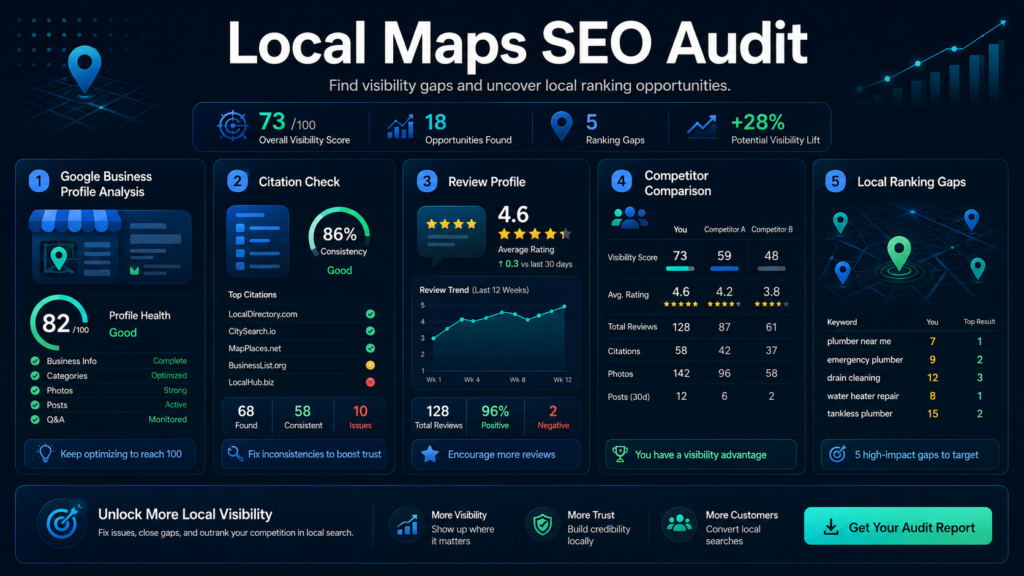
If your business is not ranking in Google Maps, the issue usually comes down to a mix of profile optimization, reviews, local relevance, website authority, citations, proximity, and competitor strength. In some cases, the problem is simple. In others, it requires a deeper Local Maps SEO strategy.
This guide explains why your business may not be showing up in Google Maps and what you can do to improve your local visibility.
Why Google Maps Rankings Matter
When someone searches for a local service, Google often displays the Map Pack before regular organic results. This is the block with three local business listings, a map, reviews, locations, and direct action buttons such as call, directions, or website.
For local businesses, this area is extremely valuable because users searching there often have strong intent. They are not just researching casually. They may be ready to call a plumber, book a dentist, compare pest control companies, find a moving company, or visit a nearby store.
Strong Google Maps rankings can help generate:
- More phone calls
- More direction requests
- More local website visits
- More booked appointments
- More trust from reviews and visibility
- More leads from users searching nearby
This is why Google Maps SEO has become one of the most important parts of Local SEO. Ranking on your website alone is helpful, but if your competitors dominate the Map Pack, they may still win the highest-intent local traffic.
How Google Maps Rankings Actually Work
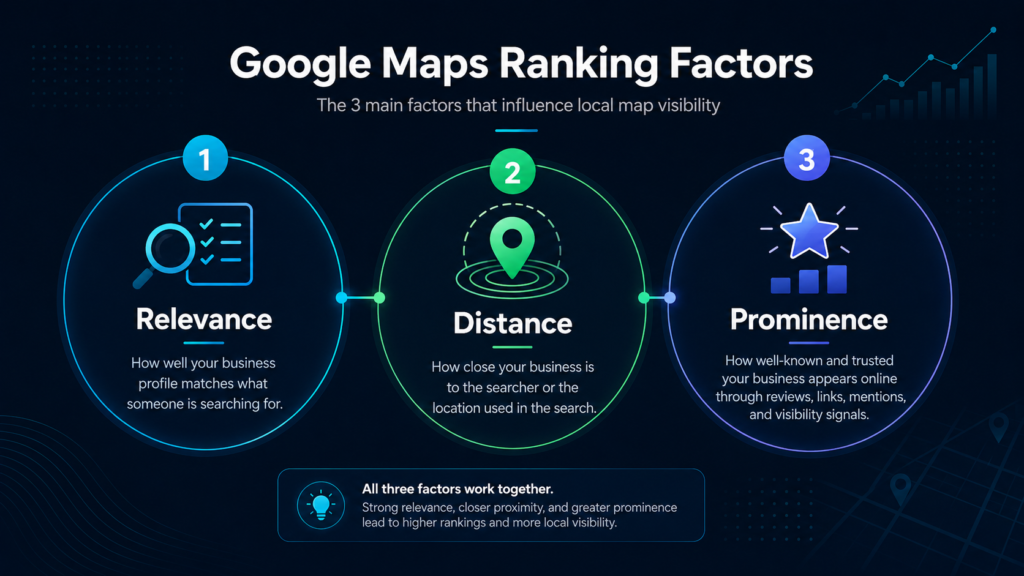
Google Maps rankings are influenced by three major ranking concepts: relevance, distance, and prominence.
Relevance
Relevance means how closely your business matches what the user is searching for.
For example, if someone searches “emergency plumber near me,” Google wants to show businesses that clearly offer emergency plumbing services. If your Google Business Profile categories, services, website content, and local landing pages do not clearly support that service, your listing may struggle to rank.
Relevance is influenced by:
- Primary and secondary GBP categories
- Business description
- Services listed in your profile
- Website content
- Local landing pages
- Reviews mentioning relevant services
- On-page SEO signals
Distance
Distance is the proximity between the searcher and your business or service area.
This is one reason Google Maps rankings can vary from one street, neighborhood, or city to another. You may rank well near your physical address but poorly farther away.
For service-area businesses, distance can be more complex because the business may not show a public address. In those cases, Google still uses location relevance, service areas, and other signals to decide when the business is eligible to appear.
Prominence
Prominence is Google’s way of evaluating how established and trusted your business appears online.
This can include:
- Review quality and quantity
- Local citations
- Website authority
- Backlinks
- Brand mentions
- Profile completeness
- Search engagement
- Local relevance signals
This is where many businesses fall behind. Their profile may exist, but competitors have stronger reviews, better local content, cleaner citations, and more authority.
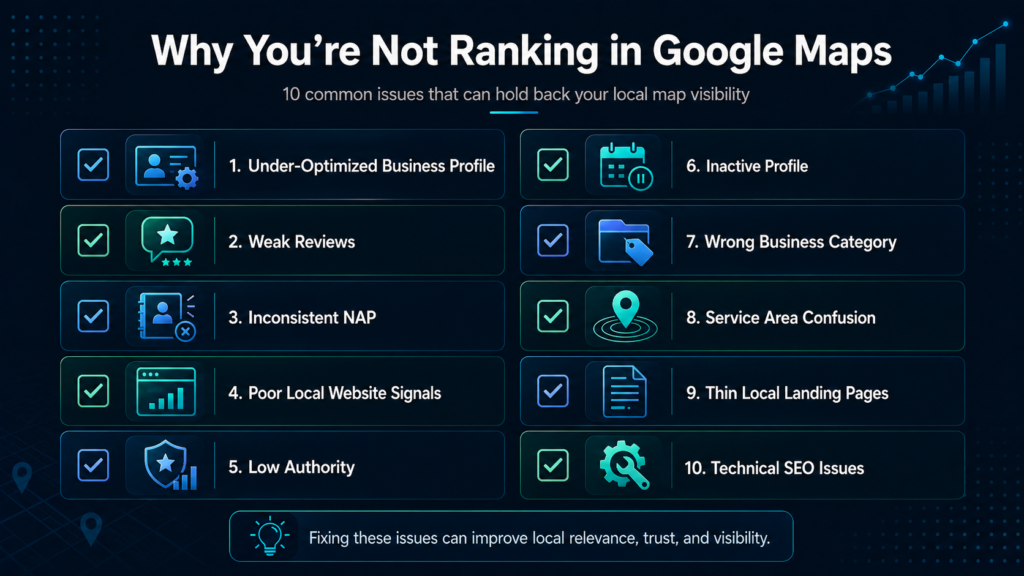
10 Common Reasons You’re Not Ranking in Google Maps
Your Google Business Profile Is Not Fully Optimized
An incomplete or weak Google Business Profile is one of the most common reasons businesses fail to rank in Google Maps.
Your profile should clearly explain what your business does, where it operates, and why it is relevant to local searchers. If important fields are missing or poorly completed, Google has less confidence in your listing.
Common issues include:
- Wrong primary category
- Missing secondary categories
- Thin business description
- Missing services
- No products or service details
- Few photos
- Inconsistent hours
- No updates or posts
- Weak connection between GBP and website
The primary category is especially important. A business using a broad or incorrect category may lose visibility to competitors with a more accurate category.
For example, a business that mainly offers pest control should not choose a generic home services category if a more precise pest control category is available.
You Have Weak or Inconsistent Reviews
Reviews are one of the strongest trust signals in local search. They influence both rankings and conversions.
A business with a weak review profile may struggle to compete, especially if competitors have:
- More reviews
- Better average ratings
- More recent reviews
- Reviews that mention target services
- Owner responses to reviews
It is not only about having a high star rating. Review freshness and relevance matter too.
For example, if a moving company wants to rank for local moving services, reviews mentioning “local move,” “apartment move,” “long-distance move,” or the city name can help reinforce relevance.
A review strategy should be consistent and natural. Sudden bursts of reviews followed by months of silence can look less organic than steady review growth over time.
Your Business Information Is Inconsistent Across the Web
NAP consistency means your business name, address, and phone number are consistent across directories, listings, and platforms.
If Google sees different versions of your business information across the web, it can reduce trust.
Common citation issues include:
- Old phone numbers
- Different business names
- Incorrect addresses
- Duplicate listings
- Inconsistent suite numbers
- Old locations still appearing online
- Conflicting business categories
This is especially common for businesses that moved locations, changed branding, or worked with multiple marketing providers.
Local citation building and cleanup help Google confirm that your business information is accurate and trustworthy.
Your Website Does Not Support Local Relevance
Your Google Business Profile and website should support each other. If your GBP says you offer a service in a location, but your website does not clearly explain that service or location, you may struggle to rank.
For example, a pest control business targeting several cities should ideally have strong service pages and location-specific content. A single generic homepage may not be enough.
Website local relevance can be improved through:
- Service pages
- Location pages
- Clear contact information
- Local schema markup
- Internal Links
- Locally relevant headings
- City and service combinations
- Embedded maps when appropriate
- Local testimonials or case examples
Google Maps SEO is not separate from your website. Your website still plays an important role in supporting your local authority.
Your Competitors Have Stronger Local Authority
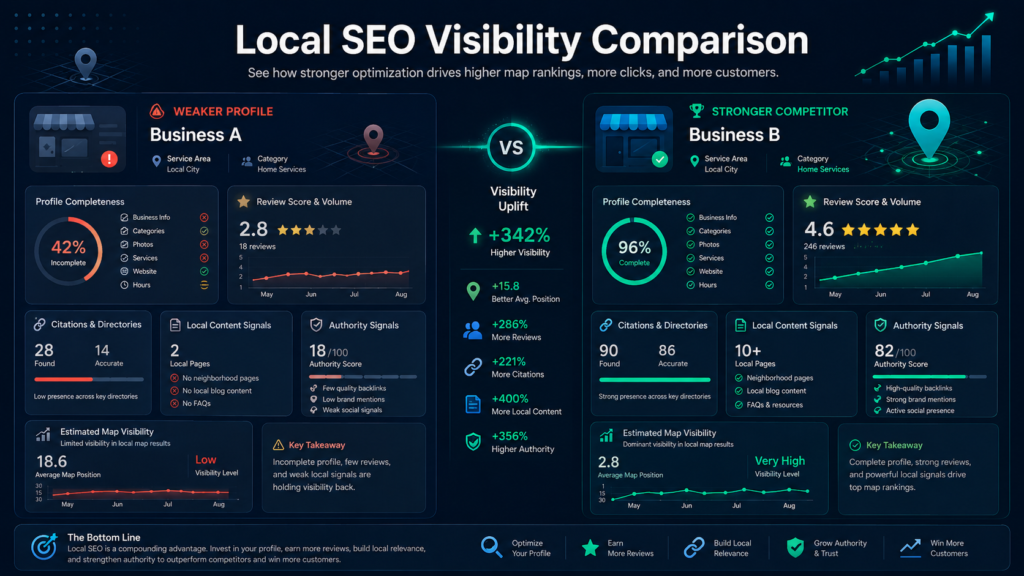
Sometimes your profile is not necessarily bad. Your competitors are simply stronger.
They may have:
- More quality reviews
- Better optimized profiles
- Stronger backlinks
- More relevant local citations
- Better service pages
- More local content
- Stronger brand recognition
- Higher engagement from searchers
This is why competitor analysis is important. Local SEO is relative. You are not trying to reach an abstract score. You are trying to outperform the businesses currently ranking in the Map Pack.
If all top competitors have hundreds of reviews, strong websites, and years of local authority, a basic profile update will not be enough.
Your GBP Category Is Wrong or Too Broad
The primary Google Business Profile category can heavily influence where you appear.
If the category does not match the search intent, you may not rank even if your business technically offers the service.
For example:
- A “marketing agency” may not rank well for SEO-related local searches if the profile does not clearly support SEO services.
- A “contractor” may not rank for specific services like roofing, electrical work, or remodeling unless the category and services align.
- A “beauty salon” may struggle for specific treatment searches if more specific categories are available.
Category selection should be based on your actual services and competitor research, not guesswork.
Your Service Area Setup Is Confusing
Service-area businesses often struggle with Google Maps rankings because they do not operate like traditional storefronts.
Common issues include:
- Service areas set too broadly
- No strong local landing pages
- Hidden address with weak location signals
- Confusing business model
- Multiple profiles for overlapping areas
- Weak proof of local relevance
If you serve multiple cities, you need a scalable Local Maps SEO strategy. Simply adding a long list of service areas inside GBP usually does not create strong visibility in each city.
For multi-location or multi-city businesses, Google needs clear signals that each location or service area is legitimate and relevant.
Your Local Landing Pages Are Thin or Missing
Location pages can support Google Maps rankings when they are useful and specific.
A weak location page usually looks like this:
- Same content copied across multiple cities
- Only city name changed
- No real local value
- No unique service details
- No local proof
- No Internal Links
- No FAQ or structured content
A strong local landing page should include:
- Clear service information
- Location relevance
- Local examples where possible
- Testimonials or proof
- FAQs
- Internal Links
- Strong metadata
- Clear calls to action
Location pages should not exist only for keywords. They should help users understand what you offer in that area.
Technical SEO Problems Are Holding You Back
Technical SEO may not be the first thing people think about with Google Maps, but it still matters.
If your website is slow, hard to crawl, poorly structured, or not mobile-friendly, it can weaken the website signals connected to your local profile.
Technical issues that can affect local visibility include:
- Slow mobile performance
- Broken pages
- Indexing problems
- Bad redirects
- Duplicate pages
- Missing or incorrect canonical tags
- Poor Internal Linking
- Weak schema markup
- Mobile usability issues
Many local searches happen on mobile devices. If your site loads slowly or creates a poor user experience, rankings and conversions can both suffer.
You Are in a Competitive Local Market
Some niches are naturally more competitive than others.
Examples include:
- Pest control
- Moving companies
- Dentists
- Personal injury lawyers
- HVAC companies
- Plumbers
- Real estate agents
- Med spas
- Cleaning companies
- Roofing companies
In these markets, Google Maps SEO optimization requires more than basic setup. You may need an ongoing strategy that includes GBP optimization, review growth, citations, content, backlinks, website improvements, and competitor tracking.
Why Businesses Suddenly Lose Google Maps Rankings
Sometimes a business was ranking well and then suddenly drops. This can happen for several reasons.
Competitors Improved Their SEO
If competitors gain reviews, update profiles, build links, improve websites, or expand content, they can push your listing down.
Local rankings are dynamic. Staying still can mean falling behind.
Google Updated Local Ranking Systems
Google regularly updates local search systems. Sometimes rankings shift even when you did not change anything.
A drop after an update does not always mean your profile is penalized. It may mean Google is weighting certain signals differently.
Your Profile Was Edited
Small edits can sometimes affect visibility, especially category changes, business name changes, address changes, or service area updates.
If rankings drop after profile changes, those edits should be reviewed carefully.
Reviews Slowed Down or Competitors Gained More
If competitors are collecting reviews consistently and your profile has gone quiet, your prominence may weaken over time.
Citation or Website Issues Appeared
A website redesign, broken landing page, changed phone number, or lost citation consistency can affect local trust signals.
Suspensions or Verification Issues
If your profile was suspended, reinstated, or required reverification, visibility can fluctuate.
Quick Fixes That Can Improve Google Maps Rankings
Not every issue requires a complete SEO rebuild. Some improvements can be made quickly.
Start with these steps:
- Review your primary and secondary GBP categories.
- Complete every important Google Business Profile field.
- Add clear services and descriptions.
- Upload fresh, relevant photos.
- Ask satisfied customers for reviews consistently.
- Respond to reviews professionally.
- Check NAP consistency across major directories.
- Improve service and location pages on your website.
- Add Internal Links to important local pages.
- Check mobile speed and usability.
- Review competitors ranking in the Map Pack.
- Track rankings from different nearby locations.
These fixes can help, but competitive markets often require a deeper strategy.
When DIY Google Maps SEO Stops Working
Many businesses can handle basic Google Business Profile updates themselves. But DIY optimization often stops working when:
- You are in a competitive local niche
- Competitors have stronger websites
- You manage multiple locations
- Rankings vary across cities
- Your profile keeps dropping
- You are not sure which ranking factor is the problem
- Reviews and citations are inconsistent
- Your site does not support local relevance
- You need measurable lead growth, not just profile updates
At that point, professional Google Maps SEO services can help identify the biggest gaps and prioritize the work that is most likely to improve rankings.
A proper Local Maps SEO strategy should include profile optimization, competitor analysis, citation cleanup, review strategy, local content, technical SEO, and ongoing tracking.
Struggling to Rank in Google Maps?
If your business is not showing in Google Maps, the problem is usually not one single factor. It is often a combination of profile gaps, weak reviews, inconsistent citations, poor local website signals, and stronger competitors.
A focused Local Maps SEO strategy can help identify what is holding you back and create a clear path toward better visibility.
We can review your Google Business Profile, website, local competitors, and ranking gaps to show what needs to improve first.