

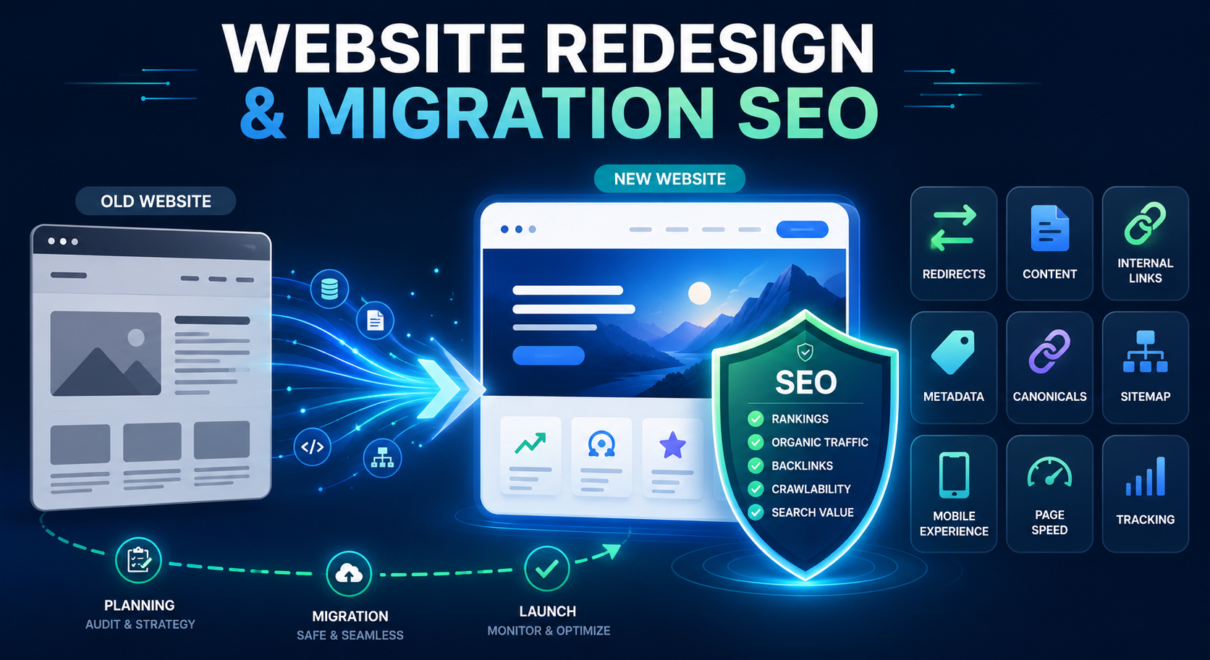
A website redesign and a website migration are both major changes. When they happen together, the SEO risk becomes much higher.
A redesign can change content, layouts, headings, internal links, navigation, templates, mobile experience, and page speed. A migration can change URLs, hosting, CMS, redirects, canonicals, sitemaps, and indexation settings.
Individually, each change can affect rankings. Together, they can cause serious organic traffic loss if SEO is not included before launch.
That is why SEO for website redesign and migration should be planned before the new site goes live, especially when design, content, URLs, hosting, and CMS structure are changing at the same time.
The goal is not only to launch a better website. The goal is to launch a better website while protecting the search visibility, rankings, backlinks, and organic traffic the old website has already earned.
This guide explains what to check before launching a redesigned or migrated website, including URLs, redirects, content, internal links, metadata, indexation, technical settings, and post-launch validation.
Why Redesign and Migration Create Higher SEO Risk
A redesign changes how the website looks and functions. A migration changes how the website is technically structured, hosted, organized, or delivered.
When both happen together, many SEO signals can change at once, including URL structure, page templates, content depth, headings, title tags, meta descriptions, internal links, navigation, canonicals, redirects, XML sitemaps, robots.txt rules, structured data, page speed, mobile experience, and tracking.
Search engines rely on consistency. If too many signals change without a clear plan, Google may need to reprocess the website and re-evaluate important pages.
Some fluctuation after a major launch is normal. But large ranking drops often happen because important SEO elements were removed, blocked, redirected incorrectly, or weakened during the process.
In practice, SEO migration when redesigning website structure is more complex than a simple design refresh because both visual and technical signals may change at once.
Start With a Full Pre-Launch SEO Inventory
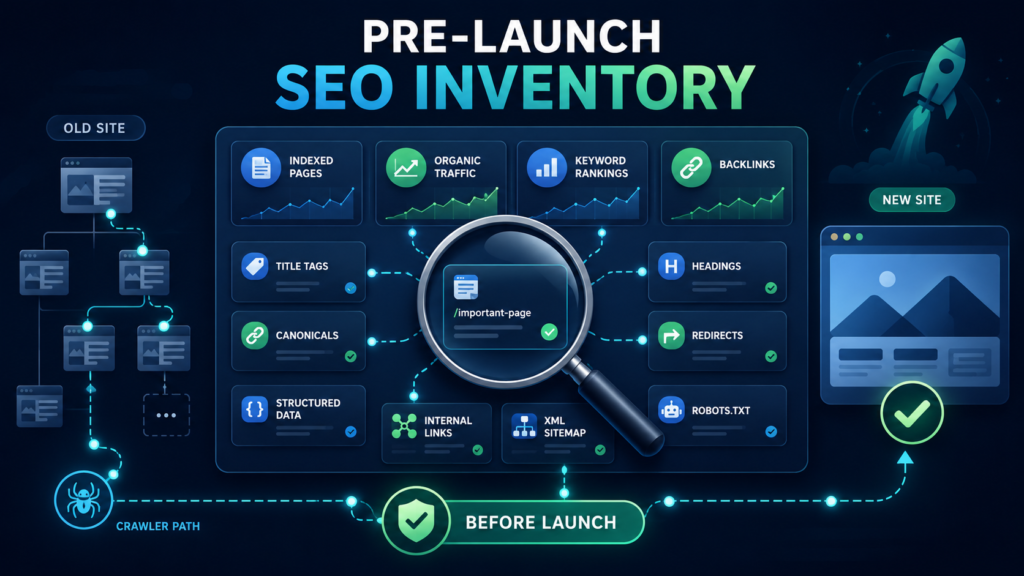
Before redesigning or migrating the site, document what currently exists.
A pre-launch SEO inventory should include:
- all current indexable URLs
- organic traffic by page
- current keyword rankings
- pages with backlinks
- top landing pages
- service, product, category, and location pages
- high-performing blog articles
- title tags and meta descriptions
- H1 and H2 headings
- canonical tags
- current redirects
- structured data
- internal links
- XML sitemaps
- robots.txt rules
- Google Search Console data
A crawl of the existing website is especially important.
After launch, you can compare the new site against the old crawl to identify missing pages, changed metadata, broken links, incorrect canonicals, or unexpected noindex tags.
Without this baseline, it becomes harder to know whether a ranking drop came from the redesign, the migration, tracking, content changes, or technical mistakes.
Identify High-Value Pages Before Making Changes

Not every page needs the same level of protection.
Before redesign and migration, identify the pages that are most valuable for SEO and business performance.
These may include pages with organic traffic, backlinks, commercial keyword rankings, leads, sales, strong internal links, or important visibility in Google Search Console.
For each high-value page, decide what will happen during the launch:
- Will the URL stay the same?
- Will the content be rewritten?
- Will the page be merged?
- Will it be redirected?
- Will it remain indexable?
- Will internal links still point to it?
If a page already brings traffic or conversions, it should be protected intentionally.
These website redesign SEO considerations are especially important when the redesign also involves URL changes, CMS changes, hosting changes, or a wider site migration.
Keep Important URLs the Same When Possible
URL changes are one of the biggest risks during redesign and migration.
If a page already ranks well, has backlinks, and serves the same purpose after launch, keeping the same URL is usually the safest option.
If URL changes are necessary, each old URL should redirect to the most relevant new URL.
For example:
- old service page → new equivalent service page
- old category page → new equivalent category page
- old blog post → updated version of the same blog post
- old location page → new equivalent location page
- old product page → same or closest matching product page
Avoid redirecting large groups of pages to the homepage unless there is no relevant alternative. Homepage redirects are often too broad and may not preserve topical relevance.
Build a Clean Redirect Map
A redirect map connects old URLs to new URLs.
It should be prepared before launch and tested immediately after launch.
A good redirect map should include:
- old URL
- new destination URL
- status code
- page type
- priority level
- traffic/ranking value
- backlink value
- notes for merged or removed pages
Use 301 redirects for permanent page moves.
Redirects should be relevant, direct, one-to-one where possible, free from chains, free from loops, and tested before launch.
Developers may implement redirects correctly from a technical perspective, but the SEO value depends on choosing the right destination for each old URL.
Preserve Important Content
During redesign, content often gets shortened to fit a cleaner layout.
This can be risky.
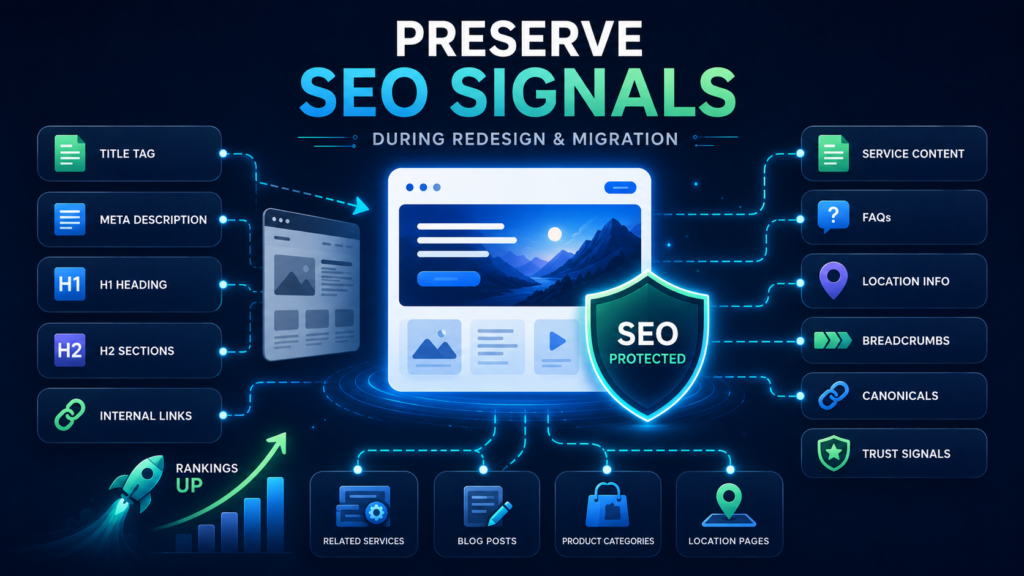
A page may rank because it explains a service in detail, answers important questions, includes location-specific information, covers subtopics, or provides useful supporting content. If the redesigned version removes that depth, rankings may drop.
Before launching, compare old and new versions of important pages.
Check whether the new page preserves:
- core service descriptions
- product/category descriptions
- FAQs
- location-specific information
- comparison sections
- technical explanations
- trust signals
- case studies
- internal links
- supporting paragraphs
- relevant headings
The new version does not need to copy the old site word for word. But it should not become thinner or less relevant.
When planning SEO for website redesign and migration, content preservation should be treated as a ranking protection step, not only a copywriting or design decision.
Review Metadata and Heading Structure
Metadata can change unexpectedly during redesign and migration, especially when moving to a new CMS, theme, page builder, or SEO plugin setup.
Before launch, check important pages for:
- title tags
- meta descriptions
- H1 headings
- H2 headings
- canonical tags
- Open Graph tags if relevant
Title tags should remain focused and relevant. A page that previously targeted a strong service keyword should not launch with a generic title like “Services” or “Home.”
H1 headings should clearly describe the page topic. Each important page should have one main heading that aligns with the content and intent of the page.
Protect Internal Linking and Navigation
Internal links help search engines understand which pages are important and how topics are connected.
A redesign can accidentally weaken internal linking.
Common issues include:
- important service pages removed from navigation
- blog-to-service links deleted
- footer links removed
- related page sections changed to non-crawlable elements
- breadcrumb links removed
- category links hidden behind scripts
- orphan pages created
Important pages should still be accessible from logical places such as the main navigation, homepage sections, related service pages, blog articles, category pages, breadcrumbs, and contextual content sections.
A redesigned site should be easier to navigate, not harder for search engines to crawl.
Check Canonicals, Noindex Tags, and Robots.txt
Canonical tags tell search engines which version of a page is the preferred version.
During migration or redesign, canonicals can easily break.
Check that canonical tags:
- point to the correct live URL
- do not point to staging URLs
- do not point to old domains
- do not point to HTTP versions
- do not point to unrelated pages
- match the preferred www or non-www version
- are self-referencing where appropriate
- are consistent with the sitemap
Also check that important live pages do not have:
- noindex tags
- X-Robots-Tag noindex headers
- robots.txt blocks
- password protection
- blocked CSS or JavaScript resources
- staging-only restrictions
A noindex or robots.txt mistake can cause severe visibility loss after launch.
The most important SEO considerations for website redesign are not only visual. They include preserving ranking content, redirects, crawlability, indexation, internal links, page speed, and tracking.
Validate XML Sitemaps and Structured Data
The XML sitemap should reflect the new website structure after launch.
It should include only URLs that are live, canonical, indexable, important, and returning 200 status codes.
It should not include staging URLs, old URLs, redirected URLs, noindex URLs, 404 pages, duplicate versions, test pages, or parameter URLs unless intentionally included.
If the old website used structured data, make sure it is not lost during redesign or migration.
Structured data may include:
- Organization schema
- LocalBusiness schema
- BreadcrumbList schema
- Product schema
- Article schema
- FAQPage schema
- Review schema where appropriate
- Service schema where appropriate
After launch, validate structured data on important page types and fix errors.
Review Mobile Experience and Page Speed
Many redesigns look good on desktop but create mobile or performance issues.
Check mobile pages for:
- page layout
- visible content
- navigation
- menu behavior
- tap targets
- font size
- forms
- calls to action
- page speed
- image scaling
- layout stability
- internal links
Important content should not disappear from mobile pages.
Also test page speed before and after launch.
Review:
- Largest Contentful Paint
- Interaction to Next Paint
- Cumulative Layout Shift
- server response time
- image optimization
- render-blocking resources
- caching
- CDN setup
- font loading
- script bloat
- mobile performance
A redesign should improve user experience, not create a slower site.
Confirm Analytics and Conversion Tracking
A launch can break tracking even when SEO is technically fine.
After redesign and migration, confirm that analytics and conversions are tracked correctly.
Check:
- Google Analytics
- Google Tag Manager
- Search Console verification
- form submissions
- phone clicks
- ecommerce transactions
- contact page events
- thank-you pages
- CRM integrations
- call tracking
- lead source attribution
- consent banner behavior
If tracking breaks, it may appear that traffic or leads dropped when the actual issue is measurement.
This is why website migration and SEO planning should include both search visibility checks and business tracking validation.
Crawl the New Site After Launch
Once the new site is live, crawl it immediately and compare the new crawl with the old crawl.
Look for:
- missing pages
- changed status codes
- 404 errors
- redirect chains
- redirect loops
- missing title tags
- duplicate title tags
- missing H1 headings
- noindex pages
- canonical errors
- broken internal links
- blocked resources
- sitemap errors
- structured data issues
- unexpected URL changes
This post-launch crawl is one of the fastest ways to catch problems.
Monitor Google Search Console and Rankings
Google Search Console should be monitored closely after launch.
Check:
- page indexing report
- sitemap status
- crawl errors
- server errors
- redirect errors
- canonical issues
- excluded pages
- mobile usability
- Core Web Vitals
- impressions
- clicks
- top pages
- top queries
Also track rankings and organic traffic.
Some fluctuation is normal, but large drops should be investigated quickly.
If traffic drops, check whether the issue is related to removed content, changed URLs, missing redirects, noindex tags, robots.txt blocks, canonical errors, broken internal links, lost metadata, slower page speed, broken tracking, or indexing delays.
Common SEO Mistakes During Redesign and Migration
Many ranking drops after redesign or migration are avoidable.
Common mistakes include:
- launching without a pre-migration crawl
- changing URLs without redirects
- redirecting too many pages to the homepage
- deleting pages with rankings or backlinks
- removing important content
- replacing strong pages with thin pages
- losing title tags and headings
- weakening internal links
- removing structured data
- leaving noindex tags on live pages
- blocking Google in robots.txt
- launching with staging canonicals
- submitting incorrect sitemaps
- creating redirect chains
- slowing the site with heavy design elements
- forgetting tracking and conversion setup
- not checking Search Console after launch
The best way to avoid these mistakes is to involve SEO before launch, not after traffic drops.
Pre-Launch SEO Checklist for Redesign and Migration
Before launching, review this checklist:
- Crawl the current website
- Export traffic and ranking data
- Identify high-value SEO pages
- Review pages with backlinks
- Confirm whether URLs will change
- Create a redirect map
- Preserve important content
- Review title tags and meta descriptions
- Check H1 and H2 headings
- Protect internal links
- Review navigation and site structure
- Validate canonical tags
- Check noindex and robots.txt rules
- Prepare XML sitemap
- Preserve structured data
- Test staging site
- Review mobile experience
- Test page speed
- Confirm analytics tracking
- Prepare post-launch monitoring
- Crawl the live site after launch
- Monitor Google Search Console
This checklist does not replace a full audit, but it covers the main areas where redesign and migration problems usually happen.
When to Get an SEO Migration Audit
A professional SEO migration audit is useful when the website already gets organic traffic, has important rankings, or depends on search for leads and sales.
It is especially important if:
- the website is being redesigned
- the site is changing CMS
- URLs are changing
- the domain is changing
- hosting is changing
- ecommerce pages are involved
- location pages are involved
- many pages are being merged or removed
- the site has valuable backlinks
- previous launches caused traffic loss
- the development team is not focused on SEO
A migration audit can review the old site, staging site, redirect plan, content changes, technical settings, indexation rules, and post-launch risks.
The goal is to prevent avoidable traffic loss before the site goes live.
Launch a Better Website Without Losing Search Visibility
A redesign and migration should improve the website without sacrificing the SEO value already built over time.
The safest approach is to plan before launch, protect important pages, preserve useful content, map redirects carefully, validate technical settings, test staging, and monitor performance after the site goes live.
A successful redesign and migration should make the website stronger for users while keeping search engines clear on what changed, what moved, and which pages still matter.
If organic traffic is important to the business, SEO for website redesign and migration should be handled before launch. An SEO migration audit can help identify risks early and protect rankings during the transition.