

A Google rankings drop after an update can be stressful, especially if your website was previously stable. Important keywords may fall several positions, organic traffic may decline, and pages that used to bring leads or sales may suddenly perform worse.
When this happens, many website owners assume they were penalized. But most ranking drops after Google updates are not manual penalties. More often, Google has changed how it evaluates pages, search intent, content quality, authority, trust signals, spam patterns, or competitor relevance.
That means the right response is not panic. It is diagnosis.
Before rewriting pages, deleting content, changing URLs, or building new links, you need to understand what changed, which pages were affected, and whether the drop is really connected to the update.
This guide explains how to diagnose a Google rankings drop after an update and how to start building a practical recovery plan.
Google Updates Can Affect Rankings in Different Ways
Google releases many types of updates. Some are broad core updates. Others focus on spam, product reviews, helpful content signals, local search, links, or technical quality. Some updates are confirmed publicly, while many smaller changes happen without major announcements.
A rankings drop after an update can happen because Google reassessed:
- content quality
- search intent match
- topical relevance
- trust and authority
- backlink quality
- spam signals
- page experience
- local relevance
- competitor strength
- website structure
- freshness and usefulness of content
This does not always mean your site did something wrong. Sometimes competitors improved. Sometimes Google changed the type of pages it prefers for a query. Sometimes your page still has value, but it no longer satisfies the dominant search intent as well as other results.
That is why diagnosis matters. A recovery plan should be based on the pattern of the drop, not assumptions.
First, Confirm the Drop Matches a Google Update
The first step is to confirm whether the ranking drop actually lines up with a Google update.
Start by identifying the exact date when rankings or organic traffic started declining. Then compare that date with known Google update timelines.
Check:
- Google Search Console performance data
- ranking tracker data
- organic traffic in analytics
- affected keywords
- affected pages
- known Google update dates
- industry volatility
- competitor movement
If your decline started before the update, the update may not be the main cause. If the decline started during or shortly after the update, there may be a connection. If the drop happened weeks later, you need to look more carefully before blaming the update.
Read more in this article: “How Can I Check Why My Rankings Dropped?“
Also remember that Google updates can roll out over days or weeks. Rankings may fluctuate during that period. A page may drop, recover, and drop again before results stabilize.
Do not make major changes during the middle of an update rollout unless there is a clear technical issue.
Check Whether the Drop Is Sitewide or Page-Specific
The pattern of the decline is one of the most important clues.
A sitewide decline may suggest a broader quality, trust, technical, or algorithmic issue. A page-specific decline may point to content relevance, search intent, competitor improvements, internal links, or backlinks affecting certain URLs.
Review whether the drop affected:
- the whole website
- one section of the site
- one content type
- one service category
- one product category
- several blog posts
- several location pages
- only non-branded keywords
- only local keywords
- only mobile or desktop rankings
For example, if only blog articles dropped, the issue may be related to informational content quality or search intent. If service pages dropped, the issue may involve commercial page depth, trust signals, competitor improvements, or authority. If product category pages dropped, ecommerce structure, thin content, duplicate content, or internal linking may be involved.
If all major sections dropped at once, technical SEO, sitewide quality signals, or a broad algorithmic reassessment may be more likely.
Review Google Search Console Data
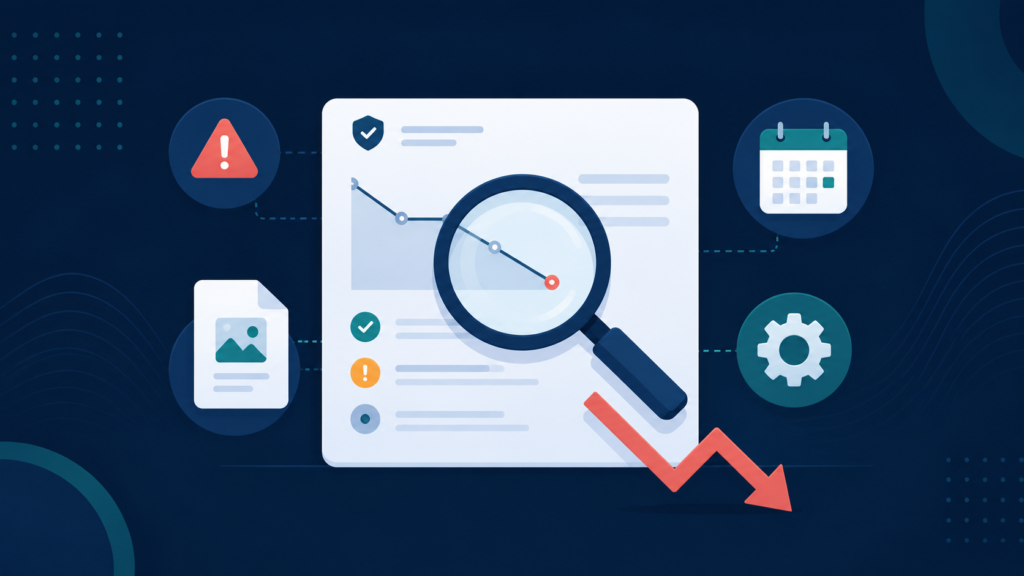
Google Search Console is essential for diagnosing rankings and traffic drops after an update.
Open the Performance report and compare data before and after the update.
Look at:
- clicks
- impressions
- average position
- click-through rate
- affected queries
- affected pages
- countries
- devices
- search appearance
The data pattern matters.
If impressions dropped, Google is showing your pages less often. This usually indicates ranking loss, reduced relevance, indexing changes, or lower search demand.
If impressions stayed stable but clicks dropped, the issue may involve lower click-through rate, changed SERP layout, new ads, AI-style summaries, featured snippets, local packs, or stronger competitor titles.
If average position declined for important queries, compare your page with the pages that replaced it. The update may have changed which pages Google considers most useful for that search.
Focus first on the URLs that lost the most clicks or impressions. These pages usually have the greatest business impact.
Compare Affected Pages Against Current Top Results
A Google update often changes the competitive landscape. Pages that ranked well before may be replaced by pages Google now considers more relevant, trustworthy, complete, or useful.
For each affected page, manually review the current search results.
Compare your page with the top-ranking competitors based on:
- search intent match
- content depth
- freshness
- heading structure
- topical coverage
- examples and explanations
- FAQs
- trust signals
- author or business credibility
- internal links
- external links or citations
- page experience
- content format
- local relevance if applicable
- product or service detail
Do not copy competitors. The goal is to understand why Google may now prefer them.
For example, if a service page dropped and competitors now provide clearer pricing guidance, FAQs, case examples, stronger location signals, and better trust elements, your page may need more than keyword edits. It may need stronger usefulness and credibility.
If a blog article dropped and the current top results are more updated, better structured, and more complete, a content refresh may be needed.
Check Search Intent Changes
Search intent changes are a common cause of rankings drops after updates.
Google may decide that users searching a keyword want a different type of result than before.
For example:
- blog posts may be replaced by service pages
- product pages may be replaced by category pages
- general guides may be replaced by comparison pages
- national results may be replaced by local results
- older informational pages may be replaced by fresher content
- smaller sites may be replaced by stronger authority sites
- short articles may be replaced by deeper guides
This can affect rankings even if your page did not technically get worse.
Ask:
- What type of pages are ranking now?
- Are results more commercial than before?
- Are results more informational than before?
- Are local results appearing?
- Are larger brands dominating?
- Are pages with stronger firsthand detail ranking?
- Is Google showing videos, images, shopping results, or AI summaries?
- Does your page still match the dominant intent?
If your page no longer matches search intent, recovery may require repositioning the page, changing structure, adding missing sections, or targeting a more appropriate keyword variation.
Review Content Quality and Usefulness
Many Google updates affect how content is evaluated. That does not mean every affected page is low-quality. It means the content may no longer be strong enough compared with what Google now rewards.
Review affected pages for:
- outdated information
- thin explanations
- generic paragraphs
- missing subtopics
- weak headings
- lack of examples
- repeated content across pages
- weak formatting
- missing FAQs
- lack of clear next steps
- poor alignment with search intent
- weak trust signals
- over-optimized or unnatural keyword use
- content written mainly to rank rather than help
For commercial pages, also check whether the page clearly explains the service, who it is for, what problems it solves, what makes the business credible, and what the user should do next.
For blog content, check whether the article fully answers the searcher’s question and whether it connects naturally to relevant service or supporting pages.
For ecommerce pages, review category content, product descriptions, filters, duplicate content, structured data, internal links, and buyer guidance.
Content recovery should be thoughtful. Do not simply add more words. Add useful information that better satisfies the query.
Check E-E-A-T and Trust Signals
E-E-A-T stands for experience, expertise, authoritativeness, and trustworthiness. It is not a single ranking factor, but it reflects the types of quality signals Google’s systems and evaluators may look for.
If rankings dropped after an update, review whether affected pages show enough credibility.
Useful trust signals may include:
- clear business information
- author or reviewer information where appropriate
- real expertise or experience
- client examples or case studies
- testimonials or reviews
- transparent service details
- accurate contact information
- updated content
- clear policies where relevant
- references or supporting sources where useful
- strong About page
- consistent brand information
- secure website experience
This is especially important in industries where trust matters, such as finance, legal, medical, health, ecommerce, local services, and professional consulting.
A page may have good SEO structure but still feel weak if users cannot tell who is behind the content, why they should trust it, or whether the business is credible.
Check Technical SEO Issues
A ranking drop that happens around a Google update may still be caused by technical issues.
Do not assume the update is the only reason.
Technical problems can appear at the same time because of plugin updates, CMS changes, theme changes, server issues, or development work.
Check:
- noindex tags
- robots.txt blocks
- incorrect canonical tags
- redirect problems
- 404 errors
- soft 404s
- crawl errors
- sitemap issues
- server errors
- mobile usability problems
- slow loading pages
- duplicate pages
- broken internal links
- orphan pages
- schema errors
- pages removed from navigation
If Google cannot crawl or understand important pages properly, rankings may drop regardless of content quality.
Technical checks are especially important if the ranking decline happened shortly after a redesign, migration, hosting change, or template update.
Review Backlinks and Authority Signals
Backlinks may not be the only cause of a rankings drop, but they should be part of the investigation.
Google updates can also change how certain links are valued. A site may lose visibility if some links are discounted, removed, changed, or outpaced by competitors.
Review:
- lost referring domains
- links lost around the drop date
- backlinks to affected pages
- links pointing to 404 URLs
- redirects from old linked pages
- links changed to nofollow
- competitor backlink growth
- low-quality link patterns
- anchor text distribution
If competitors gained strong links while your site stayed the same, your rankings may decline because the competitive gap increased.
If your site lost valuable backlinks, recovery may involve redirecting old linked URLs, rebuilding important links, improving linkable assets, or earning new relevant mentions.
Backlinks should be evaluated with context. A single lost link may not matter, but several strong lost links to priority pages can affect visibility.
Check Local SEO Signals if Local Rankings Dropped
If your rankings drop affects local searches or Google Maps visibility, review local SEO separately.
Google updates can affect local rankings, and local results are influenced by more than website content.
Check:
- Google Business Profile categories
- business name accuracy
- address or service area changes
- phone number consistency
- review growth or slowdown
- competitor reviews
- duplicate listings
- citation consistency
- local landing page strength
- proximity patterns
- map grid rankings
- location-specific content
- local backlinks or mentions
A business may lose local visibility even if its website pages are still indexed. For local SEO, Google Business Profile signals, reviews, proximity, citations, and location relevance all matter.
For multi-location businesses, review each location separately. One branch may decline while another remains stable.
Avoid Common Recovery Mistakes
After a Google rankings drop, the wrong response can make recovery harder.
Avoid these common mistakes:
- changing every page at once
- deleting content without analysis
- changing URLs without redirects
- stuffing keywords into affected pages
- assuming it is definitely a penalty
- building random backlinks immediately
- ignoring technical issues
- copying competitors too closely
- reacting before the update finishes rolling out
- focusing only on traffic instead of affected pages and queries
- making changes without documenting them
A better approach is to investigate first, make prioritized updates, and monitor results.
If you change too many things at once, it becomes difficult to know what helped or hurt.
Build a Recovery Roadmap
Once you understand the likely cause of the drop, build a recovery roadmap.
A practical recovery plan may include:
- fixing indexing or crawl issues
- correcting redirects or canonical tags
- updating affected content
- improving search intent alignment
- strengthening trust signals
- adding missing sections or FAQs
- improving internal links
- refreshing outdated pages
- improving local SEO signals
- recovering valuable backlinks
- redirecting old linked URLs
- building relevant authority
- monitoring affected keywords and pages
Prioritize the pages with the greatest business value first.
For example, if a service page that generated leads dropped, it should usually be reviewed before low-value informational content. If an ecommerce category page lost visibility, that may be more urgent than a blog article with little commercial value.
Recovery should be based on impact, not just the number of affected URLs.
When You Need a Google Rankings Drop Audit
A professional Google rankings drop audit is useful when the decline is significant, unclear, or connected to business results.
An audit is especially helpful when:
- rankings dropped after a known Google update
- several important pages lost visibility
- organic traffic also declined
- leads or sales dropped
- the cause is not obvious
- competitors moved ahead suddenly
- technical issues may be involved
- content quality needs deeper review
- the site recently migrated or redesigned
- previous SEO work may have caused problems
- you need a clear recovery roadmap
A proper audit should review the update timing, affected pages, affected keywords, technical issues, content quality, search intent, backlinks, internal links, competitors, and recovery priorities.
The goal is not just to confirm that rankings dropped. The goal is to identify what changed and what should be fixed first.
Diagnose the Update Impact Before Making Changes
A Google rankings drop after an update can happen for many reasons. It may be related to content quality, search intent, technical SEO, backlinks, trust signals, local SEO, or competitor improvements.
The worst response is to make random changes without understanding the pattern.
Start by confirming the timing, identifying affected pages and keywords, reviewing Search Console data, comparing current SERPs, checking technical issues, and analyzing competitors. Once the cause is clearer, recovery becomes more focused.
If the decline is significant or unclear, a rankings and traffic loss audit can help identify what happened and turn the investigation into a practical recovery roadmap.