
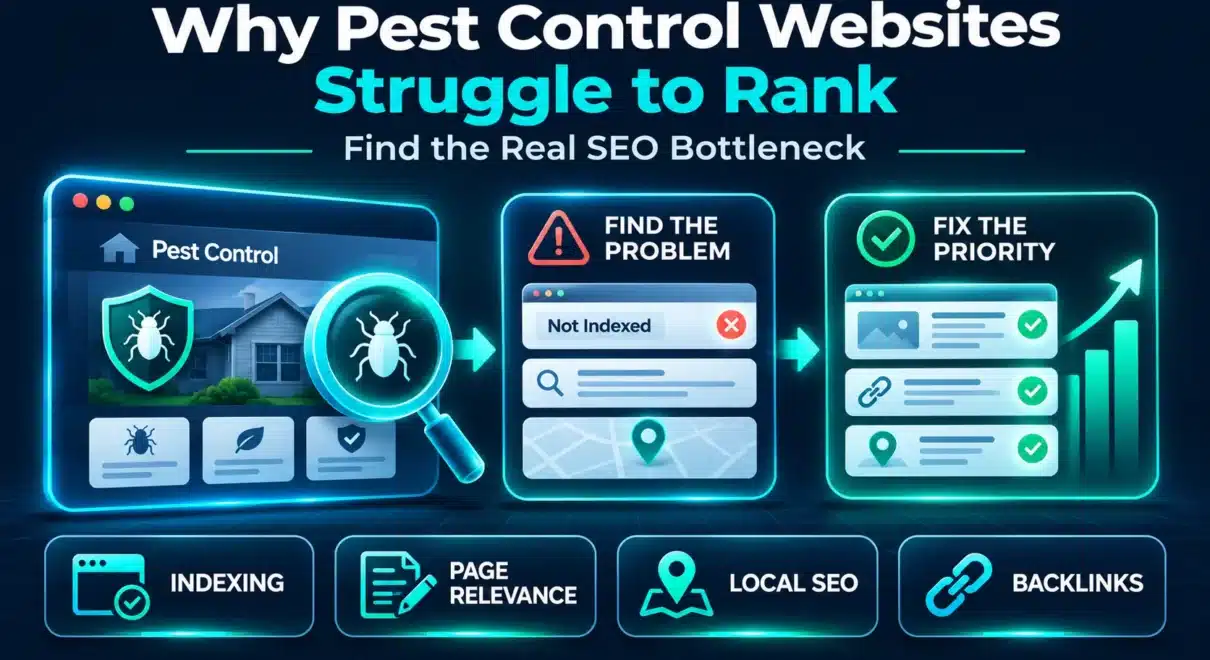
A pest control website can look professional, offer excellent service, and still barely appear when homeowners search for an exterminator nearby. The underlying issue is often more specific than “Google doesn’t like the website.” An important page may not be indexed, the wrong URL may be targeting the city, the content may not answer the treatment-related query, or competitors may have stronger authority and local signals.
The fastest way to improve rankings is to identify which kind of visibility problem you actually have. Fixing an indexing issue is very different from strengthening a page that already ranks at position 12. And improving a Google Business Profile is not the same task as improving organic search visibility.
This diagnostic guide shows pest control companies how to recognize the problem, find the most likely bottleneck, and choose the next SEO action. It draws on our 30-city Pest Control SEO Study, which analyzed 300 organic results, ranking page types, website content and backlinks, and Google Maps observations.
First, Identify the Type of Ranking Problem
Before changing your homepage, adding another city page, or ordering new backlinks, check which of these situations describes your business. The symptoms determine what to investigate.
| What you see | Most useful first investigation | Typical next move |
|---|---|---|
| Important service page is missing from Google | Indexing, HTTP status, canonical and noindex settings | Restore accessibility and the intended indexable URL |
| Page is indexed but receives almost no impressions | Keyword intent, geographic relevance and internal discovery | Clarify which query and location the page serves |
| Search Console shows impressions, but rankings stay low | Competitors’ landing pages, content usefulness and authority | Strengthen the relevant page and its supporting signals |
| Homepage ranks, but termite or rodent searches do not | Missing or poorly connected treatment-specific pages | Build or improve the correct service destination |
| Organic site appears, but Google Maps visibility is weak | Business Profile, eligibility, categories, proximity and reputation | Work on GBP and local prominence separately |
| Rankings exist, but visitors rarely call | Search intent, contact paths, mobile experience and offer | Improve the landing-page journey and lead tracking |
This table is a routing tool, not a checklist of everything to do at once. A missing page needs a technical answer. An indexed page stuck below competitors needs a competitive answer. A company that gets visits but few calls has a conversion problem that may be separate from ranking.
Run three checks before diagnosing competitors
Open Google Search Console and compare the important queries, landing pages, impressions and clicks. Inspect one page that should rank for the primary city and one treatment page, such as termite control or rodent removal. Then examine the actual organic Top 10 and Google Maps results for the same search and location.
A service page should have a clear intended query, a valid URL, and a purpose that is distinct from other pages on the site. Once you know those three things, the remaining investigation becomes much more focused.
Problem 1: Google Cannot Find or Select the Right Page
A valuable service page may be absent from search because it returns an error, carries an accidental noindex directive, redirects somewhere irrelevant, or has a canonical pointing to another page. The page can also exist but be poorly linked from the rest of the site, making discovery and evaluation harder.
Look up the exact URL in Search Console’s URL Inspection tool. Check whether it is indexed, whether Google selected the expected canonical, and whether the live page can be retrieved. Look at internal links from the homepage, services menu, and related treatment pages. Don’t assume a URL is indexed just because it is present in an XML sitemap.
A common practical scenario is a website redesign that changes /termite-control/ to /pest-services/termites/ but leaves old navigation links, redirects, or canonicals inconsistent. Another is an important city landing page accidentally set to noindex after a staging-to-live migration. Until the intended destination is accessible and indexable, additional content and link-building activity aimed at that URL is premature.
Recommended action: Fix the actual accessibility or canonical problem, reconnect the page through logical internal links, then request reindexing when appropriate. Google’s URL Inspection guidance provides the right starting point for this check.
Problem 2: Your Website Targets the Wrong Search Intent
A homepage about general pest control is not necessarily the best answer for “bed bug heat treatment in [city].” Similarly, a blog post about signs of termites may attract research-oriented visitors while a person requesting a termite inspection needs a service page with availability, process, qualifications, and a clear inquiry path.
Identify the searcher’s job to be done. Broad “pest control [city]” searches may surface homepages or established local landing pages. Service-specific searches often benefit from a clearly targeted treatment page. Searches about costs, identification, or preparation may favor explanatory guides. The right page type should be chosen from the real results, not assumed from a keyword spreadsheet.
What our study found about ranking page types
Our organic rankings analysis found that, of 300 Top 10 result appearances across 30 cities, 195 belonged to pest-control companies. Among those company appearances, 105 were inner pages and 90 were homepages. Inner pages included branch, location, and other landing pages, not just city pages.

That near-even split tells us something operationally useful: there is no reason to create a new city page automatically for every market. First determine whether your best existing page already serves the query. Then improve that page, or create a genuinely distinct service or location destination when the search requires one.
Recommended action: Map one primary URL to each important service-and-location intent. Check if multiple URLs are competing for the same query in Search Console before introducing another. For a full website architecture decision framework, see our Pest Control SEO Playbook.
Problem 3: The Landing Page Is Too Generic for the City or Pest Problem
Weak local relevance is more than forgetting a city name in the title. A page can mention “pest control Denver” ten times yet fail to explain which problems the company treats, what an inspection involves, which areas technicians cover, and how customers can book an appointment.
Pest control searches are often urgent and specific. A homeowner with rodents in an attic wants to know whether the company performs inspection, exclusion, removal, and follow-up. A commercial client may need documentation, recurring service information, or restricted operating hours. A useful page addresses those questions directly instead of relying on generic claims such as “fast, reliable and affordable exterminators.”
Local relevance patterns from ranking websites
Our study’s saved HTML evidence covered 190 pest-control company ranking appearances. The searched city or an accepted geographic variation appeared in 182 page bodies and 176 HTML titles. 167 pages linked to distinct pest-control services. These are practical reference points when assessing how clearly a ranking page communicates location and service coverage.

Compare that with your own priority page. Does the title identify the service and market naturally? Can a visitor find the actual treatments without scrolling through a long block of generic copy? Is there a clear relationship between the city page and termite, mosquito, bed bug, and rodent pages where those services are available?
Recommended action: Rewrite the opening answer to state exactly what the business provides and where. Add verified operational details, a useful treatment explanation, local proof where available, and contextual internal links. Our content findings show where many ranking pages still have room to be more useful.
Problem 4: The Page Has Relevance, but Its Authority Is Not Competitive
Once a page is indexable, clearly targeted, and genuinely useful, backlinks and broader website authority often become the next constraint. Pest control markets vary widely: a smaller regional operator may compete against nearby independents in one town and national brands in another.
The right comparison looks at both the exact ranking URL and the whole domain. A strong domain can help a city page compete even when that page has few direct referring domains. Conversely, a page with many links from repetitive or unrelated sources may still struggle if it does not serve the search well.
Our backlink analysis found broad distributions among the 91 measured unique inner ranking pages. The median exact-page referring-domain count was 30.5 for Top 3 pages and 33 for pages in positions 4–10. The lowest measured Top 3 page had just 3 referring domains to that exact URL. Strong rankings can therefore occur without an enormous page-level link profile, particularly when the website has relevant content, useful internal links, and competitive domain-wide signals.
The action is not to chase an arbitrary link total. Identify the authority gap for the specific services and cities that matter. Pursue reputable local business relationships, relevant industry publications, genuine sponsorship mentions, useful editorial placements, and contextual links to pages worth recommending. This is the kind of targeted authority work we emphasize in Pest Control SEO campaigns.
Recommended action: Compare the top ranking company’s page-level referring domains, whole-domain referring domains, and relevance to your market. Build links where the competitive case is strongest, while improving the service page they are meant to support.
Get a Clear Diagnosis of Your Pest Control SEO
Not sure whether page targeting, Google Maps, or website authority is holding you back? Request our free competitor analysis and see which issues deserve attention first.
Problem 5: Google Maps and Organic Search Tell Different Stories
Business owners often search for their company name, see a Maps listing, and assume the website is also performing well organically. That is not necessarily true. Google Maps displays business profiles, while the organic results display website pages. The two systems reward some overlapping forms of relevance but have different geography and result formats.
Our Google Maps analysis observed 87 Local Pack listings. Only 21 were confidently matched to the same businesses in the organic Top 10 for the corresponding city searches. That is why a business should maintain separate measurements for Maps and organic performance.
If the company is visible organically but not in the Local Pack, review the Business Profile’s eligibility, primary category, business information, services, service-area settings, review activity, and geographic competition. Google’s local ranking guidance emphasizes relevance, distance, and prominence. A business operating farther from a searcher may face a different Maps challenge than its website faces in organic results.
If Maps visibility is strong but organic positions are weak, inspect the actual ranking pages, content structure, internal links, indexability, and backlinks. Don’t spend the entire campaign changing Business Profile details when the problem is a poorly targeted website page.
Recommended action: Diagnose the channel that is weak. Our guide on Google Maps versus organic rankings for pest control companies explains the distinction in greater depth.
Problem 6: Too Many Pages Compete for the Same Location or Service
Publishing twenty city pages is not the same as building twenty useful search destinations. When several pages target essentially the same query and offer nearly identical content, Google may select a different canonical or consistently show only one URL. The site can also divide its own internal links and relevance between several weak alternatives.
A typical example is creating separate URLs for “pest control in [city],” “exterminator [city],” and “pest removal [city],” each with the same service description. Those phrases frequently express the same commercial need. Another is creating city pages for nearby towns without meaningful differences in coverage, response arrangements, service information, or local proof.
Use Search Console’s query and page filters to see whether multiple URLs gain impressions for the same topic. Review whether they actually address distinct user needs. Where they do, clarify targeting and internal links. Where they do not, strengthen the best destination and consider consolidation, updating references and redirects carefully when needed.
Recommended action: Consolidate redundant targeting before scaling new pages. Create additional pages only where they answer different service or geographic needs and can provide credible, specific information.
Problem 7: Your SEO Work Has No Clear Priority Order
A business may spend a month polishing FAQ schema while its main termite page is excluded from indexing. Another may order generic backlinks while its primary location page has no meaningful description of the services it offers. Both are examples of executing SEO tasks without identifying the main constraint.
A useful diagnostic creates a priority sequence based on the problem, not a universal monthly checklist. Indexing and broken customer-contact paths are immediate concerns. Missing page relevance and duplicated targeting typically come next. Content expansion, internal links, authority development, and Google Business Profile work should then be coordinated around the relevant services and cities.
| Primary diagnosis | What to do first | What to develop alongside it |
|---|---|---|
| Valuable page is blocked or canonicalized away | Restore correct indexability and intended URL | Repair links and verify Search Console coverage |
| Indexed page targets a vague or wrong query | Rewrite its service-and-city proposition | Improve relevant treatment content and internal links |
| Several weak pages compete for one intent | Choose the primary destination and consolidate where useful | Plan distinct service/location content clusters |
| Good page sits just below stronger competitors | Review relevant authority and competing page quality | Targeted link building and local citations |
| Google Maps underperforms organic | Check Business Profile, local eligibility and prominence | Genuine reviews, accurate citations, local relationships |
| Rankings exist but inquiries do not | Fix offer clarity, contact paths and tracking | Better matching between query and landing-page purpose |
This priority order allows ongoing tasks such as content improvement, link development, citations, and reporting to continue each month while additional effort concentrates on the current bottleneck. For an example of how those workstreams can fit a focused small-business campaign, see our $300/month pest control SEO analysis.
A Practical Diagnosis: Two Pest Control Companies With Different Problems
Consider two illustrative businesses targeting the same metro area. Both say, “We are not ranking,” but their next SEO steps should differ.
Company A has a strong local reputation and an active Google Business Profile, but Search Console shows that its termite page isn’t indexed. The first improvement is technical: restore the correct indexable URL, resolve any canonical or redirect problem, reconnect the page internally, and confirm that Google can see it. New backlinks cannot replace that foundational fix.
Company B has an indexed, relevant rodent-service page receiving impressions at positions 11–18. The page is accessible and converts existing inquiries, but competing websites have deeper local service information, clearer treatment explanations, and stronger relevant links. This company needs a focused page-and-authority campaign rather than another broad technical audit.
The distinction saves time and budget. One company needs visibility restored; the other needs competitive strength built. The same “SEO package checklist” should not be applied blindly to both.
What to Monitor After You Make a Fix
Choose a short list of high-value searches and URLs, then record their baseline before implementing major changes. Track indexing status, relevant impressions, organic positions, clicks, Maps presence, qualified phone calls, and form inquiries separately. Google Search Console shows whether the right pages become visible for the right queries; your lead data shows whether those visitors become business opportunities.
Recheck the specific symptom that prompted the work. If the problem was an excluded page, verify that the intended URL is indexed. If it was weak service intent, watch whether the target page begins receiving more relevant queries. If it was local profile visibility, compare the same locations and search conditions rather than treating one isolated map check as a trend.
Search performance also changes with competition, seasonality, and user location. The purpose of diagnosis is to replace random SEO activity with a clear test and a useful next decision.
Find the Bottleneck Before Investing in More SEO
A pest control website that struggles to rank usually needs a better diagnosis before it needs more activity. Check that its important pages can be indexed, that each valuable search maps to the right page, that local and treatment information is strong, and that website authority and Google Maps signals can compete in the chosen markets.
The 30-city Pest Control SEO Study shows why there is no one-size-fits-all ranking recipe: company websites reach the Top 10 with different page structures, backlink profiles, and Maps visibility. The advantage comes from identifying which elements your own website needs to improve first and carrying out a focused, consistent campaign.
If you want us to identify those priorities, request a free pest control SEO competitor analysis. We can review your main service and location opportunities, explain where competing companies are ahead, and recommend a practical next step. You can also compare our pest control SEO packages if you’re ready to start a managed campaign.
Get a Clear Diagnosis of Your Pest Control SEO
Not sure whether page targeting, Google Maps, or website authority is holding you back? Request our free competitor analysis and see which issues deserve attention first.