
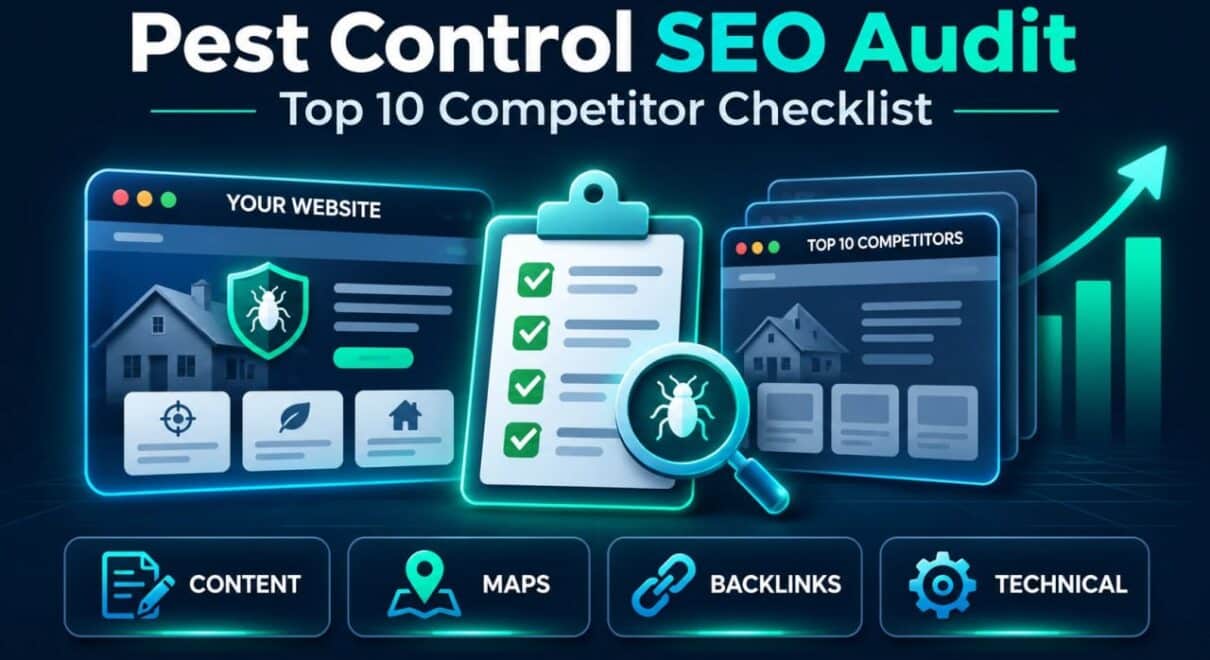
Pest Control SEO Audit Checklist: Compare Your Website With Local Top 10 Competitors
A pest control SEO audit checklist should help a business owner understand why competing companies appear more prominently in Google and decide which improvements deserve attention first. That requires more than running a technical scanner or checking whether your homepage contains the phrase “pest control.”
Start with the Google results in your own service area. Identify which pest control companies rank, what pages Google shows, how their websites answer customer questions, and how their Google Maps profiles compare. Then check your own website against the same criteria.
Our 2026 Pest Control SEO Study examined 300 organic Top 10 results across 30 U.S. cities, alongside Google Maps listings, referring domains, page content, and structured data. The findings provide context for this checklist, but individual markets still need individual analysis.
Prepare a Small Competitor Benchmark Before Changing Anything
Choose one commercially valuable search, such as pest control [city], and two to four more specific searches that reflect the services you actually sell. These might include termite treatment, rodent control, or bed bug removal in the same city.
Record the results under consistent conditions, preferably using the same location and device type. Google Maps results can change with the searcher’s proximity, so record the location where you checked them.
For each query, note the top-ranking actual pest control providers. Directories, lead-generation websites, and editorial articles may also appear, but they should be categorized separately. A directory’s website structure is not a useful direct template for a local exterminator.
A basic comparison sheet needs only a few fields:
| Field | Your website | Competitor 1 | Competitor 2 | Competitor 3 |
|---|---|---|---|---|
| Ranking URL and organic position | Record | Record | Record | Record |
| Homepage, service page or city page | Record | Record | Record | Record |
| Indexed, accessible and canonical | Check | Check | Check | Check |
| Local treatment information and proof | Check | Check | Check | Check |
| Referring domains to ranking page | Record if available | Record | Record | Record |
| Google Maps position, reviews and rating | Record separately | Record | Record | Record |
Do not try to audit every possible SEO factor at once. Find the discrepancies that affect the specific services and locations you want to win.
1. Check Which Page Google Actually Ranks
The first question is not how many city pages your website has. It is which URL Google considers relevant to the local search.
In our 30-city study, 195 of the 300 organic Top 10 appearances belonged to pest control companies. Of those company appearances, 105 were inner or location pages and 90 were homepages.
Both approaches can work. A local business sometimes ranks with its main homepage; a company serving several markets may rank with a dedicated city or branch page. The appropriate choice depends on the query, the business, and the pages already performing in that market.
For your target city, compare the URLs in the actual results. Then ask:
- Does your intended ranking page clearly address that city and service?
- Is a different page on your website competing for the same query?
- Can visitors reach the page from a sensible menu or service-area section?
- Does the page offer real information, or does it only swap the city name into a generic template?
Practical action: Choose a primary destination for each important search-intent group. Improve that page rather than creating several nearly identical alternatives.
2. Confirm Google Can Access and Index the Page
A useful landing page cannot perform consistently in search if Google cannot access it or chooses another URL as canonical.
For your main service and location pages, use Google Search Console’s URL Inspection tool. Check whether the inspected URL is indexed, whether Google selected the intended canonical, and whether the last crawl revealed a problem. Review the actual page as Google sees it where available.
Also examine common technical blockers: accidental noindex rules, blocked resources, broken internal links, redirect chains, incorrect canonical tags, and pages that return errors. A sitemap helps discovery but does not override a noindex directive or an inaccessible page.
Do not interpret every crawler warning as a ranking emergency. A missing meta description is not equivalent to a valuable service page being excluded from the index.
Practical action: Resolve indexing and accessibility problems on revenue-generating pages before spending money expanding content or building links to them.
3. Compare Local Relevance and Pest Treatment Content
A good pest control landing page should tell a customer whether the company handles their problem in their location, what happens next, and how to request help.
Review the page title, primary heading, first screen of content, service navigation, treatment explanations, proof of legitimacy, and contact options. The copy should reflect the real service offered: termite inspections are not interchangeable with rodent exclusion or mosquito treatments.
In the study’s 190 measured company-page appearances, the target city or an accepted alternative appeared in 176 page titles and 182 page bodies. Also, 167 pages linked to distinct pest-control services. These are common patterns among observed ranking pages, not proof that inserting a city name or adding links will produce a particular ranking.
Compare your page with the strongest relevant competitors. Is the treatment process explained? Are inspection or follow-up expectations clear? Are licensed staff or other verifiable credentials identified where applicable? Can a visitor quickly reach a more specific service page?
Content length is only a secondary checkpoint. The study’s observed 30th percentile was about 885 main-content words across the measured company ranking appearances. That is a useful comparison point, not an instruction to write 900 words on every page. Some topics require more explanation; others do not.
Practical action: Add missing information that helps real customers make decisions. Avoid padding pages to reach a word-count target.
4. Measure Page-Level Links Separately From Website Authority
Backlink reports can be misleading when they mix links to the entire business website with links to one city or service landing page.
When comparing ranking competitors, check both:
- Referring domains to the exact ranking URL. This shows the number of distinct websites linking directly to that page.
- Referring domains to the website as a whole. This describes broader link coverage across the domain.
The study’s 91 measured unique inner ranking pages had a 30th-percentile figure of 23 referring domains to the exact page. This observation can guide a comparison, but it is not a required number of links, and it does not say those links caused the rankings.

A company page with fewer direct links can rank above one with many more. The relevance of the page, strength of the overall site, competitive environment, and numerous other factors matter too.
Audit where competitors’ legitimate mentions come from: business associations, local media, community sponsorships, relevant industry organizations, and useful resources. Discount obviously irrelevant or suspicious link patterns rather than copying them.
Practical action: Assess link quality and topical/local relevance before deciding how many new referring domains to pursue.
5. Audit Google Maps as a Separate Visibility Channel
Google Maps and the regular organic results are different competitive environments. Strong visibility in one does not guarantee a matching position in the other.
In the 30-city study, 21 of 87 observed Local Pack listings were confidently matched to the same businesses in the organic Top 10. That makes a separate Maps audit worthwhile.
Check whether your Google Business Profile accurately represents the business: name, primary category, service area, phone number, hours, website, actual services, and relevant photos. For service-area businesses, follow Google’s rules on displaying or hiding an address. Do not invent a public office just to target another city.
Then compare reviews in the same market. Among 86 observed top-three Maps listings with available review data, the lower-third benchmark was approximately 188 reviews and a 4.9-star rating. Some listed businesses had fewer reviews or lower ratings. These figures describe the observed sample, not Google’s qualification criteria.

Google explains local rankings primarily through relevance, distance, and prominence. Reviews contribute to the broader business profile, but no fixed review count can overcome every competitive or geographic disadvantage.
A sensible operational improvement is to ask customers consistently for genuine, unbiased reviews and respond appropriately. Do not offer incentives or selectively solicit only satisfied customers; follow Google’s review policies.
Practical action: Build a Maps improvement plan with its own competitor benchmark, review process, and business-information checks. Do not merge its review targets into an organic-page audit score.
6. Check Technical Quality and Structured Data Without Overcomplicating Them
Technical SEO should make essential pages accessible, understandable, and usable. Start with mobile experience, loading issues, HTTPS, broken links, sensible navigation, and accurate canonical tags. Test important pages with Google’s tools rather than relying on the website homepage alone.
Structured data deserves inspection, but it is not a shortcut to ranking. In our study, 185 of 190 measured company-page appearances had some source-detected structured data, while 153 had Business or Organization markup. These are widespread implementation patterns among the sampled pages.
Check whether the structured data accurately identifies the business and matches visible information. Google’s SEO Starter Guide offers a useful reference for foundational practices. Validate its syntax and the applicable Google requirements. Avoid adding irrelevant FAQ, review, or LocalBusiness properties solely to increase the markup count.
Practical action: Fix clear errors and inconsistencies, then move on to the larger competitive gaps. Do not spend the entire SEO budget adding markup types with no demonstrable purpose.
7. Confirm the Website Can Turn Visibility Into Calls
Ranking improvements matter to the business only when they create opportunities for qualified inquiries and bookings.
Open the most important landing pages on a mobile phone. Is the phone number prominent and tap-to-call? Can customers request an inspection without a long form? Are emergency availability, service areas, and business hours stated accurately? Does the page reassure users about the specific problem they searched for?
Use Google Search Console to identify the queries and landing pages generating impressions and clicks. Use your own analytics, call-tracking data, and enquiry records to evaluate what happens after visitors arrive. Our 30-city SEO study did not measure customer conversions, so content or ranking patterns from it should not be treated as evidence of lead-generation outcomes.
Practical action: Fix broken or confusing contact paths immediately. They can waste demand you already earned even before rankings change.
Turn the Audit Into a Prioritized 30-Day Fix List
A useful SEO audit should finish with a manageable set of actions, not a spreadsheet containing hundreds of unranked warnings.
Use a simple priority model: address issues that prevent a valuable page from being indexed or contacted first; then correct missing local/service relevance and important Google Business Profile information; then work on content depth, internal links, authority, and longer-term improvements.
| Finding | Why it matters | Typical urgency | First action |
|---|---|---|---|
| Key termite page is excluded from indexing | Customers cannot reliably find the intended organic page | Critical | Diagnose noindex, canonical or access issue |
| City page barely explains local service | The landing page may not answer the query well | High | Add genuine service-area and treatment information |
| GBP has inaccurate service details | Searchers may receive incomplete or wrong business information | High | Correct and verify the profile |
| Tap-to-call button fails on mobile | Potential enquiries may be lost | High | Repair and retest contact action |
| Relevant service pages are hard to reach | Customers and crawlers have weak navigation paths | Medium | Add contextual internal links |
| Competitors have stronger relevant links | Potential authority-building opportunity | Ongoing | Plan legitimate local or industry outreach |
| Structured data is incomplete but valid basics exist | May be useful, but not necessarily urgent | Low to medium | Correct factual mismatches, validate |
For every selected fix, record an owner, the expected practical benefit, an effort estimate, and how you will verify completion. Recheck the important Google queries after implementation, but do not interpret a short-term ranking fluctuation as proof that one individual change worked.
What the Competitive Benchmarks Actually Tell You
The study’s lower-range observations are comparison references, not minimum requirements for ranking. For measured inner pages, about 23 referring domains marked the 30th percentile; for measured company-page content, about 885 words marked the 30th percentile. The Maps review and rating benchmarks came from a separate group of businesses.
The most useful question is not “Have I reached 23 links or 900 words?” It is “Which specific, relevant weaknesses separate my important pages from the competitors customers currently see?”
For some pest control businesses, the biggest opportunity will be indexing a missing service page or improving the right city landing page. For others, stronger references, more credible service explanations, or a more complete Google Business Profile may deserve the attention.
Need a Competitor-Based Pest Control SEO Review?
A practical audit should identify a small number of worthwhile improvements and explain their business relevance. If you’d like an outside comparison, CostEffectiveSEO offers a free pest control SEO competitor analysis focused on local visibility, service pages, and prioritized implementation.