

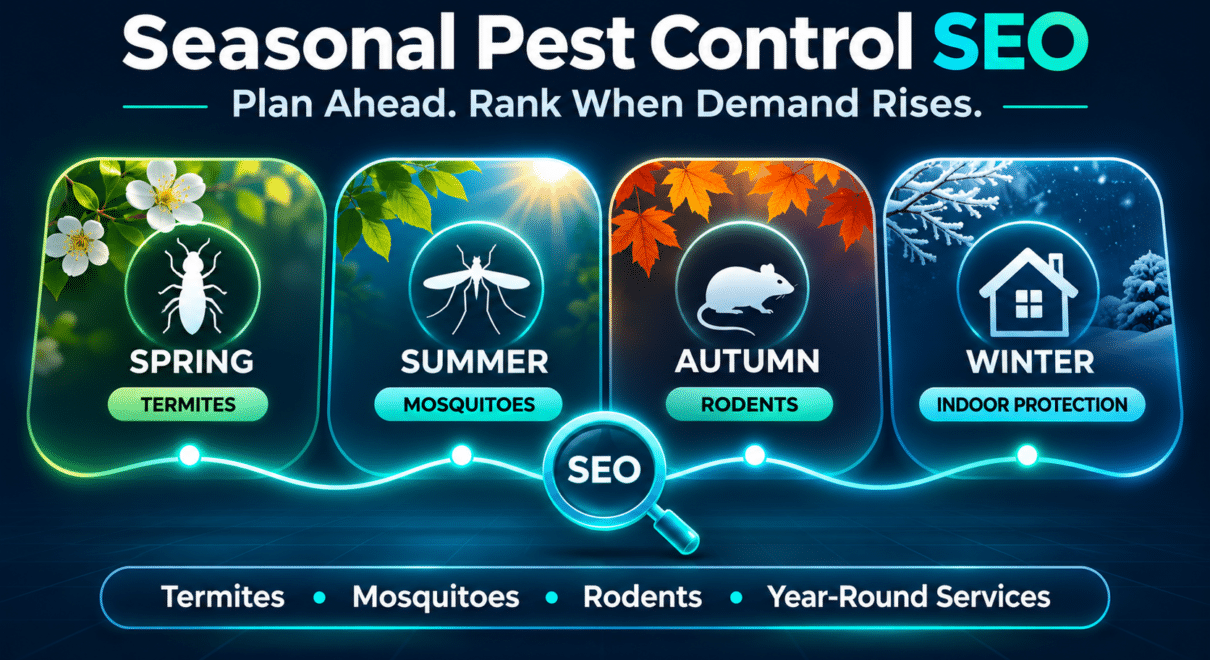
Pest control demand does not arrive evenly throughout the year. A homeowner who notices termite swarmers, mosquitoes taking over the yard, or scratching in the attic is often looking for help now. The pest control companies most prepared to capture those searches are the ones that have already built relevant service pages, established local visibility, and made it easy to request an inspection.
That is the purpose of seasonal SEO for pest control: prepare for predictable changes in customer demand without treating search optimization as a campaign that runs for only a few weeks. The website's main service pages stay active all year. What changes is which services receive additional content, stronger internal links, local promotion, and attention in the monthly SEO plan.
Our 30-city Pest Control SEO Study gives us a useful starting point for that structure. Among 190 measured company ranking-page appearances, 167 linked to distinct pest-control services, 182 included the target city or an accepted alternative in their page content, and 176 included that local reference in the HTML title. Those patterns reinforce an important principle: seasonal visibility works best when each important pest treatment has a discoverable page connected to the business's real service area.
The Best Time to Optimize Is Before Customers Start Searching
SEO work usually needs lead time. A new or significantly improved service page needs to be crawled; internal links must make it easy to find; content must address the right search intent; and relevant mentions or backlinks take effort to earn. Waiting until a mosquito outbreak dominates local searches often means competing with businesses that prepared months earlier.
For an established website, a useful operating target is to review the upcoming seasonal service six to twelve weeks before its expected demand increase. This is a planning window, not a prediction of how fast Google will rank a page. A technically weak website or competitive city may require a longer runway, while an existing page with some visibility may benefit from faster refinements.
The preparation work should be specific: check which URL already appears for the seasonal search, improve that page, publish one or two useful supporting articles where warranted, strengthen links from relevant parts of the website, and begin appropriate local outreach. Continue your normal link building, citations, Google Business Profile maintenance, and lead tracking alongside that preparation.

Build the Seasonal SEO Calendar Around Your Actual Market
A pest calendar should start with the local climate, the pests your technicians actually treat, and the services that generate worthwhile business. It should not be copied from a national template without adjustment.
For example, Texas A&M's termite guidance describes swarming that can begin in January or February in South Texas but later in the Texas Panhandle. CDC mosquito guidance likewise shows why mosquito season extends across different months in different regions. Colder-weather rodent entry is common in many markets, while indoor pest services can remain relevant all year.
| Service focus | Demand pattern to investigate | SEO work to prepare | Main landing-page destination |
|---|---|---|---|
| Termite inspections and treatment | Swarming and inspection interest, often spring but earlier in warmer areas | Review termite service page, swarm-identification article, local inspection FAQ | Permanent termite inspection/treatment page |
| Mosquito control | Warming weather, rainfall, outdoor activity | Prepare prevention and service-timing content, strengthen service-area links | Permanent mosquito control page |
| Rodent control and exclusion | Frequently stronger around seasonal movement indoors; often fall in cooler markets | Improve entry-point, attic-noise and inspection content; highlight year-round exclusion | Rodent control and exclusion page |
| Bed bug treatment | Indoor demand across the year | Keep preparation, identification and treatment expectations current | Permanent bed bug service page |
| General pest and recurring maintenance | Ongoing demand with local peaks | Refresh core service information, recurring-program details and local coverage | Core pest-control page or homepage |
The key decision is not which season a pest “belongs” to. It is when your area typically produces the relevant customer questions and how far in advance your website should answer them.
Give Each High-Value Pest Service a Permanent SEO Home
A common mistake is to create a temporary blog article for each seasonal spike while leaving the main treatment page weak. A strong service landing page should remain the primary commercial destination for that treatment throughout the year. Seasonal articles explain particular questions and point back to it.
A useful termite cluster could include a primary termite treatment page, a guide to recognizing swarmers, an article on what happens during an inspection, and locally relevant information about the kinds of structures or situations customers commonly ask about. A mosquito cluster might include a control-service page, a guide to reducing breeding areas, and an article on scheduling treatment before outdoor events.
The supporting pages should each answer a different question. They should not be copies of the service page with a different keyword inserted. That gives Google and visitors a clearer relationship between the general service, the seasonal question, and the next step to book treatment.
Our study found that 167 of 190 measured ranking-page appearances (87.9%) linked to distinct pest-control services. It also found that local context was common in ranking pages' titles and content. Those are useful competitive references when deciding how to connect seasonal articles with service and location pages.

An example of a practical content cluster
For a company serving a legitimate primary market, the structure could look like this:
- Commercial service page: “Termite Inspection and Treatment in [City]” with the actual process, coverage, contact options and qualifications.
- Pre-season informational article: “What Do Termite Swarmers Look Like in [Region]?” addressing identification and appropriate next steps.
- Customer-decision article: “What Happens During a Termite Inspection?” explaining the company's real inspection process.
- Related service page: Wood-destroying-insect inspections, prevention or follow-up services when they are genuinely offered.
- Contextual links: Supporting articles link back to the primary termite page; the termite page links to the most relevant explanations.
This structure also supports wider content-cluster development. Our SEO playbook for pest control companies explains how content, location pages, citations and backlinks fit into a recurring campaign.
Prepare Termite SEO Around Local Swarming and Inspection Demand
Termite searches are often driven by a particular event: discarded wings near a window, a visible swarm, suspicious wood damage, or a home inspection. The main landing page should lead with inspection availability and the treatment services the company actually offers. It should explain what customers can expect next, not simply repeat “termite exterminator” across the page.
Before the local swarming period, review the page title, city and service information, mobile contact options, internal links, and relevant customer questions. Update supporting content about identifying swarmers and scheduling inspections. Use verified regional examples when available. Texas, the Northeast, and the Gulf Coast do not share a single identical termite calendar.
Where the company has real customer experiences, professional credentials, or follow-up procedures, bring them onto the page in a clear and verifiable format. These details strengthen the treatment page's relevance and give a prospective customer more confidence to make an inquiry.
Monthly execution: Continue legitimate link acquisition and local business citation work, while concentrating that month's content and page improvements on the termite service before demand accelerates.
Build Mosquito SEO Before Warm Weather and Rainfall Drive Demand
Mosquito-related searches may involve different intentions: immediate relief for a yard, recurring mosquito treatments, event protection, breeding-site questions, or whether a service is appropriate for a particular property. The service page should make the available options clear and connect to genuinely useful explanations.
In many northern markets, spring is a sensible preparation period; in warmer or wetter areas the useful window can arrive earlier or extend longer. Weather, rainfall and local mosquito species matter. The SEO plan should reflect those differences rather than assuming every city has the same summer peak.
Start with a strong mosquito-control landing page, then add content answering practical questions that customers ask before booking. Explain service frequency only if it reflects your actual program. Link from relevant seasonal guides to the commercial service page. Ensure that a homeowner who arrives on a prevention article can easily request the mosquito service when appropriate.
For service areas with outdoor hospitality, commercial properties or event work, build dedicated content only when those services are actually offered. It can be more valuable to improve one competitive mosquito page than create several nearly identical “mosquito control near me” articles.
Monthly execution: Maintain link outreach, citations, local business information and reviews, while improving mosquito-related pages and internal linking ahead of the area's usual demand window.
Make Rodent SEO a Priority Before Seasonal Indoor Activity Increases
Mice and rats can be an issue year-round, but seasonal changes can create additional reasons for homeowners to search for control and exclusion services. The University of Arizona's fall pest guidance notes that rodents often move indoors as the weather cools to find food, warmth and shelter.
A high-value rodent page should explain the differences between inspection, control, exclusion and monitoring, according to what the provider actually delivers. Customer questions are highly practical: What causes scratching in the attic? Where can rodents enter? What does an exclusion assessment involve? Will the company inspect exterior access points?
Publish or improve those explanations before the usual local increase in activity. Connect the content to rodent-control and exclusion services, and make sure the area served is easy to understand. For warmer regions or commercial properties, keep the messaging focused on actual conditions instead of assuming a cold-weather problem.
Monthly execution: Keep rodent service pages and customer contact paths current, and build legitimate local authority continuously. Do not stop improving other high-value services while rodent content receives more attention.
Keep Bed Bug and Indoor Pest Pages Active All Year
Not every profitable pest-control service should be planned as a short seasonal campaign. Bed bugs can reproduce indoors throughout the year, and customers generally search when they have an immediate problem. West Virginia University Extension describes bed bugs breeding year-round inside buildings.
That makes a permanent, well-optimized bed bug treatment page particularly important. Give customers a clear explanation of inspections, preparation, the actual treatment choices available, and what they should expect after contacting the business. Seasonal travel periods may inspire supporting articles, but the commercial service page should remain available and optimized throughout the year.
The same principle applies to cockroaches and other indoor pests in climates where demand continues across seasons. Focus on the value of the service and on real customer questions, not a marketing calendar that creates unnecessary pages.
Find the Content Gaps That Seasonal Competitors Leave Open
Our 30-city research examined source-level information on 190 pest-control company ranking-page appearances. Several useful customer-facing details were less widely implemented than basic local signals: substantive local pest information appeared on 101 pages (53.2%), treatment-process explanations on 67 pages (35.3%), and answered FAQ sections on 51 pages (26.8%).
For seasonal SEO, these gaps are practical opportunities. A mosquito page can address what customers should do before an appointment. A rodent page can explain inspection and exclusion. A termite page can clarify the customer's first steps after spotting swarmers. The advantage is not content quantity for its own sake; it is a stronger page for the exact problem the customer is trying to solve.

Before creating another seasonal article, inspect the relevant service page and the current local Top 10. If the most important questions remain unanswered, improve that page first. Then publish new supporting content only when it contributes a distinct, useful explanation.
Run Seasonal Campaigns Through a Consistent Monthly SEO Cycle
Seasonal priorities should sit inside a normal, ongoing SEO campaign. Building backlinks only in one month or checking local citations only after a problem appears is not an effective operating model. Those activities support the site throughout the year.
| Monthly workstream | Activities that continue every month | What changes with the season |
|---|---|---|
| Technical and on-page SEO | Check priority URLs, indexability, titles, internal links, mobile contact paths and content quality | Which treatment pages receive deeper improvements |
| Content clusters | Improve commercial service pages and add genuinely useful supporting content | Which pest questions, service areas and seasonal topics get priority |
| Backlinks and authority | Pursue relevant local/industry mentions, citations, editorial opportunities and suitable partnerships | Which service or resource is emphasized in outreach |
| Local SEO and reputation | Maintain accurate business details, genuine review processes, eligible GBP service information and citations | Which service availability, photos and customer questions are highlighted |
| Measurement and leads | Monitor GSC, GBP performance, calls, forms and booked-service outcomes | Which seasonal query groups and landing pages are evaluated most closely |
A new campaign may initially devote more resources to fixing its foundations. Once the main service pages are sound, the emphasis can move toward content depth, higher-value location coverage and authority development. The regular monthly workstreams remain in place.
Work backward from the next likely peak
Use a straightforward planning sequence for each priority pest service:
- Six to twelve weeks ahead: Review current rankings, the primary service page, Google Search Console queries, existing content and the local competitors. Decide what deserves improvement.
- Four to eight weeks ahead: Publish the highest-value updates, connect supporting articles, improve calls to action, and continue targeted local link outreach and citations.
- As demand increases: Check page visibility and conversion paths, highlight current service availability truthfully, and answer new customer questions that appear in enquiries and searches.
- After the busy period: Review calls, booked work and search performance; retain and refine the evergreen pages; record what should be prepared earlier next year.
The purpose is to prepare commercial pages ahead of need and keep them strong afterward. Do not turn every seasonal article into an expiring page that must be replaced each year.
Which seasonal services could bring you more local leads?
Request a free competitor analysis of your website, service coverage and local search opportunities.
Use Search Console and Real Enquiries to Set the Timing
A national seasonal calendar is a starting hypothesis. Your website and customer records should determine the actual schedule.
In Google Search Console, group queries by treatment and service area. Compare impressions, clicks and landing pages across relevant months, and where sufficient history exists, compare similar periods across years. Check which URLs are already gaining attention and where the website remains absent despite clear commercial demand. Use local rank tracking for priority city and treatment searches, with consistent settings.
Combine that information with Google Business Profile interactions and your actual phone calls, form submissions, inspections and booked jobs. A strong seasonal keyword is valuable when it brings relevant enquiries that the company can serve. A sharp increase in impressions for a pest outside the actual service portfolio may not deserve a new content cluster.
Choose two or three seasonal service groups to monitor closely rather than creating an enormous reporting dashboard. A concise monthly review should answer: Which service is growing? Which page is earning or losing visibility? What are competitors showing that ours does not? Which next improvement could generate more qualified work?
Three Examples of How the Seasonal Plan Changes by Market
A northern-market pest control company: In a colder metro such as Minneapolis, spring and summer preparation can emphasize mosquito and termite searches, while rodent inspections and exclusion receive additional attention before colder weather. The precise calendar should follow local conditions and prior lead data.
A Sun Belt company: In a warmer market such as Houston or Phoenix, pest activity can start earlier, last longer, or respond to rainfall patterns. The company should maintain permanent core service pages and move content deadlines to match the local season rather than a nationwide schedule.
A business focused on property management: Rodent, bed bug, cockroach and recurring prevention work may be commercially relevant across the year. Its SEO should emphasize property-manager intent, service coverage, response processes and the right commercial pages, with seasonal subjects as supporting content rather than the entire strategy.
In all three cases, the monthly technical, content, citation and link-building work continues. The service emphasis changes with actual customer needs.
Seasonal Pest Control SEO: Common Questions
Should I create a new pest control page every season?
Usually the better approach is to keep a permanent commercial page for each important pest service and refresh its useful information as needed. Create a separate seasonal article when it answers a genuinely different customer question and can link clearly to that commercial page.
How far ahead should I optimize a seasonal pest-control service?
Review important service pages around six to twelve weeks before the expected local increase in interest, and begin earlier if the website needs technical work or substantial authority development. Continue monthly SEO work throughout the year.
Should I stop building backlinks during the off-season?
No. Relevant backlinks, citations and trusted local mentions support the website over the long term. Keep those efforts consistent, while choosing seasonal service pages and useful supporting resources when planning outreach.
Can seasonal SEO help Google Maps as well as organic rankings?
Yes. Clear, accurate business services, ongoing reviews, a relevant website and consistent local information support a stronger overall local presence. Manage Google Business Profile activity and website SEO as related but distinct workstreams; changing a seasonal page does not automatically change a Maps position.
Put Seasonal Demand to Work Before Competitors Do
An effective seasonal pest control SEO strategy combines permanent service pages, useful content clusters, local relevance and consistent authority development. The goal is to be visible when customers need a particular treatment, not to publish a rush of articles after those searches have already increased.
Start with the next high-value pest service in your area. Confirm the right landing page, strengthen the customer information, connect supporting guides, and keep backlinks, citations, Maps optimization and lead tracking moving every month. That approach compounds over successive seasons and makes the website better prepared for the next opportunity.
If you'd like a clear plan for your market, request a free pest control SEO competitor analysis. CostEffectiveSEO can identify the most important service and location gaps and recommend the right monthly priorities. You can also review our pest control SEO packages and pricing if you're ready to start a campaign.
Get a Pest Control SEO Plan for Your Market
Find the priority service pages, seasonal content opportunities and authority gaps worth addressing next.