
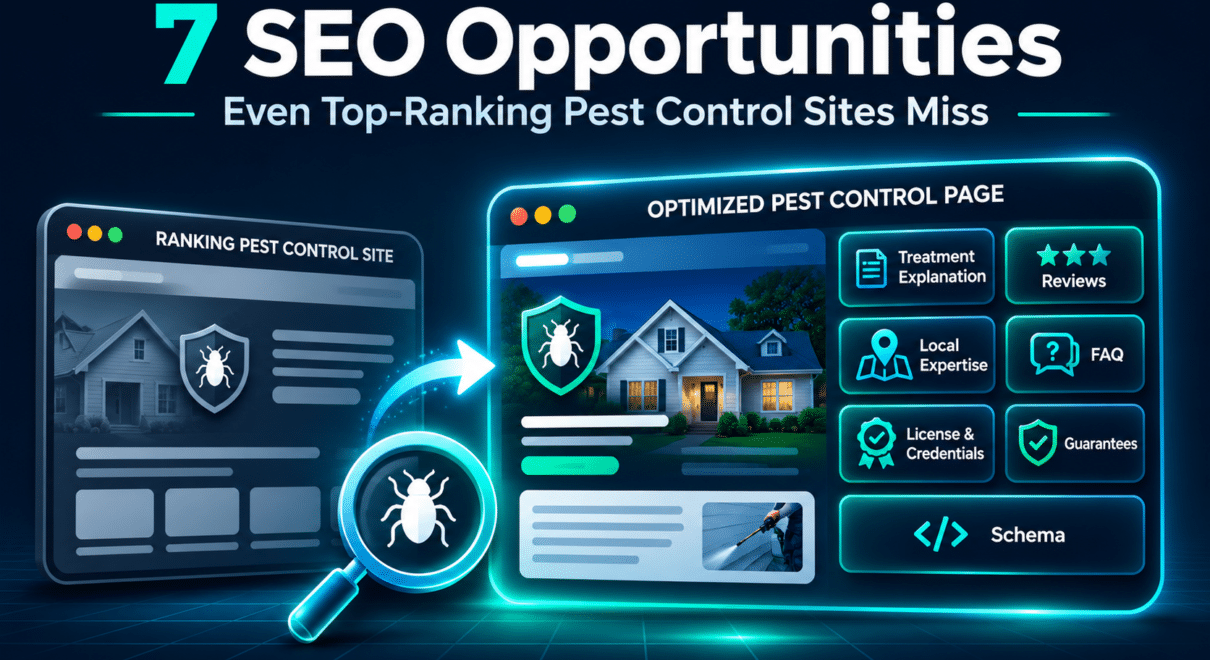
A pest control company does not have to copy every page, backlink, and Google Business Profile detail of the businesses ahead of it. Sometimes the more useful opportunity is to notice what those competitors have not explained well and make the customer's decision easier.
That is the idea behind this guide to pest control website optimization. Rather than offer another list of generic SEO mistakes, we examined how often seven practical content and structured-data features appeared among pest control company pages already visible in Google's organic Top 10. The results reveal gaps worth investigating even when a website is ranking successfully.
The evidence comes from the CostEffectiveSEO Pest Control SEO Study, which examined 300 organic ranking appearances in 30 US cities. Of these, 195 appearances belonged to pest control companies and 190 had usable source-level content evidence. These are ranking-page appearances, not 190 independent businesses. These observations describe content detected on the sampled ranking pages.
The SEO opportunity: Many Top 10 competitors still leave valuable information out of their most important landing pages. Clear treatment explanations, useful local details, real credentials, customer evidence, and well-organized service information can strengthen relevance for competitive searches, support better organic visibility, and give customers more confidence to contact the business. These are practical improvements that can be implemented without rebuilding the entire website.
What Our 30-City Study Found on Ranking Pest Control Pages
We evaluated several content and trust features in the saved source of 190 company ranking-page appearances. The table shows how often each feature was detected, and how often our capture did not detect it.
| Feature on ranking page | Detected in the captured page | Not detected in the captured page |
|---|---|---|
| Answered customer FAQ section | 51 of 190 (26.8%) | 139 (73.2%) |
| Substantive treatment-process explanation | 67 of 190 (35.3%) | 123 (64.7%) |
| Specific guarantee with a stated remedy | 68 of 190 (35.8%) | 122 (64.2%) |
| Attributable testimonial or customer review | 83 of 190 (43.7%) | 107 (56.3%) |
| Licensing or professional-credential reference | 91 of 190 (47.9%) | 99 (52.1%) |
| Substantive local pest information | 101 of 190 (53.2%) | 89 (46.8%) |
Service-type structured data was identified on only 37 of the same 190 measured appearances (19.5%). By contrast, some form of structured data was detected on 185 pages (97.4%). This distinction matters: having basic sitewide schema is common, while explicitly describing particular services in machine-readable form was much less common in the saved source. See the full structured-data findings.
The opportunity is to make priority pages more complete, relevant, and competitive. SEO specialists routinely use treatment explanations, service-specific FAQs, local information, and trust signals to strengthen on-page relevance and support organic rankings. Our study shows that even established Top 10 competitors often leave these areas underdeveloped. The effect of each improvement varies with the search query, competition, and the website’s existing SEO foundation.

1. Explain What Actually Happens During Pest Treatment
A customer searching for termite treatment or rodent control often wants more than a confirmation that the service is available. They may be wondering whether the company will inspect first, whether they need to prepare their home, what the visit includes, and whether follow-up visits are possible. A thin service page can leave all of those questions unanswered.
Only 67 of 190 measured ranking-page appearances (35.3%) contained a substantive treatment-process explanation in our source-level review. That is an opportunity to make the page more helpful without writing a long technical guide about chemicals or claiming that every treatment follows the same steps.
For a rodent control page, a useful sequence could explain an initial assessment, identification of potential entry points, a treatment or exclusion plan appropriate to the property, and recommendations for monitoring or follow-up. The details must match the business's actual methods and applicable safety practices. Do not promise a fixed result or describe a treatment you do not provide.
Practical improvement: Add a short “What happens during your service?” section to priority service pages. Describe the customer's next steps in plain English, then link to a deeper page only if it answers a separate, meaningful question. This is more useful than repeating a list of target keywords in every paragraph.
2. Make Local Pest Knowledge More Specific Than a City Name
Local SEO content is not improved merely by adding a city to the title and header. The page should help customers understand whether the provider serves their neighborhood, which pest problems it handles there, and why that information is relevant to their situation.
Our research detected substantive local pest information on 101 of 190 measured pages (53.2%). Nearly half of the ranking-page captures lacked that depth of location-specific detail. Businesses can use this opening to build stronger city and service-area pages with genuinely local information, clearer service coverage, and content that reflects the questions customers ask in each market.
A Dallas termite page might explain the inspection and prevention questions that Dallas-area property owners commonly ask, with any regional claims verified. A coastal mosquito service page might clarify how service timing and treatment limitations are handled in that market. A branch page should show information about the real branch, not imply an office exists in every city the team visits.
Practical improvement: Choose one important city or service-area page and replace generic “proudly serving” filler with factual coverage details, real customer concerns, appropriate location-specific examples, and links to the treatments actually offered. If the same material could be pasted unchanged into twenty other city pages, it probably needs more work.
For a fuller decision process, our SEO playbook for pest control companies explains how local page priorities fit into an ongoing campaign.
3. Put Verifiable Licenses and Professional Credentials Where Customers Look
Pest control involves work inside people's homes and businesses. Customers have good reason to look for credible business identification, professional qualifications, and any licensing details required or relevant in their state. A logo that says “trusted” does not replace information someone can check.
Licensing or credential references were detected on 91 of 190 ranking-page appearances (47.9%). This measure concerns the captured ranking page: a business might provide its license number on a separate contact, about, or legal page. Nevertheless, a high-intent service landing page can benefit from giving visitors a clear path to verification.
Where appropriate, identify the business's real licensing jurisdiction, current qualifications, relevant industry memberships, or technician credentials. Make sure all statements can be substantiated. Avoid copying badges from competitors or saying that every technician holds a certification when that has not been confirmed.
Practical improvement: Audit the most important service pages for visible, accurate credentials and a link to an appropriate business-information page. Verifiable qualifications strengthen customer confidence, reinforce the credibility of the service provider, and make high-intent landing pages more complete.
4. Show Real Customer Evidence, Not Generic Praise
A pest control company can explain every service it offers and still leave visitors uncertain about the experience of hiring it. Genuine customer accounts can answer questions about punctuality, communication, the inspection process, and what happens after the visit.
Our saved-source analysis detected attributable customer-review or testimonial signals on 83 of 190 ranking-page appearances (43.7%). The remaining 107 captures did not meet the source-observation test. Some websites display reviews through third-party widgets that a source-only extraction may not fully identify, so we should not label all those businesses as having no reviews.
The stronger approach is to show authentic and suitably attributed feedback when permission and platform terms allow. Specific context is more helpful than an anonymous “Great company!” quote: for example, what service was requested, how the appointment was arranged, and what aspect of the process the customer valued. Do not manufacture customer names, alter the meaning of a review, or assume that reviews copied from a platform are automatically eligible for Google review rich results.
Practical improvement: Place one or two genuinely representative customer experiences near the corresponding service information and make the next step easy to find. If the best reviews are already on Google Maps, a clear link to the public profile may be more useful than reproducing them inaccurately.
5. Answer Questions That Delay the Inspection Request
A good FAQ is not a warehouse of keyword variations. It addresses the practical uncertainty that keeps a homeowner or property manager from contacting the business. Typical questions may concern whether an inspection is required, how a customer should prepare, what follow-up might involve, and whether the company treats a particular problem in the stated area.
Answered FAQ sections were detected on 51 of 190 measured pages (26.8%), making them the least frequently observed content feature in our comparison table. That gives pest control businesses a clear opportunity to address useful, service-specific questions competitors have not covered. Well-written answers can expand relevant topic coverage and make landing pages more helpful for long-tail searches and prospective customers.
For instance, a bed bug service page could answer “Should I move furniture before an inspection?” by describing how the customer should obtain the company's specific preparation instructions. It should not prescribe technical treatment procedures or make blanket safety assurances without the business's verified guidance.
Practical improvement: Collect actual presale questions from your calls, estimates, or customer-service team. Add three to five concise answers to the page where the questions naturally arise. Link to detailed resources when needed and avoid repeating the same FAQ block across every city URL.
Google's people-first content guidance favors content that meets genuine reader needs. FAQ structured data should not be added with an expectation of standard FAQ rich results for an ordinary pest control website.

6. Explain a Real Service Guarantee in Specific Terms
“Guaranteed results” sounds attractive, but the statement is not very useful unless a customer can understand what it means. If a pest control company offers a documented warranty, callback policy, or follow-up remedy, a service page can explain its coverage and conditions clearly.
A specific guarantee with a stated remedy was detected on 68 of 190 measured pages (35.8%). Notably, this feature appeared on 48.1% of Top 3 pages, compared with 31.2% of pages ranking 4–10. If the business offers a genuine warranty, callback policy, or follow-up commitment, explaining its terms clearly can improve page completeness, build confidence, and give customers another reason to choose the service.
A helpful guarantee description might clarify which service is covered, the relevant time period, whether follow-up treatment is included, what exclusions apply, and how the customer requests support. A company without a formal guarantee can still explain its inspection, communication, and follow-up process accurately.
Practical improvement: Review existing service promises with the operations team, then publish only what the company actually provides. Plain terms improve customer understanding and reduce ambiguous expectations.
7. Use Structured Data to Describe Real Services Accurately
Schema markup is a way to communicate structured information about a business and its pages. Many pest control websites already use basic Organization, LocalBusiness, WebSite, or WebPage markup. That does not mean their specific service information is modeled consistently.
In our study, 185 of 190 pages (97.4%) had some detectable structured data, while just 37 of 190 (19.5%) had a detected Service type. Within the measured inner/location-page subset, Service markup appeared on 24 of 101 pages. The opportunity is to move beyond generic sitewide markup and make the relationship between real services, providers, and relevant locations clearer in structured form.
Where it makes sense, describe the real business, its services, and the relationship between the service page and the provider using appropriate, valid markup. Keep the name, geographic details, and service descriptions consistent with the visible page. Avoid inventing branch locations, duplicated reviews, unverified ratings, or unsupported structured-data properties.
Service structured data is most useful when it accurately describes the provider and the specific treatment offered on the page. As part of a well-optimized website, it supports clear, machine-readable service information and complements the visible content, internal links, and technical foundations that search engines rely on.
Practical improvement: Inspect a priority service page's existing JSON-LD or other markup. Correct factual inconsistencies and invalid syntax first. Extend structured data only when it accurately represents information already visible to customers.
Which Improvements Should a Small Pest Control Company Prioritize First?
Not every improvement takes the same effort or offers the same type of benefit. A useful monthly campaign should choose the work that solves a real problem for customers or search visibility, rather than making all seven changes across every page at once.
| Improvement | Typical effort | Main value | Suggested priority |
|---|---|---|---|
| Explain treatment steps on a priority service page | Low–medium | Better intent coverage and customer clarity | High when explanation is missing |
| Add genuine local pest and service-area details | Medium | More specific relevance and usefulness | High for competitive city pages |
| Display verified credentials | Low | Easier business verification and trust | High if credentials exist but are hard to find |
| Add attributable customer evidence | Low–medium | More credible buying decisions | High when legitimate evidence is available |
| Answer real presale questions | Low–medium | Reduces friction before contact | Medium–high depending on queries |
| Clarify an existing guarantee | Low | More precise customer expectations | Medium when a real policy exists |
| Audit and refine Service markup | Low–medium | Better structured-data consistency | Supporting task after core page quality |
Use these priorities as a practical starting point, then adapt them to the website’s most valuable opportunities. If an important service page is not indexed, fix accessibility first. Otherwise, prioritize gaps in treatment information, local relevance, customer proof, and service-page structure, while maintaining regular technical, content, and link-building work.

A Practical Monthly Improvement Cycle
Start with one commercially important landing page, not the entire website. Compare it against the actual businesses ranking for its city and service query. Document which questions the page already answers and which claims need confirmation from the operator. Implement the highest-value edits, verify that the changes work on mobile, then measure search visibility and genuine inquiries over a comparable period.
Continue the core monthly SEO work alongside this content process: maintain technical access and indexability, improve existing service and location pages, expand meaningful supporting content, manage accurate local citations and Business Profile information, and pursue relevant backlinks. Content refinement is one workstream in a broader campaign, not a substitute for local authority building.
For a practical example of choosing improvements on a smaller budget, see our $300/month pest control SEO audit, which shows how to prioritize real website improvements and targeted authority building.
Turn Overlooked Content Gaps Into a Competitive SEO Advantage
The most effective approach is to identify which important customer questions your competitors leave unanswered, then build a more complete destination for that query. Treatment explanations, accurate local details, FAQs, credible customer evidence, and clear service information can strengthen topical coverage and usability. Combined with technical SEO, internal linking, relevant backlinks, and ongoing local optimization, these improvements give a pest control company more ways to compete for valuable searches.
Start with the landing pages that matter most to revenue. Compare them with actual Top 10 competitors, improve the weakest content and trust signals, connect related service pages, and reinforce the work with relevant links and local visibility activity. The goal is not to add features mechanically; it is to create a stronger page that addresses the searcher’s problem and makes the next step obvious.
For the complete methodology and source-level statistics, see the content findings and structured-data analysis in our original 30-city study.
Find the SEO Opportunities Your Competitors Are Missing
The best next step is to compare your own service and location pages with the businesses ranking in the markets you want to serve. An opportunity might be a missing treatment explanation, unclear location targeting, a weak internal-link path, inconsistent structured data, or a larger technical or backlink gap.
CostEffectiveSEO's pest control SEO services combine competitor research, targeted on-page improvements, relevant authority building, local visibility work, and ongoing measurement. You can request a free SEO competitor analysis or explore our available SEO packages and pricing before choosing a campaign scope.