
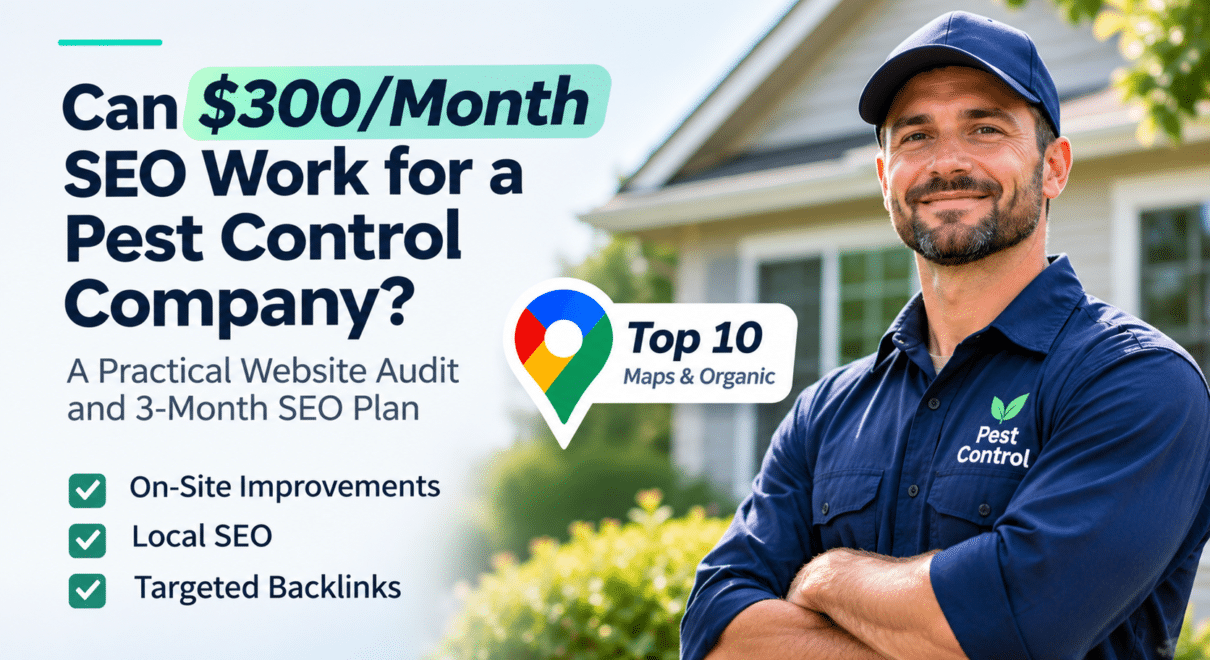
Can $300/Month SEO Work for a Pest Control Company? A Practical Website Audit
A pest control company does not always need an expensive SEO campaign to make its website more useful, easier to understand, and better aligned with local searches. A $300 monthly budget calls for careful prioritization, especially when a business wants to compete in both Google Search and Maps. Whether it is enough depends on the website’s starting condition, the competition, and which improvements can be made without extensive development or outreach.
The best test is a real website, not an invented success story. We selected a pest control business that appeared in the lower half of Google’s organic Top 10 during our 30-city Pest Control SEO Study, reviewed its saved page source, and identified a set of feasible tasks for a limited budget. The resulting plan is an editorial audit and proposed campaign scope, not an engagement we conducted for the audited business or evidence that this particular budget improved its rankings.
Short answer: Affordable pest control SEO can be worthwhile when the site is already functional and a few well-defined pages need attention. A $300 monthly budget can support a targeted campaign, but a site needing a redesign, major technical repairs, or simultaneous expansion across many cities will generally need a broader scope.
What Can a $300 Monthly SEO Budget Actually Cover?
A small-budget SEO campaign should have a clearly defined objective, recurring implementation, and enough flexibility to address the website’s most important constraints. Instead of dividing the fee into units of labor, evaluate which SEO deliverables matter most for the business, how they work together, and what must be prioritized first. A $300 monthly budget in this article is an illustrative planning amount, not a quotation for a specific CostEffectiveSEO package. You can compare our actual pest control SEO packages and pricing.
| Campaign component | Recommended role within a focused $300 plan | Practical boundary |
|---|---|---|
| Technical and on-page essentials | Check crawlability, indexing, titles, headings, and the most valuable target page | Prioritize meaningful problems over a complete site rebuild |
| Local keyword and page targeting | Choose one priority city/service opportunity and avoid conflicting landing pages | Do not create dozens of thin location pages |
| Content and internal linking | Improve treatment information, service relevance, trust details, and links between existing pages | Expand content selectively instead of publishing for volume |
| Relevant backlinks and local authority | Assess competing referring domains and pursue a small number of relevant links or citations within the campaign scope | Do not equate link quantity with quality or promise a fixed ranking |
| Google Maps and performance monitoring | Review Business Profile accuracy, local visibility, relevant inquiries, and completed changes | Maps outcomes depend partly on geography and competition |
The objective is a coordinated SEO campaign with measurable priorities, not a long list of unrelated deliverables. A smaller budget may justify a narrower service-area or keyword focus, but it should still connect on-site improvements with local authority development.
A Real Example: A.P. Pest Control in Denver
We selected A.P. Pest Control, a Denver-area provider, because its homepage appeared at organic position #8 for our sampled “pest control Denver” search in November 2026. The website is a genuine operating business with existing services and local information, making it more useful for a practical audit than a hypothetical site built to demonstrate obvious problems.
The audit draws on the exact ranking URL, https://appestcontrol.net/, and the HTML captured for our study. We also checked the business’s publicly accessible website. This is an independent, unsolicited desk audit, not an engagement with the company. Rankings, site content, and Google features can change after the collection date; we did not inspect private Search Console or Business Profile accounts.
What the business already does well
The homepage already links to bed bug, rodent, and other pest-control services; displays team information; offers a way to request a quote; lists its coverage area; and includes customer-review material. The site has a blog and dedicated location pages, including a Denver page. Our saved source also detected business-related structured data and a self-referencing canonical URL.
These are meaningful existing assets. A responsible low-budget audit should protect them and prioritize selective improvements, not describe a functional website as if it has no SEO foundation.
Where the saved homepage suggests improvements
| Observed in the November 2026 capture | Practical opportunity | Essential check before editing |
|---|---|---|
| Homepage ranked #8 for “pest control Denver” | Determine whether the homepage or existing Denver page should be the primary target | Compare the two URLs’ Google Search Console impressions, queries and indexing |
| HTML title read “Home - Denver Pest Control” | Make the page title describe the business and search intent more clearly | Avoid giving the Denver landing page an indistinguishable title |
| No H1 was detected in the saved homepage source | Add one clear, truthful primary heading if absent from the rendered page | Check the rendered page and theme output first |
| About 560 main-content words were extracted by the study’s method | Expand a useful answer to the target customer’s questions, rather than padding to a target word count | Confirm which material loads dynamically and what users already see |
| Service, city and blog URLs already exist | Strengthen contextual links to the most important service/location destinations | Identify which pages already receive impressions and prevent targeting overlap |
| The homepage mentions inspection, tailored treatment and follow-up | Explain the steps more clearly for customers who want to know what to expect | Confirm the actual treatment and follow-up process with the business |
These are source-based observations and recommended checks, not a list of verified sitewide defects. For example, reviews are visible on the public site, even though some captured-HTML feature tests did not identify every dynamically displayed review signal.
The First Priority: Decide Which Denver Page Should Rank
A.P. Pest Control’s homepage appeared in our sampled organic Top 10. The website also links to a separate pest-control-denver-co page. That creates a useful question for any local provider with multiple relevant URLs: which page should be the strongest destination for the main city query?
Do not immediately redirect, delete, or rewrite either page. First compare their Google Search Console queries, impressions, clicks, and indexing status. Check which URL attracts the most relevant searches and which one can best answer the customer’s questions. Then make the page roles more distinct.
For example, the homepage may introduce the company, its Denver-area coverage and core services, while a city page gives specific local coverage, treatment information and service details. The correct division depends on actual visibility and the business’s service model. Our research on ranking page types found 105 inner-page appearances and 90 homepage appearances among 195 company results in the organic Top 10, so neither page type automatically wins.
Practical action: Determine the primary ranking URL and document its purpose before adding more content or creating additional city pages.
The Next Priority: Improve the Page People Actually Visit
Small, specific editing tasks can often deliver more immediate usefulness than publishing another generic blog article.
Write a clearer title and H1
The saved homepage title, “Home - Denver Pest Control,” identifies the general topic but gives little business-specific context. One possible revision, if the homepage remains the preferred city-level target, would be “Denver Pest Control Services | A.P. Pest Control.” A natural H1 could be “Pest Control in Denver and Nearby Communities.”
These are suggestions, not final production tags. If another URL already targets the same query successfully, adjust the wording and targeting to avoid unnecessary overlap. Google’s SEO Starter Guide emphasizes descriptive titles, useful content, and link structures that help people and search engines understand pages.
Make treatment expectations concrete
The homepage already mentions inspections, tailored treatment and follow-up. That is a useful starting point. Expand it into a short section explaining what typically happens during an appointment, what the customer may need to prepare, what follow-up involves, and which treatment details depend on inspection or pest species.
Specificity helps the reader assess the service. Avoid unverified safety guarantees, promises of complete elimination, or treatment claims that the business cannot support.
Connect high-intent service pages
A visitor searching for rodent removal or bed bug treatment should not need to hunt through a generic “other pests” page. Review the existing navigation and add a few descriptive, relevant links from the homepage or appropriate articles to the real treatment pages. Prioritize the services the company provides and wants to sell; do not manufacture pages for pests or cities with no meaningful service differentiation.
Use the trust evidence that already exists
The public website features personnel and testimonials. Rather than commissioning an entirely new trust section, make licensing or qualification information easy to verify where appropriate, retain genuine review context, and explain any real guarantees in terms customers can understand. Trust content should be accurate before it is optimized.
What Our 30-City Study Says About Quick Improvements
The Pest Control SEO Study 2026: content findings reviewed 190 company ranking-page appearances with usable content evidence. Several useful page elements were not detected in a large share of those captured pages:
- Answered FAQ sections: not detected in 139 of 190 (73.2%).
- Substantive treatment-process explanations: not detected in 123 of 190 (64.7%).
- Guarantees that specify a remedy: not detected in 122 of 190 (64.2%).
- Attributable review or testimonial signals: not detected in 107 of 190 (56.3%).
- Licensing or credential references: not detected in 99 of 190 (52.1%).
Source-detected gaps, not proven ranking factors or confirmed sitewide absence.
Source: CostEffectiveSEO Pest Control SEO Study 2026These are potential information gaps, not five proven ranking factors. The measures indicate what was detected in saved ranking-page HTML, not whether the business has that feature elsewhere on its website. Not every pest control business offers a guarantee, and no business should invent credentials or promises for SEO.
For a site with limited resources, the opportunity is to add the most valuable missing information to the page customers already find. A useful explanation of how rodent treatment works is preferable to ten interchangeable paragraphs repeating “pest control Denver.”
Find Out Which SEO Improvements Matter Most for Your Website
Not sure how your pest control website compares with the companies already ranking in your city? Request a free competitor analysis to identify priority opportunities in search visibility, website content, and local SEO.
If the form does not appear, open the free SEO analysis form here.
How Backlinks Fit Into a $300 SEO Campaign
Backlinks are an important part of a balanced SEO strategy, but they should support the right pages and the right geographic targets. An established pest control business with a functioning website may not need hundreds of new domains before it can compete for some local searches. More competitive cities and service categories may demand substantially stronger authority.
In our 30-city study’s backlink analysis, we measured referring domains pointing to the exact inner pages that ranked, not just to company homepages or whole domains:
- Among 26 measured Top 3 pages, the median was 30.5 referring domains, with an observed minimum of 3.
- Among 65 measured pages at positions 4–10, the median was 33 referring domains, with an observed minimum of 1.
- The ranges overlapped heavily: a higher page-level referring-domain count did not reliably distinguish a Top 3 result from a lower Top 10 result in this sample.
The observed distributions overlap heavily; backlink counts are not a guaranteed ranking threshold.
Source: CostEffectiveSEO Pest Control SEO Study 2026These low-end observations matter. They show that some pages appeared in the Top 10 with very few measured referring domains pointing directly to the ranking URL. That makes local SEO achievable for some smaller businesses without reproducing the backlink profile of the largest competitors. However, such pages may benefit from links to their root domain, strong website relevance, internal linking, brand awareness, and other signals. The study does not establish that one or three referring domains is sufficient for other websites.
Combine on-site relevance with targeted link development
A practical campaign should first confirm which service and city pages deserve to rank, then improve useful page content and internal links. Link building can reinforce that work through genuinely relevant local or industry publications, supplier or association references, editorial coverage, and properly managed business citations. The objective is relevance and credibility, not a count of placements.
At CostEffectiveSEO, our experience with focused local campaigns shows that selected local keywords can often reach Google’s organic Top 10 in approximately two to five months when the website already has a workable foundation and on-site improvements are paired with targeted authority development. This is an experience-based timeframe, not a duration measured by our one-time 30-city study, and it is not a guarantee. Results vary according to the initial rankings, local competition, indexing, campaign consistency, and keyword difficulty. Difficult markets may require more time and investment.
Practical action: Audit the pages already visible for target services, establish their internal-link support, compare referring-domain quality with realistic competitors, and develop links selectively as part of the overall campaign.
A Three-Month Pest Control SEO Plan at $300 per Month
The example below illustrates how an affordable campaign might progress for a website like A.P. Pest Control, based on the improvements visible in our independent audit. It is a proposed work plan, not work performed for that company or a promise that every package includes every activity shown.
| Campaign stage | Main SEO priorities | Intended deliverables | Illustrative monthly budget |
|---|---|---|---|
| Month 1: Establish the ranking target | Review GSC and current indexation; select the main Denver URL; clarify title and H1; identify strongest service and location queries; assess existing links | Clear URL targeting, priority on-page fixes, baseline rankings and competitor comparison | $300 |
| Month 2: Strengthen content and authority | Improve treatment explanations and service relevance; strengthen contextual internal links; verify credentials and trust details; begin selective local/industry link opportunities | More useful landing-page content, clearer service paths, relevant authority-development activity | $300 |
| Month 3: Reinforce and evaluate | Improve one important service or city page; refine Business Profile and citations as applicable; continue targeted link development; assess leads and ranking movement | Better local coverage, progress tracking, prioritized next actions | $300 |
Illustrative three-month budget: $900. The specific mix depends on the business’s starting point, competition, website access, and the actual service package. External publication fees, extensive development, or major content production may require additional scope.
The plan deliberately avoids producing dozens of weak city pages or treating bulk links as a substitute for useful, well-targeted website content. It also avoids promising that all ranking improvements must occur within a particular three-month window.
What Our Other Small-Business Local SEO Campaigns Demonstrate
The Denver website assessment above is not a CostEffectiveSEO client case study. Separately, CostEffectiveSEO has delivered substantial first-page visibility and local search growth for service businesses through focused campaigns involving on-page optimization, geographically relevant content, targeted links, and Google Business Profile work.
| Published campaign | Documented monthly budget | Documented results | How to interpret it |
|---|---|---|---|
| Private Las Vegas Tutors | $280/month | 14 tracked Top 3 rankings and 42.4% average competitive share of voice in the selected comparison | Evidence of strong organic local-search coverage in a focused competitive set; share of voice is not total market share |
| Limo Service Atlanta | $490/month | 112.9% year-over-year growth in Google Business Profile interactions and 53.7% growth in organic clicks for the reported May comparison | Shows coordinated Maps/Business Profile and website-search growth at a higher, but still limited, monthly scope |
These cases illustrate how an efficient, locally targeted strategy can achieve meaningful visibility with monthly campaigns in the hundreds rather than thousands of dollars. They are from tutoring and transportation, not pest control. Their published reporting periods, measurements, and budgets differ, and neither case guarantees the same outcome or timeframe for another business.
The strongest lesson is that prioritization matters more than the apparent size of the SEO checklist. Winning a useful group of local searches requires addressing the website’s most important gaps and building relevant authority consistently.
How to Know Whether the Small Budget Is Working
Success should be measured using both search visibility and business outcomes. Before editing the first page, record a baseline. Then compare like-for-like periods and equivalent markets rather than interpreting every daily movement as progress.
| Track | Useful measurement | What it can tell you |
|---|---|---|
| Google Search Console | Impressions and clicks for target queries and the selected landing page | Whether the page is gaining meaningful organic exposure |
| Indexing and page selection | Indexed status, canonical signals and which URL earns impressions | Whether Google can discover and present the intended page |
| Google Business Profile | Profile interactions and local visibility checks | Whether the local business listing is generating attention independently of organic rankings |
| Contact journey | Working phone links, submitted forms, qualified calls and booked inspections | Whether website attention turns into real inquiries |
| Completed work | Specific changes published, date, URL and owner | Whether the campaign is delivering the planned improvements |
The company would need to provide access to its Search Console, Business Profile, analytics or call records to measure these items accurately. We do not have that private data for A.P. Pest Control and therefore cannot claim a traffic, call or revenue improvement from our suggested edits.
A useful early outcome might be a clearer page target, fewer avoidable website obstacles, improved service information, and reliable measurement. Stronger rankings or leads may follow, but they cannot be guaranteed by a fixed monthly fee.
When a $300 Monthly SEO Plan Makes Sense - and When It Doesn’t
A limited engagement can make sense for a single-location business with a functional site, an established Business Profile, owner access to its content, and a small number of meaningful service or city priorities. It is especially suitable when the owner wants to address obvious shortcomings systematically rather than outsource an entire marketing function.
It is less suitable when the site needs major reconstruction, has substantial technical errors, operates many disconnected locations, targets exceptionally competitive national keywords, or expects full SEO, outreach, content production, and conversion optimization simultaneously.
A growing business may begin with a small targeted engagement and later expand the scope after it has identified commercially valuable queries, resolved its basic issues, and measured the next set of opportunities. That decision should be made from evidence, not from a promise that one price point fits every company.
What a Small Pest Control Business Should Do First
The practical lesson from this audit is that the order of improvements matters more than the size of the task list. The example site already has services, local information, reviews, and a way to request a quote. Its first step is to clarify the preferred ranking page and strengthen what customers learn there, then improve connections to the pages that matter commercially.
For a different business, the first priority might instead be a missing indexable site, incomplete Business Profile, or broken contact form. The right scope starts with a diagnosis.
For a personalized assessment, use the free form below. Our team can review your competitors, existing search visibility, and priority opportunities before recommending an appropriate level of support.
If you want to know where your own website stands, request a free Pest Control SEO analysis. CostEffectiveSEO can identify relevant competitors, highlight practical opportunities, and explain which fixes deserve attention first. For businesses ready to proceed, our Pest Control SEO packages and pricing provide ready-to-go options, and the Pest Control SEO service page explains our approach.
Request a Free Pest Control SEO Competitor Analysis
See how your website compares with competitors in your target service areas and which SEO improvements deserve priority.
If the form does not appear, open the free SEO analysis form here.